

Why Vacuuming Is One of the Largest Hidden Labor Costs
In commercial cleaning, vacuuming is often treated as a routine task rather than a strategic cost driver. That assumption is expensive. Across schools, office buildings, and institutional facilities, vacuuming quietly consumes more labor hours than almost any other recurring task. Unlike visible services such as floor refinishing or restroom sanitation, vacuuming inefficiency rarely triggers alarms—yet it steadily inflates payroll.
Traditional vacuuming relies on linear push-pull passes. That motion inherently creates overlap, missed strips, and frequent rework. Operators compensate by slowing down, repeating lanes, and visually “correcting” coverage. Over a single room, the time loss seems negligible. Across thousands of square feet, day after day, it compounds into one of the most persistent margin drains in commercial cleaning operations.
Labor is the highest controllable expense in cleaning. When vacuuming consumes more time than necessary, labor costs rise even when wages and headcount remain unchanged.
How Traditional Push-Pull Vacuuming Creates Inefficiency
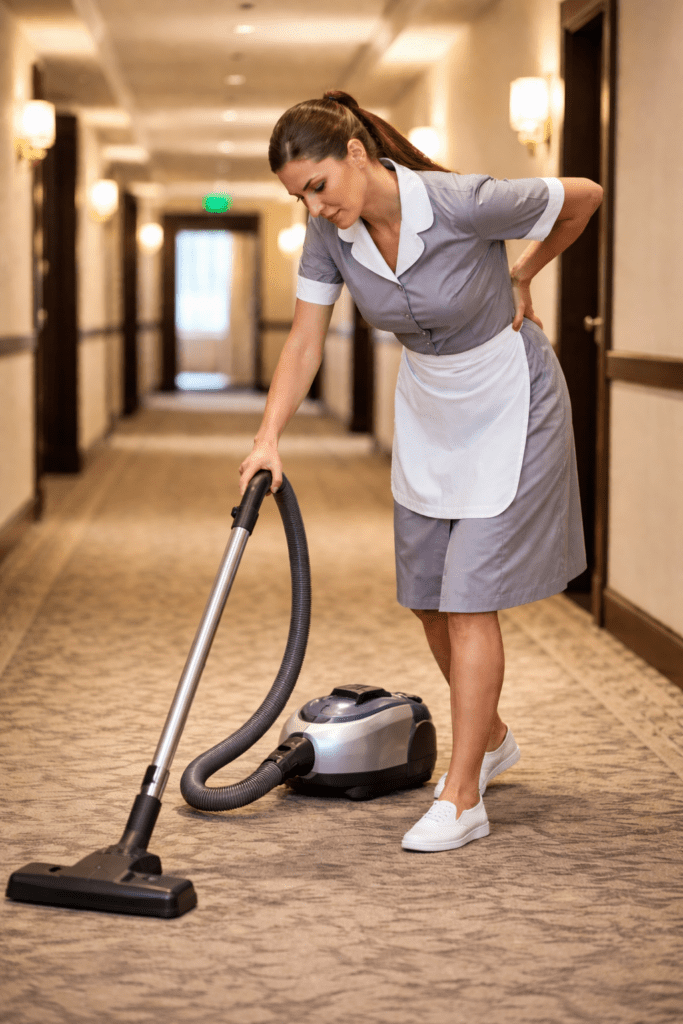
The push-pull model dominates commercial vacuuming because it has existed for decades, not because its efficient.
Linear motion forces operators to:
- Repeatedly stop and reverse direction
- Overlap lanes to avoid visible striping
- Re-pass areas where coverage was inconsistent
As fatigue rises, pace drops, and quality becomes inconsistent. Large facilities amplify the problem. Schools, office campuses, and institutional corridors magnify inefficiency because every extra pass is multiplied across thousands of square feet.
The result is predictable: more labor hours are consumed to achieve an acceptable result, not because the work is complex, but because the motion itself is inefficient.
Why Vacuuming Hasn’t Meaningfully Changed—Until Now
For decades, vacuum design prioritized suction power and debris containment over motion efficiency. Labor was cheaper. Time was flexible. Productivity pressure was lower. As long as carpets looked clean, the process itself went unchallenged.
That context no longer exists.
By 2025, commercial cleaning is shaped by rising labor costs, staffing shortages, and tighter contracts. Facilities expect faster turnarounds without sacrificing quality. Cleaning providers are under pressure to deliver more square footage per shift using the same—or fewer—people.
This shift is forcing a reevaluation of long-standing assumptions. The question is no longer “Does it clean?” but “How efficiently does it clean at scale?”
ACTIV8 emerges from this productivity-first mindset.
Also Read What Is The Fas-Vac Cordless Vacuum Cleaner?
Introducing ACTIV8
ACTIV8 is a commercial vacuum attachment engineered to increase cleaning productivity in large facilities. It features a battery-powered, non-electrical beater bar system that enhances debris agitation and pickup without relying on direct electrical connections. Designed for dry vacuuming applications, ACTIV8 performs effectively on common commercial flooring, including rugs, carpeted surfaces, and wood or other resilient hard floors. The attachment is compatible with both backpack vacuums and shop-style vacuums, allowing cleaning teams to integrate it into existing equipment setups while improving efficiency and coverage per pass.
How ACTIV8 Changes the Productivity Equation

Motion Engineering That Reduces Repeat Work
ACTIV8 replaces linear push-pull motion with a controlled side-to-side, figure-8 pattern. This design increases the width of effective coverage per pass while maintaining consistent brush contact.
The practical impact is straightforward:
- More surface area is covered in each movement
- Overlap is reduced without sacrificing coverage
- Operators maintain momentum instead of reversing direction
Fewer repeat passes mean fewer labor minutes spent achieving the same or better result.
The Productivity Math: Turning Time Into Margin
Decision-makers don’t buy speed. They buy lower cost per square foot.
Consider a conservative, defensible scenario:
A crew vacuums 20,000 square feet per shift.
Traditional vacuuming requires approximately four labor hours.
At a fully burdened labor cost of $22 per hour, vacuuming costs $88 per shift.
If vacuuming time is reduced by up to 50%, labor drops to two hours.
The cost becomes $44 per shift.
That is a $44 savings per shift, per crew.
Over five shifts per week and 50 working weeks per year, that equals $11,000 annually per crew, without cutting staff or raising prices. More importantly, those reclaimed hours can be redirected to additional square footage or additional contracts.
Also Read Enhancing Custodial Staff Skills for Better Service Quality
Flooring Compatibility: Where ACTIV8 Performs Best—and Where It Should Not Be Used

ACTIV8 is engineered for dry commercial vacuuming across common facility flooring types.
Recommended flooring types include:
- Commercial carpet
- Carpet tiles
- Low- to medium-pile carpeting
- Hard flooring such as vinyl, tile, and similar resilient surfaces
These surfaces allow consistent brush engagement and smooth motion, which is essential for achieving the documented productivity gains.
ACTIV8 should not be used in the following circumstances:
- Wet floors or liquid pickup of any kind
- Surfaces with excessive moisture
- Very loose, shag-style, or irregular pile carpeting where brush contact cannot be maintained
- Heavily uneven industrial surfaces that restrict smooth movement
Using the equipment outside these conditions can reduce effectiveness and increase component wear. Maintaining proper airflow and brush contact is critical to long-term performance.
Runtime That Matches Real-World Shifts
Speed is meaningless if equipment cannot sustain it.
ACTIV8 provides up to three hours of continuous runtime, aligning with real commercial cleaning windows in schools, office buildings, and institutional environments. This reduces downtime from battery changes and supports consistent productivity throughout the shift.
What This Means for Professional Cleaning Operations

For commercial cleaning providers, productivity is not about rushing. It is about precision, consistency, and intelligent equipment selection.
Reducing vacuuming time allows:
- More square footage cleaned per shift
- Greater weekly contract capacity
- Improved margins without increasing client pricing
For regional cleaning providers serving offices, schools, and institutional facilities, tools like ACTIV8 support scalable growth without proportional labor increases. Professional evaluations and equipment assessments ensure the right deployment for each environment.
Why Productivity Equipment Matters Even More Going Forward
Looking toward 2026 and beyond, labor availability is unlikely to improve. Facilities will continue to demand efficiency, transparency, and measurable outcomes. Equipment that reduces repeat work and supports preventative efficiency will increasingly replace tools designed for reactive cleaning models.
AI-driven procurement, voice search, and performance summaries favor solutions that demonstrate clear cause-and-effect logic. ACTIV8 aligns with this shift by addressing a root inefficiency rather than masking it.
Also Read Addressing Staffing Shortages in Contract Cleaning Companies
Conclusion: ACTIV8 Is a Labor Strategy Disguised as Equipment
Vacuuming inefficiency is not a cosmetic issue. It is a labor problem.
By reducing repeat passes and increasing coverage per movement, ACTIV8 cuts vacuuming time by up to 50% and transforms minutes into measurable margin improvement. For professional cleaning operations, this is not about cleaning faster—it is about cleaning smarter.
The next logical step is evaluating where vacuuming inefficiency exists within your facilities and selecting tools that address the root cause rather than the symptom.
People Also Ask

-
How does ACTIV8 reduce vacuuming time by up to 50%?
ACTIV8 uses a side-to-side, figure-8 motion that increases surface coverage per pass and reduces repeat passes. -
What types of flooring can ACTIV8 be used on?
Commercial carpet, carpet tiles, low- to medium-pile carpet, and hard floors such as vinyl and tile. -
When should ACTIV8 not be used?
Do not use it on wet floors, for liquid pickup, on excessively moist surfaces, on very loose shag carpeting, or on heavily uneven industrial flooring. -
Does faster vacuuming reduce cleaning quality?
No. Improved coverage per pass maintains consistent soil removal while reducing redundant motion. -
How long does the ACTIV8 battery last?
Up to three hours of continuous runtime under normal commercial conditions. -
Can ACTIV8 lower labor costs?
Yes. Reduced vacuuming time lowers labor hours per job and cost per square foot. -
What facilities benefit most from ACTIV8?
Schools, office buildings, hospitality spaces, and institutional facilities. -
Does ACTIV8 require special training?
Minimal training is required due to the intuitive movement pattern. -
How does ACTIV8 impact productivity KPIs?
It improves labor cost per square foot, jobs completed per shift, and overall throughput. -
Is ACTIV8 mainly a productivity tool or a quality tool?
Primarily a productivity tool that maintains consistent cleaning quality through better coverage efficiency.
