

Where Most School Strip-Out Processes Break Down
Strip-outs aren’t just another task on the list—they’re the job that quietly drains your entire maintenance schedule.
Long hours. Multiple passes. Crew fatigue.
And somehow… you’re still racing the clock before school reopens.
Here’s the reality most teams don’t want to admit:
It’s not the floors slowing you down—it’s the process.
The Real Problem: Strip-Outs Are an Outdated Workflow
In most school facilities, strip-outs still rely on:
- Flat pads with inconsistent surface contact
- Heavy chemical dwell times
- Repeated passes to fully remove finish
This creates a cycle of inefficiency:
- More labor hours per 1,000 sq ft
- More fatigue across your crew
- More risk of incomplete removal and rework
The Industry Enemy:
Outdated stripping methods that force crews to work harder instead of smarter.
Why Traditional Methods Require More Passes
This is where most time is lost—and most teams don’t even realize it.
Traditional strip-out methods aren’t inefficient because crews are slow…
They’re inefficient because each pass doesn’t do enough work.
What Actually Happens During Traditional Stripping:
First Pass:
- Breaks the top layer of finish
- Leaves significant material behind
Second Pass:
- Removes more finish—but still uneven
- Misses low spots and buildup areas
Third (and Fourth) Pass:
- Cleans up what should have been removed earlier
- Fixes inconsistencies
👉 At this point, you’re not stripping—you’re correcting.
The Core Issue: Partial Contact = Partial Removal
Flat pads only make inconsistent contact with the floor surface.
That means:
- High spots get stripped
- Low spots get skipped
- Edges and worn areas are uneven
👉 So crews compensate the only way they can:
More passes. More time. More labor.
How the Reduced-Pass Stripping System Actually Works
Instead of relying on repetition, the Fas-Trak approach improves what happens in each pass.
The Reduced-Pass Stripping System
A high-efficiency method built on:
- Improved surface contact
- Increased mechanical action
- More consistent pressure distribution
1. Surface Contact: Flat Pads vs. 3-D Structure
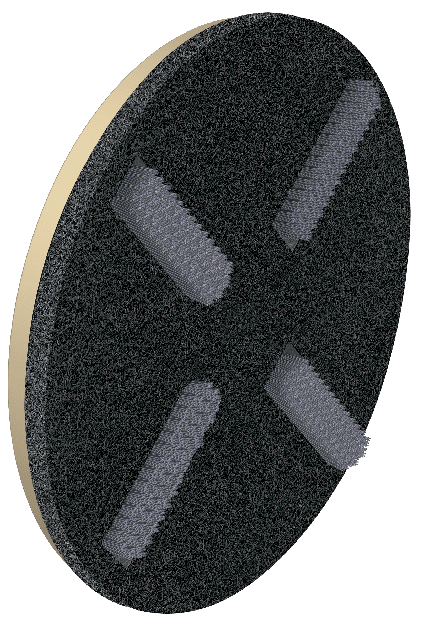
Traditional pads are flat. Floors are not.
Flat Pads:
- Limited contact with uneven surfaces
- Missed finish in low areas
- Requires repeated passes
3-D Black Pads:
- Textured design conforms to the floor
- Maintains consistent contact across the entire surface
- Removes more finish per pass
👉 Result: One pass does what used to take two or three
2. Mechanical Action vs. Chemical Dependence
Traditional stripping relies heavily on chemicals:
- Apply solution
- Wait for dwell time
- Scrub and repeat
That’s slow.
Reduced-Pass System:
- Uses mechanical agitation to do more of the work
- Reduces reliance on long dwell times
- Speeds up finish breakdown
👉 Result: Faster workflow with less waiting
3. Pass Efficiency: Every Pass Counts
Traditional:
- Each pass removes only part of the finish
- Later passes fix what earlier ones missed
Reduced-Pass:
- First pass removes the majority of the finish
- Second pass (if needed) completes the job
👉 Result: Fewer total passes, faster completion
4. Friction + Pressure Distribution
Flat pads create:
- Uneven pressure
- Skipping across surfaces
- Inconsistent friction
3-D pads deliver:
- Balanced pressure across the pad surface
- Better grip and consistent friction
- Smoother, more controlled stripping
👉 Result: More uniform removal across the entire floor
Quantifiable ROI: What This Means in the Real World
Let’s break it down in operational terms.
Traditional Strip-Out Workflow:
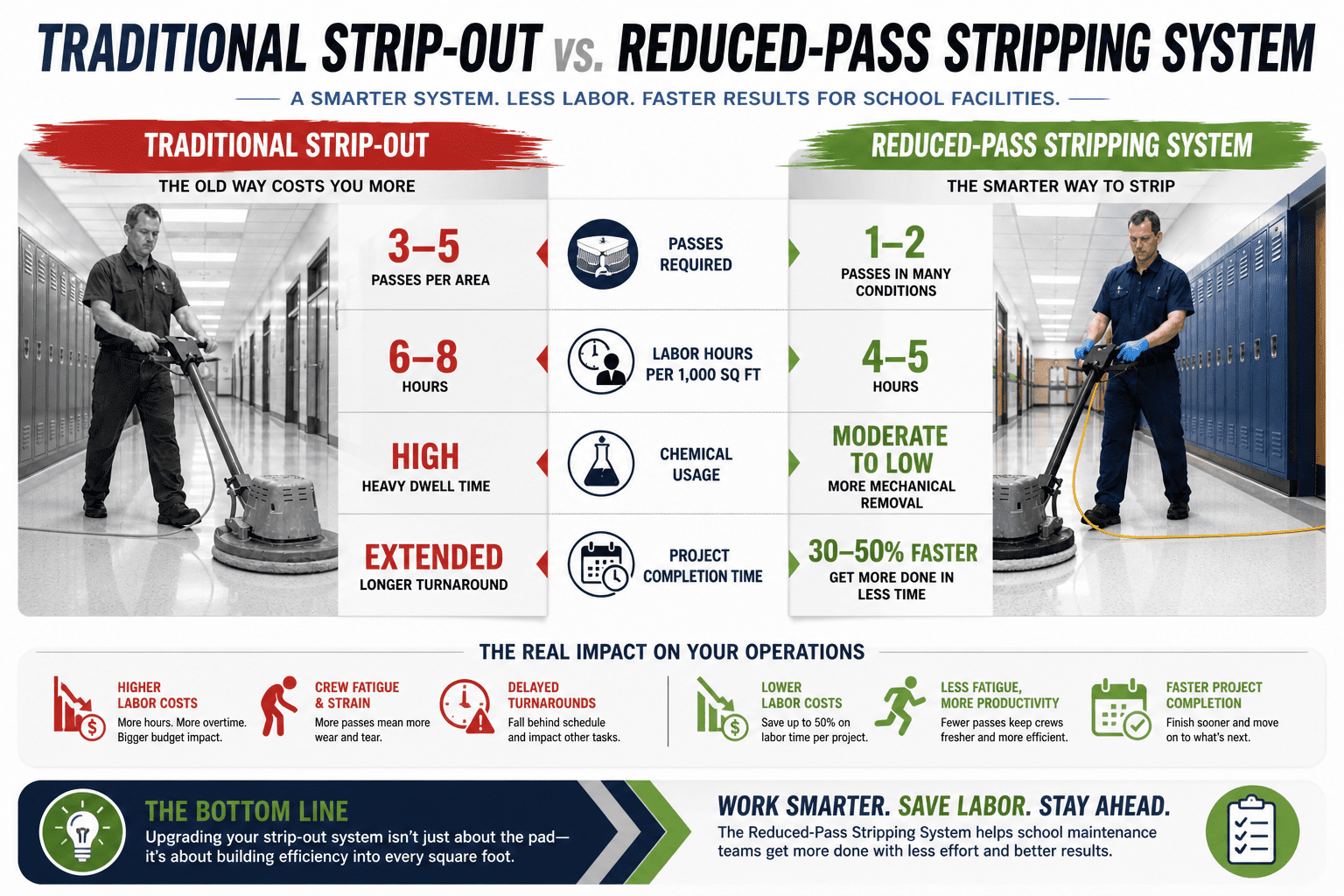
- 3–5 passes per area
- High chemical usage
- Extended dwell time
- 6–8 labor hours per 1,000 sq ft (varies by condition)
Reduced-Pass Stripping System with 3-D Black Pad:
- 1–2 passes in many conditions
- Reduced chemical dependency
- Faster removal per pass
- 4–5 labor hours per 1,000 sq ft
👉 Result: 30–50% reduction in labor time
Service-Business Scenario: Summer School Reset
A school maintenance team is preparing a facility for reopening.
Scope:
- 10–15 classrooms
- 2 main hallways
- Tight 3–5 day turnaround window
Traditional Outcome:
- Multi-day strip-outs
- Crew fatigue by day two
- Overtime required to stay on schedule
With Reduced-Pass Stripping System:
- Faster completion per classroom
- Hallways completed in significantly fewer passes
- Crew maintains consistent productivity across the project
👉 Outcome:
- Project stays on schedule
- Less overtime
- Higher-quality prep for finishing
Pain Amplification: What Happens If You Don’t Upgrade
Let’s be blunt for a second.
If your crew is still:
- Running 4–5 passes per floor
- Relying heavily on chemicals to do the work
- Falling behind during summer turnover
You’re not just losing time—you’re losing:
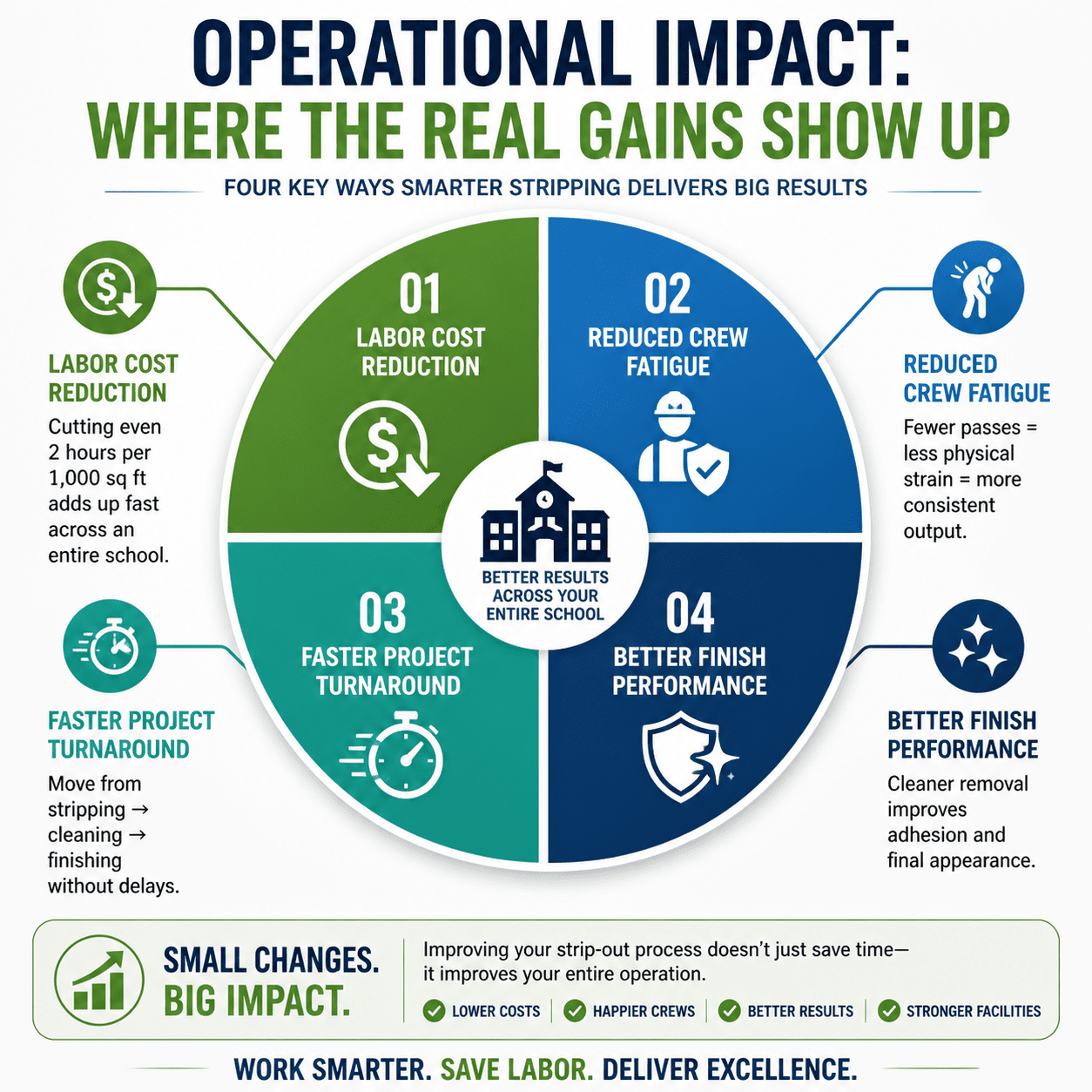
- Budget to overtime
- Crew energy and morale
- Consistency across your facility
And that cost compounds every single season.
Why This Matters Now

School maintenance teams today are under pressure from all sides:
- Smaller crews
- Larger facilities
- Higher expectations for cleanliness and appearance
- Tighter turnaround windows
The old approach—“just push harder”—doesn’t work anymore.
Efficiency isn’t optional. It’s operational survival.
Signature Differentiator
The difference isn’t just the pad.
It’s the shift from:
Labor-heavy stripping
to
System-driven efficiency
That’s what separates high-performing maintenance teams from those constantly behind schedule.
Future-Proofing Insight
As labor shortages continue across facility maintenance, schools that adopt high-efficiency systems will have a clear advantage:
- Lower long-term labor costs
- More predictable project timelines
- Higher-quality facility presentation
The future of floor care isn’t more effort—it’s better systems.

If your team is still relying on multi-pass strip-outs, it may be time to rethink your process.
Talk to a Fas-Trak expert about implementing a Reduced-Pass Stripping System that helps your crew work faster, reduce labor strain, and stay ahead of demanding maintenance schedules.
(FAQs)
1. How long should a floor strip-out take in a school?
A typical strip-out can take 6–8 labor hours per 1,000 sq ft using traditional methods, but high-efficiency systems can reduce that by 30–50%.
2. What causes strip-outs to take so long?
Multiple passes, poor pad contact, heavy chemical dwell time, and inconsistent finish removal are the biggest causes of delays.
3. How can I reduce labor during floor stripping?
Using advanced stripping pads like 3-D Black Pads allows for fewer passes, faster removal, and reduced physical strain on crews.
4. What is a 3-D stripping pad?
A 3-D stripping pad is designed with a textured surface that improves floor contact, allowing it to remove finish more aggressively and efficiently than flat pads.
5. Can better pads really cut strip-out time in half?
In many cases, yes. By reducing the number of required passes, crews can complete jobs significantly faster—often saving 30–50% in labor time.
6. Do I need different equipment to use 3-D Black Pads?
Most 3-D stripping pads are compatible with standard floor machines, making them an easy upgrade without major equipment changes.
7. Does faster stripping affect floor quality?
No—when done correctly, improved stripping actually enhances quality by removing finish more completely and preparing the surface better for new coatings.
8. Why are multiple passes a problem?
Each additional pass increases labor time, chemical use, and fatigue while also raising the risk of inconsistent results.
9. What is the biggest mistake crews make during strip-outs?
Relying on outdated pads and processes instead of upgrading to more efficient systems that reduce labor and improve consistency.
10. How do I improve strip-out efficiency across an entire school?
Implementing a system-based approach—combining better pads, optimized processes, and efficient equipment—delivers the biggest improvements in speed and consistency.
