

The School Tour That Starts Before Anyone Says a Word

Imagine a parent visiting your school for the first time.
Perhaps they're attending an open house.
Maybe they're considering a school transfer.
Maybe they're arriving for a sporting event, parent-teacher conference, concert, or graduation ceremony.
Before they meet a teacher.
Before they see a classroom.
Before they learn about academics.
They've already started forming opinions.
They notice the entrance.
They notice the hallways.
They notice the restroom.
They notice the odor near the locker room.
They notice the condition of the school bus.
Whether fair or not, these observations quickly become part of their overall perception of the school.
Parents rarely say:
"I appreciate your environmental hygiene strategy."
Instead, they say:
"The school felt clean."
Or:
"Something felt off."
That feeling matters more than many schools realize.
First Impressions Are Facility Impressions
Educational leaders spend tremendous effort improving curriculum, student engagement, technology, athletics, and staff development.
Yet facility conditions often shape the first impression long before any of those strengths are visible.
Research consistently shows that physical environments influence trust, comfort, confidence, and perception.
Parents naturally associate facility conditions with:
- Attention to detail
- Student safety
- Administrative leadership
- Organizational effectiveness
- Pride in the school
A clean, fresh, well-maintained environment reinforces confidence.
A neglected environment can create questions.
The Restroom Test
Ask almost any facility director and they'll tell you the same thing.
If visitors want to evaluate a building, they should look at the restrooms.
Restrooms are among the most heavily used spaces in educational facilities.
They also create some of the strongest impressions.
Parents may never see custodial closets.
They may never inspect maintenance records.
But they will remember a restroom that feels neglected.
Odor concerns often have an even greater impact because they immediately influence perception.
This is why many schools are incorporating larger-area odor management strategies such as Odor Control 20 (OC20) to help support more consistent restroom environments and reduce recurring odor complaints.
Also Read 📖Why Urinal Odor Problems Start with Splash, Not Cleaning
The Hallways That Tell a Story

Hallways are the arteries of a school.
Every student uses them.
Every visitor sees them.
Every parent walks through them.
A hallway communicates far more than people realize.
Clean floors.
Fresh air.
Well-maintained surfaces.
A positive atmosphere.
Together, these small details shape perception.
Large educational facilities often struggle with maintaining consistency across extensive hallways, gathering spaces, cafeterias, and common areas.
Solutions such as Ultra-Trak help facility teams efficiently address larger environments while supporting broader environmental hygiene objectives.
Also Read 📖Why Is the Fas-Edge a Game-Changer for Hard-to-Reach Floor Cleaning?
View Product Sheet👉🏻 https://fas-trak.com/wp-content/uploads/2024/02/microtrak-plus_v8_hf.pdf
Athletic Facilities Leave Lasting Impressions

Few school environments create stronger reactions than athletic facilities.
Locker rooms.
Weight rooms.
Training areas.
Equipment storage spaces.
Parents attending sporting events often experience these environments directly.
Athletes use them daily.
Coaches spend countless hours inside them.
Unfortunately, these same environments often create the greatest odor challenges.
Moisture, equipment storage, perspiration, limited ventilation, and high daily traffic can quickly create conditions that impact perception.
This is where targeted solutions such as Rapid OC become valuable components of an environmental hygiene strategy designed specifically for demanding athletic environments.
Also Read 📖How Do Ultra-Trak & Micro-Trak Transform Coating Application?
Check out this video 📽️https://www.youtube.com/watch?v=23BXW-rVhg4
The School Bus Experience

For many students, the school bus is the first and last school environment they experience each day.
Parents notice it too.
A school bus does more than transport students.
It represents the school itself.
Food debris, dirt, athletic equipment, moisture, and daily traffic create challenges that transportation departments manage continuously.
Schools increasingly recognize that appearance alone is not enough.
Environmental hygiene matters.
Solutions such as Fas-Tab HSC Tablets help support daily sanitizing and deodorizing efforts while simplifying preparation and promoting consistency across transportation fleets.
Also Read 📖School Odor Control Solutions: Why School Odors Keep Coming Back and How to Stop Them
Consistency Is What Parents Actually Notice
One clean hallway does not create confidence.
One clean restroom does not create confidence.
One fresh-smelling locker room does not create confidence.
Consistency creates confidence.
When parents move throughout a campus and experience the same positive conditions everywhere they go, they develop trust.
Consistency tells visitors that systems exist.
Consistency suggests leadership.
Consistency reflects operational excellence.
This is why environmental hygiene programs are becoming increasingly important.
The objective is not perfection.
The objective is repeatability.
Also Read 📖Why Are Cleaning Results Inconsistent? Fas-Tabs Create Controlled Outcomes
The Tools Behind Better Experiences
Many people think facility perception is created by custodial effort alone.
In reality, outcomes often depend on having the right systems and tools in place.
Different environments require different solutions.
Fas-Tab HSC Tablets

Ideal for:
- Classrooms
- School buses
- High-touch surfaces
- Common areas
Rapid OC
Ideal for:
- Locker rooms
- Weight rooms
- Equipment rooms
- Athletic facilities
Odor Control 20 (OC20)

Ideal for:
- Restrooms
- Open educational spaces
- Large common areas
- Visitor-facing environments
Ultra-Trak

Ideal for:
- Hallways
- Cafeterias
- Gymnasiums
- Large gathering spaces
Fluid Tool
Supports:
- Consistent application
- Standardized procedures
- Reduced waste
- Improved efficiency across custodial teams
Together, these solutions help schools create the consistency that parents, students, staff, and visitors notice every day.
👉🏻Cleaning Equipments
The Future of School Facility Perception
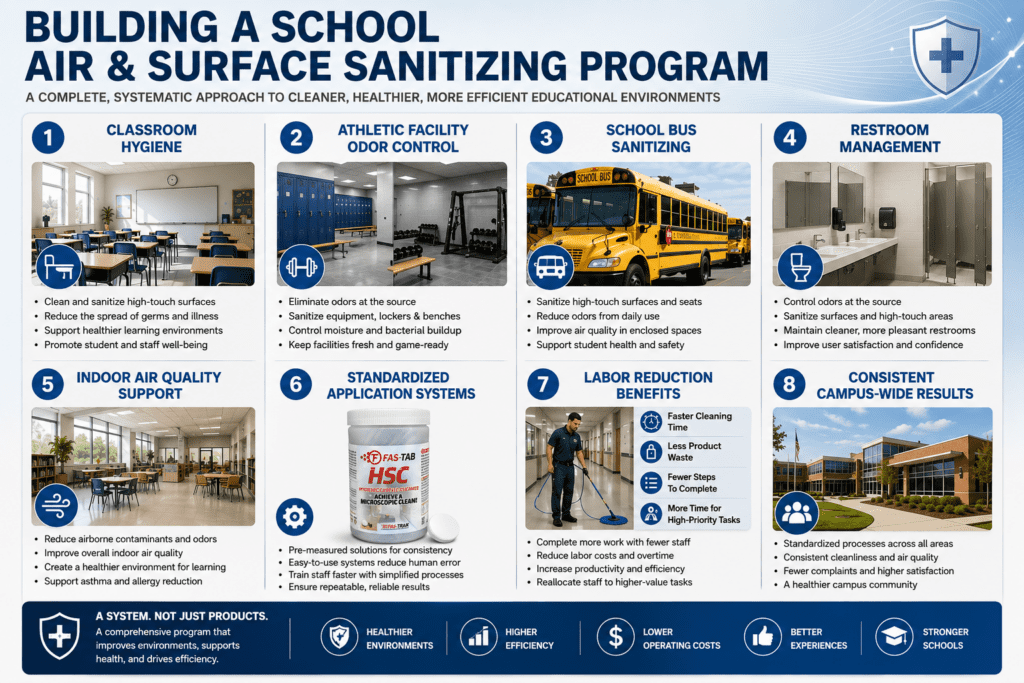
Schools today are evaluated on far more than academics.
Parents pay attention to experiences.
Students notice environments.
Staff recognize operational consistency.
Communities observe facility conditions.
As expectations continue to rise, environmental hygiene will increasingly become part of the overall educational experience.
The schools that excel will not simply react to complaints.
They will build systems designed to create positive impressions from the moment someone walks through the door.
Also Read 📖School Air & Surface Sanitizing Systems: A Complete Guide for Educational Facilities
What To Expect Next...
Parents may never ask about your sanitation procedures.
They may never see your facility management plans.
But they absolutely notice the results.
Every hallway, restroom, locker room, bus, classroom, and common area contributes to how a school is perceived.
The schools that prioritize environmental hygiene are not simply creating cleaner facilities.
They are building trust.
They are strengthening confidence.
And they are shaping the experiences people remember long after they leave.
Learn how Fas-Trak's Air & Surface Sanitizing solutions can help educational facilities create cleaner, fresher, and more consistent environments that support positive first impressions across the entire campus.
📞Contact Fas-Trak

Frequently Asked Questions
1. Why does school cleanliness have such a strong impact on parent perception?
Parents often form impressions within minutes of entering a school. Clean hallways, fresh-smelling classrooms, well-maintained restrooms, and organized common areas help build confidence that the facility is well-managed and student-focused.
2. What school areas do parents notice first during a visit?
Parents typically notice entrances, hallways, classrooms, restrooms, cafeterias, athletic facilities, and school buses. These highly visible environments often shape their overall perception of the school.
3. How do odors affect a school's reputation?
Persistent odors can create negative impressions, even when facilities appear clean. Odor issues in locker rooms, restrooms, buses, or common areas can influence how parents, students, staff, and visitors perceive the entire school environment.
4. Why are school restrooms so important to facility perception?
Restrooms are among the most frequently used spaces in a school and often serve as a reflection of overall facility maintenance. Clean, fresh restrooms help reinforce confidence in the school's operational standards.
5. What environmental hygiene challenges are most common in school athletic facilities?
Locker rooms, weight rooms, equipment storage areas, and training facilities often experience moisture buildup, heavy traffic, perspiration, and limited ventilation, creating conditions that can contribute to recurring odor concerns.
6. How can schools improve cleanliness without increasing labor demands?
Many schools improve efficiency by implementing standardized environmental hygiene programs, using purpose-built cleaning solutions, and utilizing tools that help staff achieve consistent results with less rework.
7. What role do school buses play in overall school perception?
School buses are often the first and last school environment students experience each day. Maintaining clean, fresh, and sanitary buses helps support a positive impression of the school's commitment to student well-being.
8. How can schools create more consistent environmental hygiene across multiple buildings?
Consistency is often achieved through standardized procedures, proper staff training, controlled application systems, and products designed to deliver repeatable results across classrooms, athletic facilities, transportation fleets, and common areas.
9. Which Fas-Trak solutions can help support a school-wide environmental hygiene program?
Schools may utilize Fas-Tab HSC Tablets for daily sanitizing and deodorizing, Rapid OC for challenging athletic and odor-prone environments, Odor Control 20 for larger open spaces, Ultra-Trak for broad facility coverage, and the Fluid Tool for consistent application practices.
10. Why are environmental hygiene programs becoming more important in educational facilities?
Parents, students, staff, and visitors increasingly expect schools to provide clean, healthy, and welcoming environments. Effective environmental hygiene programs help support positive perceptions, reduce complaints, improve consistency, and contribute to a better overall educational experience.
