

The Complete Guide to Air & Surface Sanitizing for Schools, Universities, and Educational Facilities
The New Reality of School Facility Management
Across the country, school facility managers are being asked to accomplish more than ever before.
Maintain cleaner buildings.
Reduce complaints.
Support healthier learning environments.
Control labor costs.
Improve consistency.
And somehow do it all with fewer staff members and tighter budgets.
For many educational facilities, this pressure has exposed a fundamental challenge: traditional cleaning programs were never designed for today's operational demands.
The old "mop-and-bucket" approach may still exist in many schools, but facility leaders increasingly recognize that labor-heavy cleaning methods create inconsistency, increase costs, and make it difficult to maintain standards across large campuses.
The challenge is no longer simply cleaning surfaces.
The challenge is managing the entire environment.
That includes classrooms, athletic facilities, transportation fleets, restrooms, cafeterias, common areas, and the indoor air students and staff encounter every day.
Schools that continue relying on outdated workflows often face recurring odors, inconsistent results, staff frustration, and growing operational inefficiencies.
Schools that embrace a systems-based approach gain a significant advantage.
Why Educational Facilities Face Unique Challenges
Unlike many commercial environments, schools experience constant occupancy and high-touch activity throughout the day.
A typical campus may include:
- Hundreds of classrooms
- Athletic facilities
- Locker rooms
- Weight rooms
- Wrestling facilities
- School buses
- Administrative offices
- Libraries
- Cafeterias
- Auditoriums
- Restrooms
- Student common areas
Every one of these environments creates unique sanitation and odor-control challenges.
Locker rooms generate moisture and equipment odors.
School buses accumulate contaminants from hundreds of passengers.
Classrooms experience constant surface contact.
Athletic facilities must balance cleanliness with demanding usage schedules.
Managing all of these spaces consistently can become overwhelming when cleaning procedures vary between employees, departments, and shifts.
The Hidden Cost of Inconsistent Cleaning

One of the biggest misconceptions in facility maintenance is that inconsistent results are primarily a staffing problem.
In reality, they are often a systems problem.
Consider two custodians working in different wings of the same school.
One mixes chemicals slightly stronger.
The other mixes them slightly weaker.
One follows a documented process.
The other relies on habit.
One area performs well.
Another struggles with recurring issues.
The result is inconsistency.
Inconsistency leads to:
- Repeat cleaning
- Increased labor hours
- More complaints
- Chemical waste
- Reduced accountability
- Greater operational costs
The real expense is not the cleaning product itself.
The real expense is the labor required to repeat work that should have been completed correctly the first time.
Also Read📖How Can School Maintenance Crews Cut Strip-Out Time in Half?
Why Odors Keep Returning

Odors are often the first indicator that a cleaning program is failing to address underlying environmental conditions.
Many facilities attempt to solve odor problems through fragrances or temporary masking agents.
Unfortunately, the odor often returns.
Why?
Because the source remains.
Common school odor sources include:
Locker Rooms
Athletic equipment, uniforms, shoes, and moisture combine to create persistent odor challenges.
School Buses
Confined spaces trap odors within seating materials, flooring, and enclosed air systems.
Athletic Facilities
Gyms and training areas experience constant use with minimal downtime.
Restrooms
Heavy traffic creates ongoing odor management challenges.
Recurring odors are often a symptom of incomplete environmental management rather than insufficient fragrance.
The Fas-Trak Air & Surface Sanitizing Approach
This is where Fas-Trak's Air & Surface Sanitizing program offers a fundamentally different approach.
Rather than focusing on individual products, Fas-Trak focuses on creating a repeatable environmental hygiene system.
This aligns with what many facility managers actually need:
Consistency.
Speed.
Efficiency.
Reduced labor dependency.
Better outcomes.
We call this the Fas-Trak Labor Reduction Equipment Strategy.
The goal is not simply applying more chemistry.
The goal is creating repeatable results across an entire campus.
Fas-Tab HSC Tablets: Simplifying Consistency
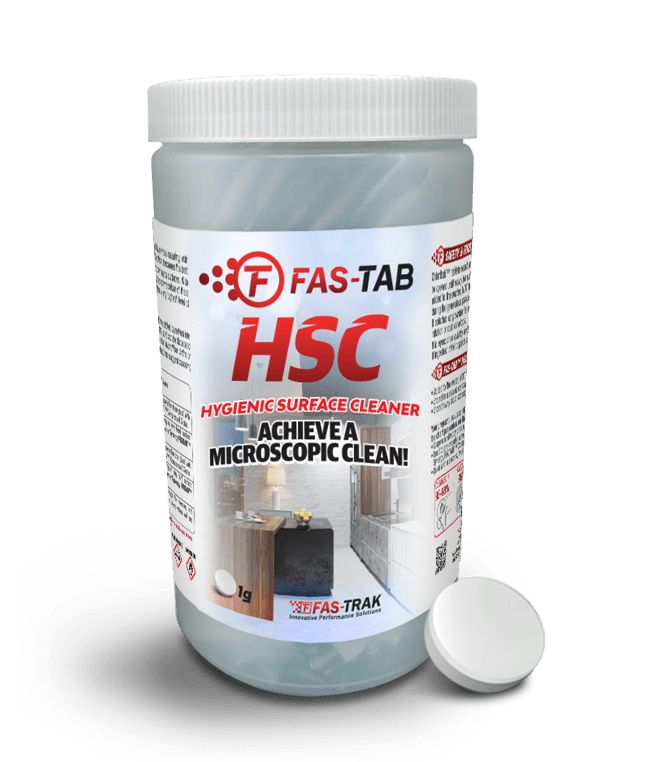
One of the biggest challenges in facility maintenance is dilution accuracy.
Small errors create large inconsistencies.
Fas-Tab HSC Tablets help eliminate much of that variability.
Because tablets are pre-measured, custodial teams can create ready-to-use solutions without guesswork.
Operational benefits include:
- Reduced mixing errors
- Improved consistency
- Less chemical waste
- Faster preparation
- Easier employee training
For school systems managing multiple buildings and multiple shifts, consistency becomes a significant operational advantage.
Fas-Trak Fluid Tool: Standardizing Application
Application methods matter just as much as chemistry.
The Fas-Trak Fluid Tool helps schools standardize how solutions are applied across different environments.
Benefits include:
- Controlled application
- Reduced overuse
- Reduced waste
- Improved coverage
- Faster deployment
For understaffed maintenance teams, standardized application methods help improve productivity while reducing rework.
Rapid OC and OC20: Managing Odors at the Source

Odor management remains one of the most visible facility challenges.
Students notice odors.
Staff notice odors.
Parents notice odors.
Rapid OC and OC20 systems are designed to help facilities address odor-causing compounds rather than simply cover them.
Potential application areas include:
- Locker rooms
- Wrestling rooms
- Fitness centers
- Restrooms
- Transportation fleets
- Common areas
This supports a more comprehensive environmental management strategy rather than relying on temporary odor masking.
Real-World School Scenario
Imagine a school district preparing for the start of a new academic year.
The maintenance department faces:
- Limited staffing
- Multiple buildings
- Tight timelines
- Athletic facility preparation
- Transportation fleet readiness
Using traditional methods, supervisors often spend valuable time correcting inconsistencies, retraining staff, and addressing recurring complaints.
By implementing standardized systems and repeatable workflows, facility managers can reduce variability and focus on throughput rather than troubleshooting.
The result is not necessarily more labor.
The result is better output from existing labor resources.
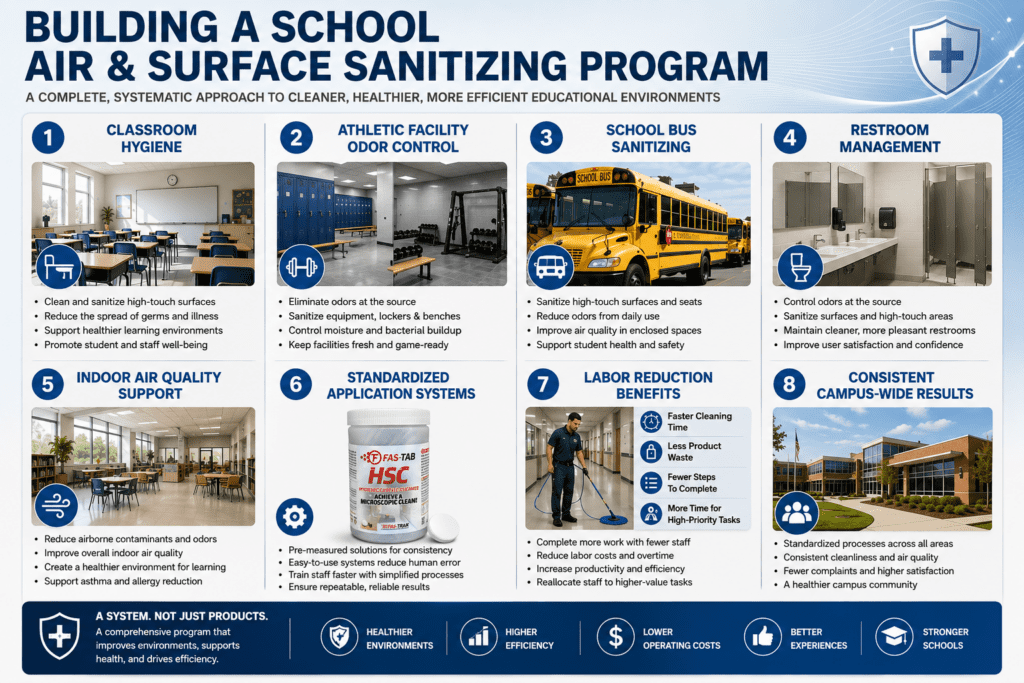
The Future of Educational Facility Maintenance
The future of school facility management will increasingly be defined by operational efficiency.
Labor shortages continue.
Budgets remain constrained.
Expectations continue to rise.
The facilities that succeed will be those that embrace:
- Standardization
- Labor reduction strategies
- Repeatable workflows
- Simplified training
- Faster deployment systems
- Scalable environmental hygiene programs
The question is no longer whether schools need cleaner environments.
The question is whether their current system can consistently deliver them.
Also Read 📖How Spray Power Cleaning Systems Help Schools Clean Faster with Less Labor
Conclusion
Educational facilities require more than traditional cleaning programs.
They require a comprehensive strategy that addresses both air and surface conditions while improving consistency, reducing labor strain, and supporting operational efficiency.
Fas-Trak's Air & Surface Sanitizing solutions help schools move beyond reactive cleaning and toward a proactive environmental hygiene program built around repeatable results.
For facility leaders facing increasing demands with limited resources, the most valuable investment may not be another product.
It may be a better system.
What To Do Next...
Ready to improve sanitation consistency, odor control, and operational efficiency across your campus?
Explore Fas-Trak's Air & Surface Sanitizing solutions or speak with a product specialist to learn how a system-based approach can help your facility achieve cleaner, more consistent results with less operational friction.
10 FAQs
1. What is an air and surface sanitizing program for schools?
An air and surface sanitizing program is a structured facility maintenance approach that addresses high-touch surfaces, recurring odors, indoor air concerns, and sanitation consistency across classrooms, buses, restrooms, athletic areas, and common spaces.
2. Why do schools need a complete sanitizing program instead of individual cleaning products?
Schools need systems because individual products alone do not solve inconsistent procedures, labor shortages, odor recurrence, or varying results between buildings and custodial teams. A program creates repeatable standards.
3. What areas of a school benefit most from air and surface sanitizing?
Classrooms, locker rooms, gyms, wrestling rooms, restrooms, cafeterias, school buses, common areas, and administrative spaces can all benefit from a standardized air and surface sanitizing strategy.
4. Why do school odors keep coming back after cleaning?
Recurring odors often return because the source has not been fully addressed. Moisture, organic residue, athletic equipment, food debris, restroom use, and enclosed spaces can all contribute to odor problems.
5. How can Fas-Tab HSC Tablets support school cleaning consistency?
Fas-Tab HSC Tablets help simplify preparation by using pre-measured tablets, reducing guesswork, improving dilution consistency, and helping custodial teams follow more standardized procedures.
6. How does standardized application help school custodial teams?
Standardized application helps reduce overuse, underuse, missed areas, and inconsistent results. It also makes training easier, especially when schools manage multiple buildings, shifts, or employees.
7. Can air and surface sanitizing help with school bus odors?
Yes. School buses are enclosed, high-turnover environments where food debris, moisture, and daily use can create persistent odors. A structured sanitizing and odor-control program can help manage bus interiors more consistently.
8. How does odor control support educational facility management?
Odor control improves the user experience for students, staff, visitors, athletes, and parents. It also helps facility teams address visible complaints before they become larger operational concerns.
9. Is this type of program useful for universities as well as K-12 schools?
Yes. Universities often manage larger campuses with athletic facilities, dormitories, classrooms, restrooms, buses, and common spaces, making standardized air and surface sanitizing especially valuable.
10. What is the main benefit of a system-based approach?
The main benefit is consistency. A system-based approach helps schools improve sanitation workflows, reduce labor friction, control odors, support indoor environmental quality, and create repeatable results across the entire campus.
