

It's Friday Afternoon... and the Odors Are Already Coming Back

It's Friday afternoon. The final bell rings, athletes head toward the locker rooms, and the last buses return to the transportation yard. Custodians begin preparing for another evening cleaning cycle.
On paper, everything appears under control. Cleaning schedules have been followed. Trash has been removed. Floors have been cleaned. Restrooms have been serviced.
Yet many facility managers already know what Monday morning may bring.
The same complaint.
Again.
The locker room smells.
The buses still smell.
The restroom near the gym smells worse than ever.
And perhaps the most frustrating part? Those areas were already cleaned.
For school facility directors, custodial supervisors, and operations managers, recurring odors can feel like a problem that never truly goes away. No matter how often certain areas are cleaned, the odors somehow return.
But what if the problem isn't that schools aren't cleaning enough?
What if the problem is that many facilities are solving the wrong problem entirely?
The Biggest Myth in School Cleaning
One of the most expensive misconceptions in educational facility maintenance is the belief that odors are simply a cleanliness issue.
They are not.
Odors are often environmental warning signs.
Think of odors like the dashboard warning light in a vehicle. The light itself isn't the problem—it is alerting you that something else is happening beneath the surface.
The same principle applies inside educational facilities. An unpleasant odor often indicates organic buildup, moisture retention, environmental contamination, poor air circulation, inconsistent sanitation practices, or high-use surfaces that are not being fully addressed.
Unfortunately, many cleaning programs focus on making an area smell different rather than eliminating what is creating the odor in the first place. The result is temporary improvement followed by recurring frustration.
Also Read 📖Why Are Tight Spaces the Hardest Areas to Finish in School Facilities?
Why Locker Rooms Are Ground Zero for Odor Problems

Few environments challenge facility teams more than locker rooms.
Think about what happens inside a typical high school locker room during a single week. Hundreds of athletes move through the space. Sweaty uniforms are stored in lockers. Equipment is used repeatedly. Shoes sit in enclosed areas. Moisture accumulates. Air circulation varies.
The environment becomes the perfect storm for persistent odors.
This is why many educational facilities are moving beyond fragrance-based odor control. Solutions such as Fas-Trak's Rapid OC are designed specifically for challenging odor environments like locker rooms, athletic training facilities, and equipment storage areas. Rather than simply masking odors, these systems help facilities target odor-causing compounds at the source, supporting a more consistent environment for athletes, coaches, and maintenance teams.
The facility may appear clean.
The environment itself may still be struggling.
The School Bus Nobody Wants to Ride

Now consider the average school bus.
Most people don't think about buses when discussing environmental hygiene, but they should.
Every day buses collect food debris, dirt, moisture, athletic gear, backpacks, and organic residue. Unlike large school buildings, buses operate within a confined space. What enters the environment tends to remain in the environment.
By Friday afternoon, many buses have experienced hundreds of student interactions. Food debris accumulates. Dirt is tracked in. Moisture enters during rainy weather. Athletic equipment is transported between events.
A quick sweep may improve appearance, but appearance and environmental hygiene are not the same thing.
Many transportation departments are now incorporating standardized sanitizing programs using solutions such as Fas-Tab HSC tablets. Because the tablets are pre-measured, transportation staff can create consistent sanitizing and deodorizing solutions without complicated mixing procedures, helping improve consistency across entire fleets.
Transportation directors often discover that odor complaints are not transportation problems at all.
They're environmental management problems.
The Restroom Challenge Nobody Talks About

Restrooms may be one of the most frequently visited spaces in a school, but they are also among the most difficult to maintain consistently.
Unlike classrooms or administrative offices, restrooms experience continuous traffic throughout the day. Moisture, organic contamination, high-touch surfaces, and limited downtime between uses create conditions where odors can quickly develop.
The challenge for facility teams is that odor complaints often influence how people perceive an entire building. A single unpleasant restroom experience can affect a visitor's impression of an otherwise well-maintained facility.
Many schools respond by increasing fragrance products or cleaning frequency. While those efforts may provide temporary improvement, they often fail to address the environmental conditions responsible for recurring odor issues.
This is where broader environmental hygiene strategies become important. Open-space odor management solutions such as OC20 can support larger educational environments by helping facility teams address odor concerns more consistently across high-traffic areas.
The objective is not simply making a restroom smell better.
The objective is creating a facility experience that remains consistently positive throughout the school day.
Athletic Facilities: The Perfect Storm for Odor Problems
Between locker rooms, wrestling mats, weight rooms, training equipment, and athletic storage areas, school athletic facilities create some of the most challenging odor-control environments on campus.
These areas often experience:
- Heavy perspiration
- Equipment storage
- Limited ventilation
- Moisture accumulation
- High daily traffic
Many facility managers discover that even aggressive cleaning schedules struggle to keep pace with the environmental demands of athletic programs.
Solutions such as Rapid OC are often utilized in these challenging environments because they help support a more proactive odor-management strategy rather than relying solely on fragrances or reactive cleaning.
The Hidden Cost Nobody Calculates
Most schools measure cleaning costs.
Few measure odor costs.
Yet recurring odor issues create operational expenses throughout an organization.
A complaint is received. A custodian is sent back. Additional cleaning occurs. A supervisor investigates. More products are used. Additional labor hours are consumed. Then the complaint returns and the cycle repeats.
Over time, the cost of recurring odor issues extends far beyond cleaning supplies.
The real expense becomes repeat labor, lost productivity, staff frustration, administrative distraction, and ongoing facility complaints.
For schools already facing staffing shortages, every unnecessary labor hour matters.
Also Read 📖How Spray Power Cleaning Systems Help Schools Clean Faster with Less Labor
The Real Enemy: Reactive Cleaning
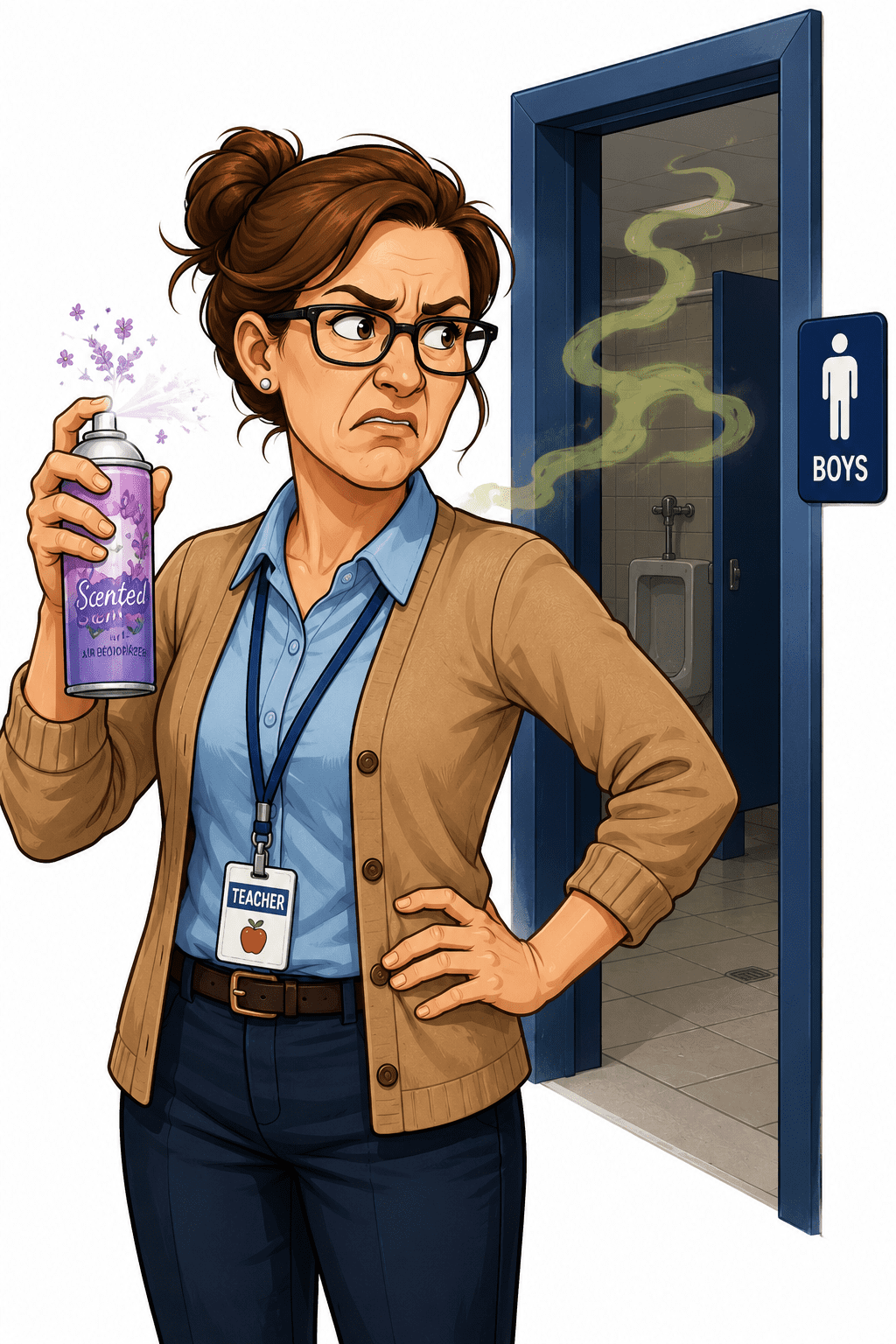
The educational facility industry often treats odors as isolated incidents.
They are not.
Odor issues are frequently symptoms of a reactive maintenance culture.
A complaint occurs. A response follows. The symptom disappears temporarily. Then the cycle begins again.
This complaint-response model creates endless repetition.
Forward-thinking facility teams are beginning to replace reactive cleaning with environmental hygiene management. Instead of asking, "How do we make this area smell better?" they ask, "What environmental condition is causing this odor?"
That single shift in thinking changes everything.
How Leading Schools Are Changing Their Approach
The most successful school districts are increasingly adopting a systems-based strategy. Rather than relying on multiple disconnected products, they are focusing on consistency in procedures, application methods, staff training, and environmental management.
This is where Fas-Trak's Air & Surface Sanitizing approach becomes particularly valuable.
Rather than functioning as just another cleaning product, it supports a broader environmental hygiene strategy designed to help facilities create repeatable outcomes across classrooms, athletic facilities, transportation fleets, restrooms, and common areas.
Consistency becomes the objective.
Because consistency reduces complaints.
Consistency reduces rework.
Consistency reduces labor waste.
And consistency improves the overall facility experience.
Also Read 📖How Are Schools Finishing Large Hallways & Classrooms Faster with Smaller Crews?
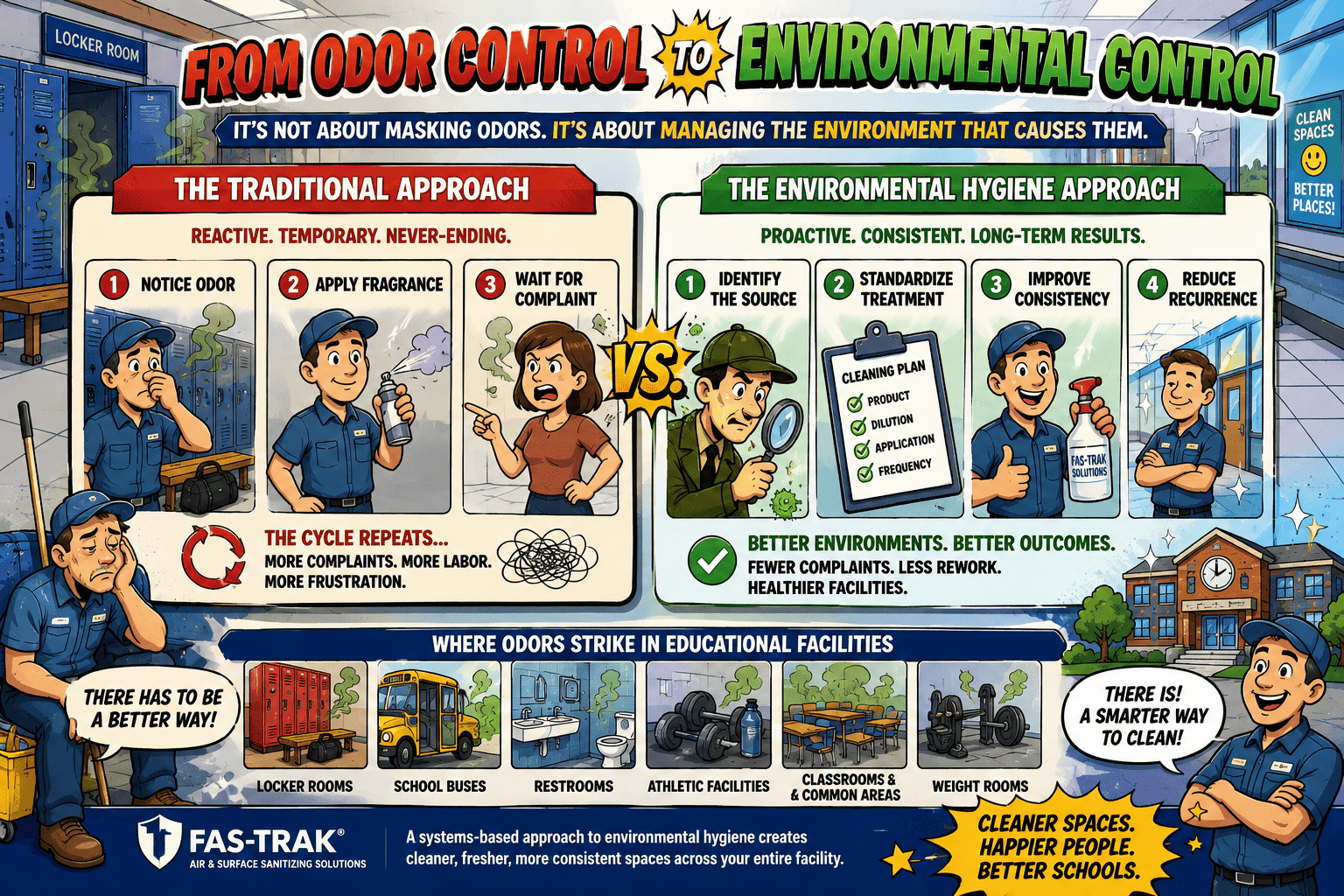
The second approach produces better long-term outcomes because it addresses the environment rather than simply masking symptoms.
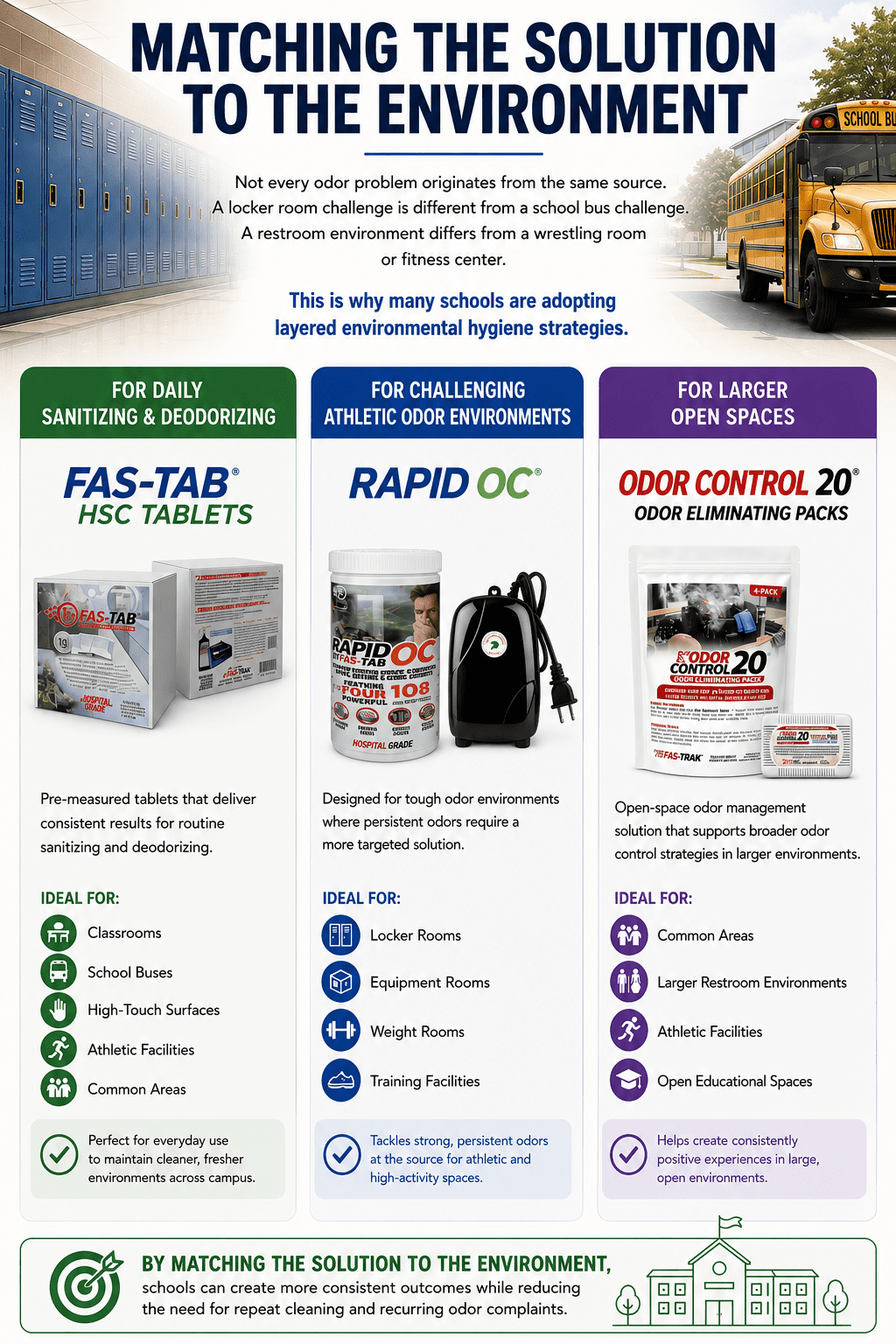
Products such as Fas-Tab HSC Tablets help support consistency by reducing preparation variability. Rapid OC helps facilities target challenging odor environments. OC20 supports larger spaces where recurring odor complaints can affect the overall facility experience.
Together, these tools help schools shift from reaction to prevention.
A Real-World School Scenario
Imagine a high school entering football season.
Locker rooms operate daily. Weight rooms remain active. Buses transport athletes across the district. Facility complaints begin increasing.
The traditional response is to clean more.
The smarter response is to investigate why the odors continue returning.
When schools begin examining environmental conditions rather than simply increasing labor, they often discover opportunities to improve consistency, reduce repeat work, and achieve better outcomes without continually adding resources.
That distinction becomes increasingly important as labor shortages continue affecting facility operations nationwide.
The Future of School Odor Management
The schools that will lead the next decade of facility management are not necessarily those with the largest budgets.
They will be the schools that build the smartest systems.
Environmental hygiene is rapidly becoming part of overall facility strategy. Parents notice it. Students notice it. Staff notice it. Administrators notice it.
As expectations continue rising, schools will need solutions that improve consistency while reducing operational friction.
The future is not about stronger fragrances.
The future is about better environmental management.
Also Read 📖School Air & Surface Sanitizing Systems: A Complete Guide for Educational Facilities
Conclusion
If odors keep returning despite regular cleaning, the issue may not be a lack of effort.
The issue may be that the source of the problem has never been fully addressed.
Locker rooms, buses, athletic facilities, and restrooms all create environmental conditions that require more than surface-level solutions. Schools that focus on environmental hygiene, consistency, and proactive management can reduce recurring complaints, improve facility experiences, and create healthier learning environments for everyone who enters their buildings.
The goal is not to make schools smell different.
The goal is to make them perform better.
What To Do Next...
Looking for a more effective way to manage recurring odors in schools, locker rooms, athletic facilities, buses, and restrooms?
Explore Fas-Trak's Air & Surface Sanitizing solutions and discover how a system-based approach can help create cleaner, fresher, and more consistent educational environments.
10 FAQs: Matching the Solution to the Environment
1. Why do schools need different odor-control solutions for different areas?
Different environments create different odor challenges. A locker room, school bus, classroom, and restroom all have unique sources of moisture, organic material, traffic patterns, and air circulation. Matching the solution to the environment helps create more consistent results.
2. What is Fas-Tab HSC and where is it typically used?
Fas-Tab HSC Tablets are pre-measured sanitizing and deodorizing tablets designed to simplify daily cleaning routines. They are commonly used in classrooms, school buses, high-touch surfaces, athletic facilities, and common areas.
3. How do Fas-Tab HSC Tablets help improve cleaning consistency?
Because the tablets are pre-measured, custodial teams can create consistent solutions without complicated mixing procedures. This helps reduce dilution errors and improves standardization across multiple buildings and staff members.
4. What types of odor problems is Rapid OC designed to address?
Rapid OC is designed for challenging odor environments where persistent odors require a more targeted approach. It is commonly used in locker rooms, equipment rooms, weight rooms, and athletic training facilities.
5. Why are athletic facilities often more difficult to keep odor-free?
Athletic facilities experience heavy foot traffic, moisture, perspiration, sports equipment storage, and limited drying time. These conditions can create ongoing odor challenges that require specialized odor-management strategies.
6. What is OC20 used for?
OC20 is designed to support odor management in larger open spaces where odors can affect the overall facility experience. It can be used in common areas, larger restroom environments, athletic facilities, and open educational spaces.
7. Can these solutions be used together as part of a school-wide program?
Yes. Many schools adopt layered environmental hygiene strategies that combine daily sanitizing, targeted odor management, and open-space odor control to create a more comprehensive approach to facility maintenance.
8. How can schools reduce recurring odor complaints?
The most effective approach is to identify the source of odors, standardize treatment procedures, improve consistency, and implement solutions that address environmental conditions rather than simply masking odors.
9. Why is environmental hygiene different from traditional odor control?
Traditional odor control often focuses on masking unpleasant smells. Environmental hygiene focuses on identifying sources, improving sanitation consistency, reducing recurrence, and creating healthier facility environments.
10. What are the benefits of matching the solution to the environment?
Matching the right solution to the right environment helps schools improve consistency, reduce repeat cleaning, lower labor inefficiencies, minimize recurring complaints, and create a better experience for students, staff, and visitors.
