


From Claims to Proof: What a Cleaning Equipment Demonstration Should Actually Measure
Operational Intelligence™
60-Second Executive Brief
The Operational Challenge
Cleaning-equipment demonstrations often answer the wrong question.
A representative arrives, introduces the equipment, explains the features, runs it across a section of flooring, and asks the customer what they think.
The machine may look impressive.
But what was actually proven?
For a facility manager, distributor, or EVS leader, the important question isn't whether a piece of equipment performs well during a demonstration. It is whether the proposed process performs measurably better than the process already being used.
That requires a different kind of demonstration—one built around a baseline, real working conditions, measurable criteria, operator feedback, and an honest comparison of results.
Why It Matters
- Specifications describe capability; they do not predict every facility's results.
- A faster machine does not automatically mean a more efficient process when setup, refilling, detail work, cleanup, training, and rework are considered.
- Frontline employees should participate in evaluations because usability and physical demands influence whether a new process succeeds after the demonstration.
- Measurement turns a sales presentation into an operational decision.
Facility Manager Takeaway
Before a demonstration begins, establish what problem is being solved and what will be measured. If success has not been defined beforehand, it becomes very easy to mistake an impressive demonstration for an operational improvement.
For Distributors and Representatives
Don't ask the customer whether they liked the demonstration.
Ask:
What changed—and can we measure it?
Read More
Estimated Read Time: 10–12 minutes
⬇️⬇️⬇️⬇️
A Sales Presentation Makes a Claim. A Demonstration Should Test It.
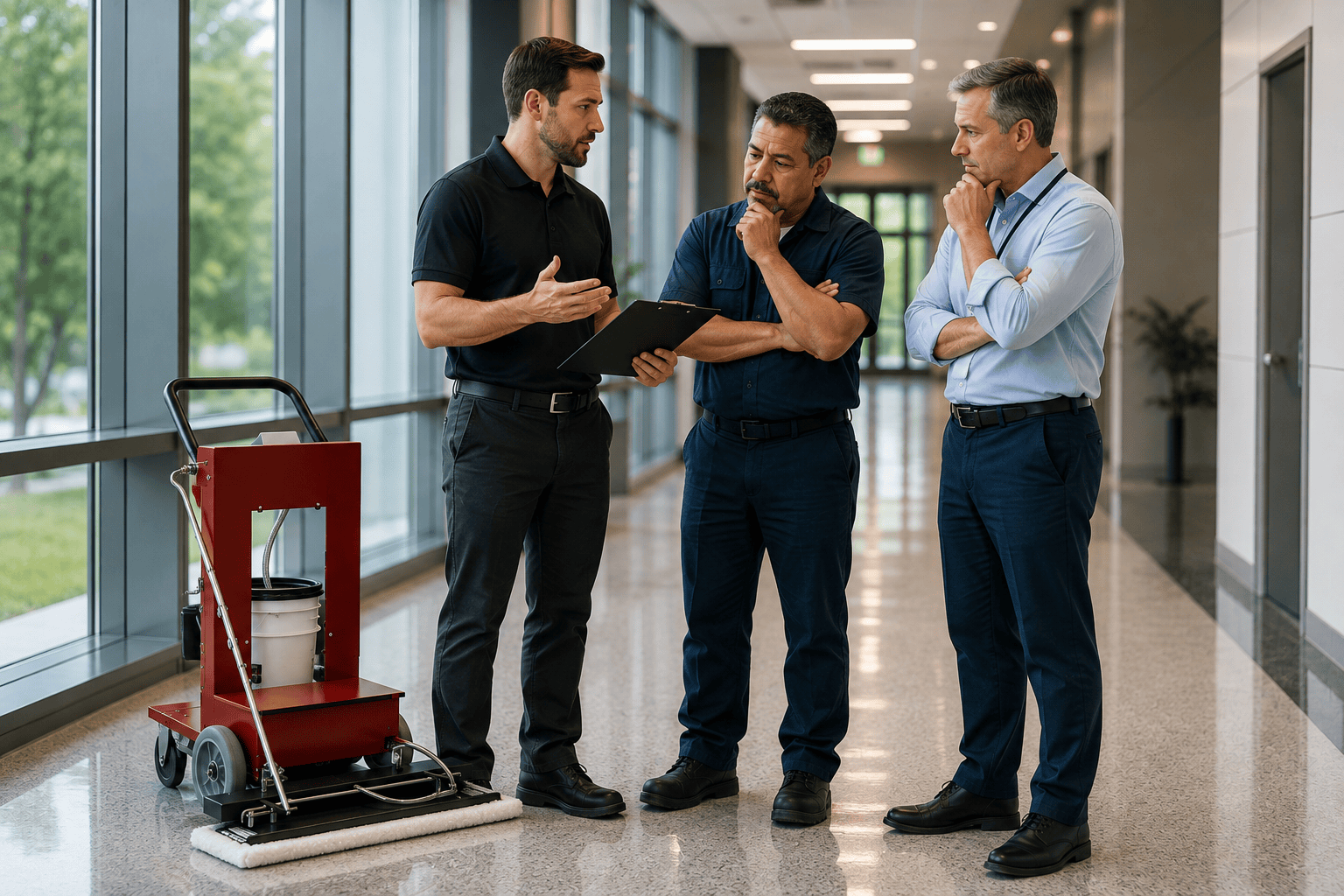
A brochure can tell you how fast equipment is designed to operate.
A specification sheet can describe capacity, dimensions, application width, features, accessories, and intended applications.
A salesperson can explain why a product may improve an existing process.
All of those things are useful.
But none answers the question that ultimately matters inside a working facility:
What happens when we put this solution into our environment, with our employees, our floors, our coatings, our schedules, and our operating constraints?
That is where a real demonstration begins.
And there is an important distinction between showing equipment and testing a solution.
Showing equipment asks:
What does this machine do?
Testing a solution asks:
Does this process improve the operational problem we identified?
The second question is far more valuable.
It also requires more discipline.
A meaningful demonstration needs a baseline.
It needs measurements.
It needs the employee who actually performs the work.
And it needs everyone involved to agree on what success looks like before the new equipment starts moving.
That is the difference between demonstration theater and Operational Intelligence™.
Also Read 📖Why the Best Facility-Service Partners Bring Ideas—Not Just Products
The Demonstration Should Begin Before the Equipment Arrives
One of the biggest mistakes in equipment evaluation happens before the demonstration even starts.
Nobody establishes the baseline.
Suppose a facility wants to evaluate a different way to apply floor finish.
The representative arrives with an Ultra-Trak Plus.
The facility watches it work.
The application looks smooth.
Everyone is impressed by how quickly the representative moves down the hallway.
But afterward someone asks:
How much faster was it?
Nobody knows.
How much finish was used?
Nobody measured it.
How many labor hours did the existing process require?
Nobody recorded them.
Did it reduce employee movement?
Probably—but by how much?
How long did the conventional process take to set up and clean afterward?
Nobody timed it.
Now the customer has an impression rather than evidence.
That is why an Operational Intelligence™ demonstration should actually begin with the current method.
Also Read 📖The New Economics of Facility Cleaning
Step One: Establish the Baseline
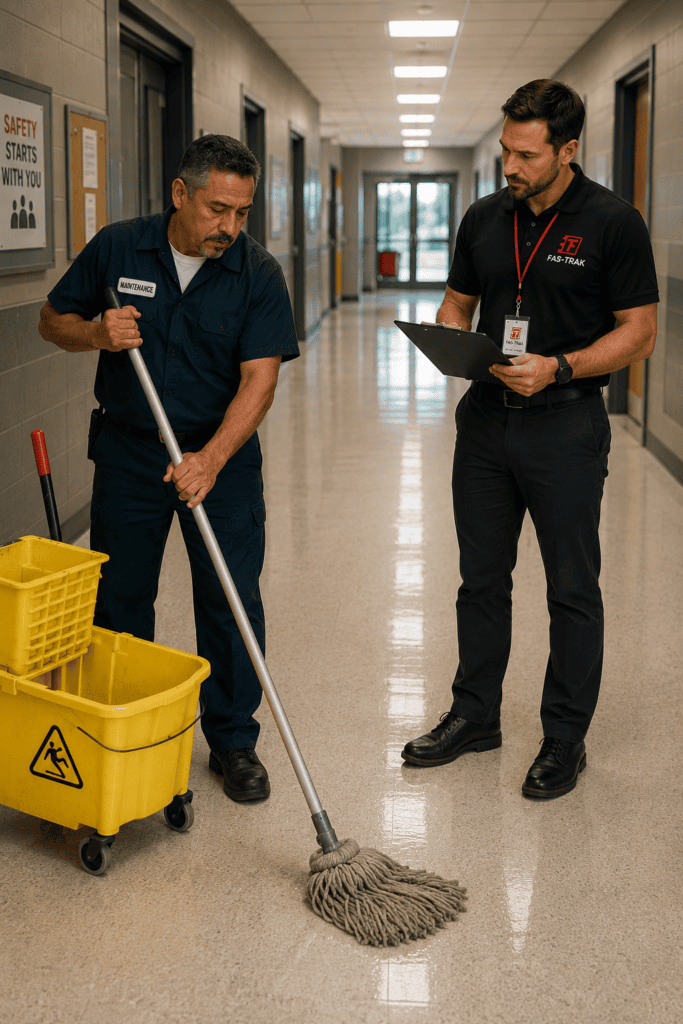
Before testing an alternative, observe the existing process from beginning to end.
Not merely the portion where finish touches the floor.
Start when the employee begins preparing for the task.
Record:
- Equipment retrieval
- Material preparation
- Transport to the work area
- Setup
- Application
- Refilling or reloading
- Walking
- Detail and edge work
- Interruptions
- Touch-up
- Cleanup
- Equipment storage
If possible, measure the amount of material used and the approximate square footage completed.
Talk to the employee performing the work.
Ask:
What part takes the longest?
What part is most physically demanding?
Where do you normally lose time?
What causes inconsistent results?
What part of this process would you change if you could?
Now the facility has something extremely valuable:
A starting point.
Without a baseline, there is nothing meaningful to compare.
Also Read 📖Fas-Trak Labor Savings Analysis | Floor Coating Efficiency & Cost Reduction
Step Two: Define the Operational Problem
This is where Week 2 builds directly on the Operational Intelligence™ approach established in Week 1.
The first facility conversation should identify the problem.
The demonstration should test the proposed answer.
For floor-finishing operations, the problem might be:
- Excessive application time
- Frequent trips to refill or reload
- Too much walking
- Repetitive dipping or manual application
- Inconsistent coating thickness
- Excessive overlap
- Difficulty maintaining a wet edge
- Too much finish being used
- Detail work requiring significant additional labor
- Long cleanup procedures
- Operator fatigue
- Different results between employees
Those are very different problems.
And they may require different evaluation criteria.
A facility concerned primarily with labor should measure time and movement.
A facility struggling with inconsistent appearance should emphasize coverage, application consistency, overlap, and rework.
A facility concerned with ergonomics should closely observe lifting, carrying, bending, repetitive motion, and operator feedback.
The demonstration becomes more meaningful when everyone knows which operational hypothesis is being tested.
Also Read 📖Why Are Cleaning Results Inconsistent? Fas-Tabs Create Controlled Outcomes
Operational Insight™
If you don't establish what success means before a demonstration begins, almost any impressive result can look like success afterward.
Operational Intelligence™ changes the sequence:
Problem → Baseline → Demonstration → Measurement → Comparison → Decision
Not:
Product → Presentation → Impression → Purchase
Step Three: Demonstrate Under Real Conditions

The cleanest, emptiest, easiest hallway in the building may produce a beautiful demonstration.
It may also tell you very little.
If the equipment is being evaluated for a school, test conditions that resemble the school.
If it will be used in healthcare corridors, consider the operational constraints of healthcare corridors.
If the customer needs equipment for tight classrooms, offices, retail spaces, patient areas, or complicated layouts, don't conduct the entire evaluation in an open warehouse simply because it makes the equipment look faster.
The demonstration environment should reflect the intended application.
That means considering:
- Floor type
- Coating or finish being applied
- Hallway width
- Corners
- Doorways
- Furniture
- Obstacles
- Room transitions
- Actual employees
- Typical work windows
- Realistic square footage
The purpose isn't to make the product fail.
It is to discover where it succeeds.
And equally important:
Where it fits.
Cleaning Equipments
Ultra-Trak Plus and Micro-Trak Plus: Demonstrating a System, Not a Race
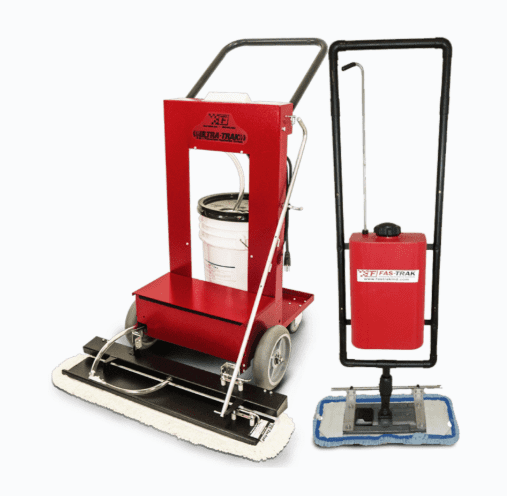
Fas-Trak's current coating-applicator line illustrates why application fit matters.
Ultra-Trak Plus is designed for larger-scale application. Fas-Trak currently states an approximate coating rate of 20,000 square feet per hour under its stated product positioning.
Micro-Trak Plus is a smaller-format system with a 1.5-gallon tank and 5-by-16-inch pad, and Fas-Trak lists an approximate coating rate of 8,000 square feet per hour.
Those specifications provide useful context.
But Operational Intelligence™ asks another question:
What production rate does the facility achieve under its own operating conditions?
A long, unobstructed corridor may favor Ultra-Trak Plus.
A smaller classroom, office, patient area, tight retail space, or detailed section may favor Micro-Trak Plus.
And in some facilities, the strongest workflow may involve both.
Fas-Trak itself positions the two applicators as complementary systems for environments containing both large areas and tighter spaces.
That means a useful demonstration shouldn't necessarily become:
Ultra-Trak versus Micro-Trak.
It can become:
Where does each tool make the most operational sense?
Also Read 📖How Do Ultra-Trak & Micro-Trak Transform Coating Application?
Step Four: Measure the Entire Process—Not Just Production Speed
Square feet per hour matters.
It just isn't the entire equation.
Imagine two processes.
Process A
Moves across the floor quickly but requires:
- Significant setup
- Frequent interruptions
- Separate detail work
- More cleanup
- Additional employee movement
Process B
Has a slightly lower visible application speed but requires:
- Less preparation
- Fewer interruptions
- Less walking
- Less correction
- Faster cleanup
Which is more productive?
You cannot answer from application speed alone.
You need to measure the complete process cycle.
Also Read 📖Fas-Trak Labor Savings Analysis | Floor Coating Efficiency & Cost Reduction
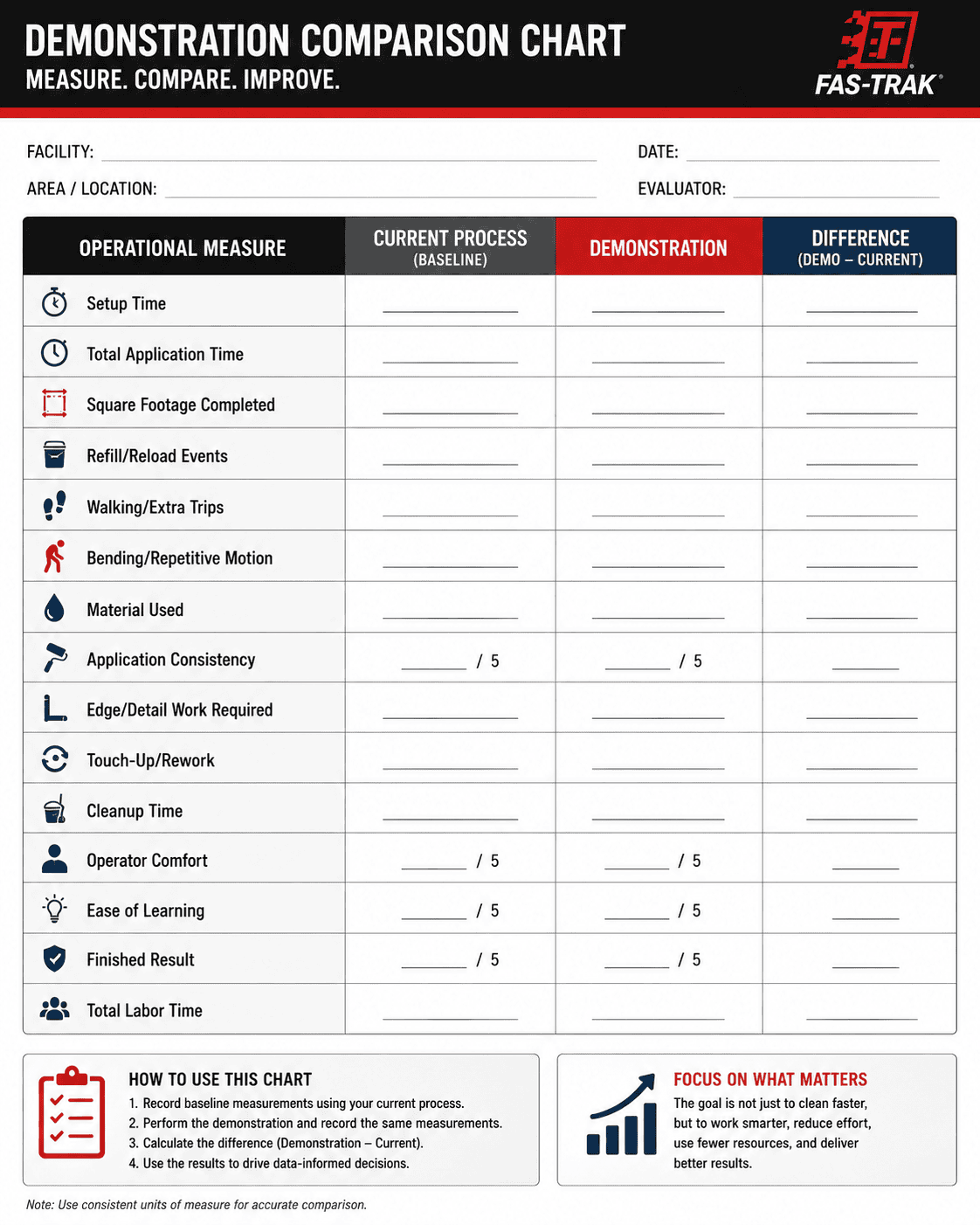
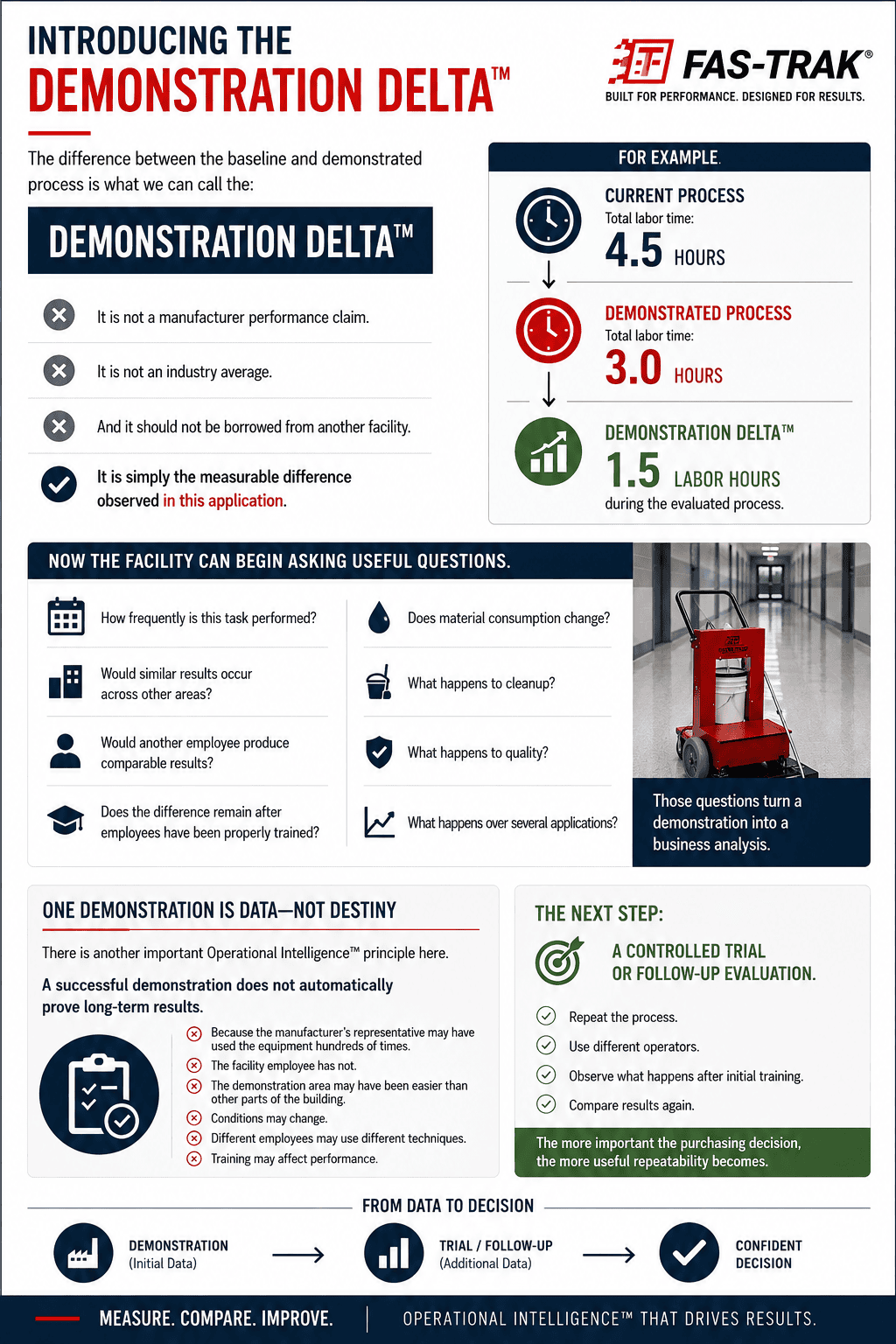
Operational Intelligence™ Real-World Demonstration Scorecard
This is the central evaluation tool for the demonstration.
Record the existing process first.
Then repeat the measurements during the proposed process.
Don't ask:
“Did you like the demonstration?”
Ask:
“What changed—and can we measure it?”
Also Read 📖 How Do I Choose The Right Floor Finish Applicator?
Operator Feedback Is a Measurement
Not every meaningful result fits neatly into a stopwatch.
Employee feedback matters.
Custodial work commonly includes sweeping and mopping, prolonged standing, regular bending, lifting, moving materials, and other physically demanding activities. NIOSH identifies these types of exposures as part of the risk environment faced by cleaning and custodial workers.
OSHA's ergonomics guidance likewise emphasizes worker participation in evaluating workplace conditions and potential improvements.
So during a demonstration, ask the employee:
How does this feel compared with your current method?
What movement disappeared?
What movement was added?
Was the equipment easy to control?
Did you feel rushed?
Was anything awkward?
Would you be comfortable using this for the complete task?
What would you change?
This isn't courtesy feedback.
It is operational data.
If employees dislike a process enough that they avoid using it after the representative leaves, theoretical productivity becomes irrelevant.
Also Read 📖Waste & Waste-Receptacle Management | Longopac System by Fas-Trak
Ergonomics Belongs on the Scorecard
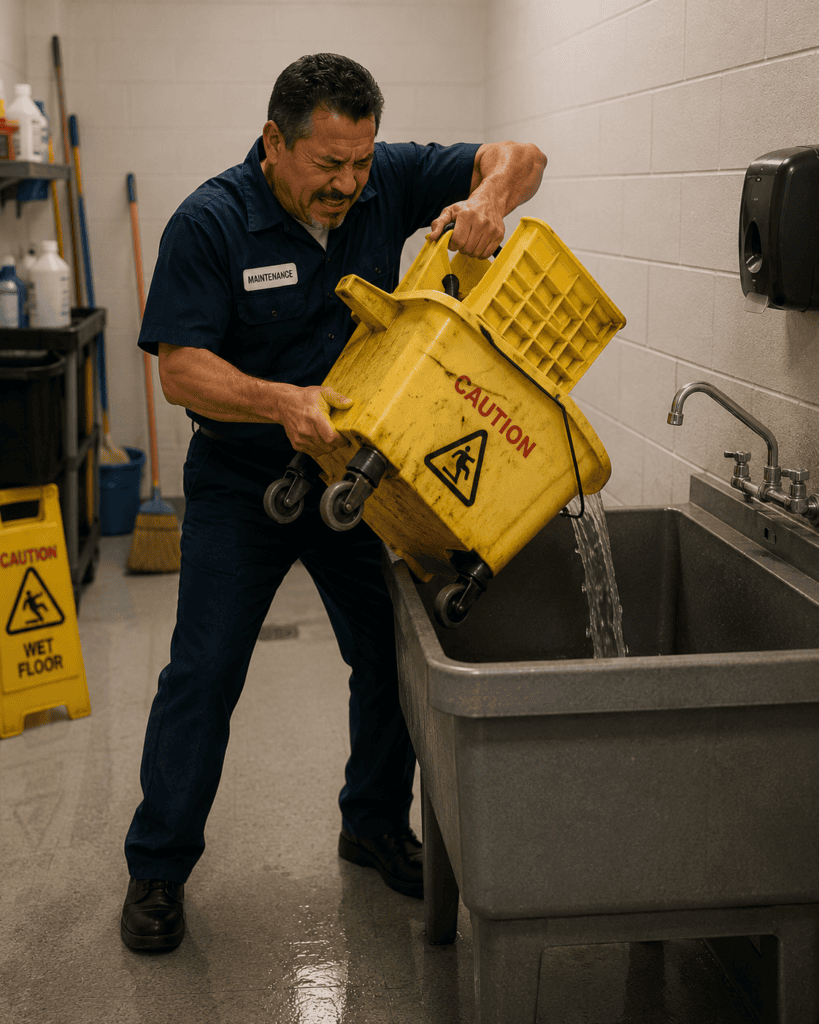
Facility managers sometimes separate ergonomics from productivity.
The two can overlap.
OSHA identifies awkward or static postures, repetitive motion, and significant force among ergonomic risk factors, and its housekeeping guidance recommends restructuring work to reduce repeated motions, forceful exertions, and prolonged bending where practical.
OSHA has also documented an environmental-services example in which a care facility introduced stand-behind and riding cleaning equipment for larger areas to reduce repetitive motion and manual pushing/pulling while also reducing task time.
That does not mean every piece of mechanized equipment automatically improves ergonomics.
It means ergonomics deserves to be measured.
During the demonstration, observe:
- Bending
- Lifting
- Carrying
- Reaching
- Repetitive hand movement
- Pushing and pulling
- Grip
- Turning
- Equipment control
- Fatigue
- Walking distance
A process that saves time by increasing physical demand may not be the improvement the facility thinks it is.
OSHA Ergonomics Explained
Material Use Should Be Measured Too
Labor isn't the only variable.
When evaluating coating application, record how much material is used.
Not because the objective should automatically be to use the least possible finish.
The objective is to use the appropriate amount consistently.
Too little may compromise results.
Too much may increase material cost, drying time, and application inconsistency.
The Ultra-Trak operating instructions describe a metered dispensing process in which wheel movement activates the pump while the unit is being pulled, with flow adjusted according to application conditions. The manual also emphasizes maintaining a wet edge and appropriate overlap.
That creates another measurable demonstration question:
Can the operator achieve consistent application while maintaining appropriate material control?
Don't assume.
Measure.
Also Read 📖Cleaning Equipment Made in America? Yes, it’s Still Happening at Fas-Trak
Training Changes Demonstration Results
This point cannot be ignored.
If a representative who has operated an Ultra-Trak hundreds of times competes against a custodian using a conventional method they have performed for years, the comparison isn't entirely equal.
The representative has product-specific experience.
So the demonstration should include training.
Let the employee operate the equipment.
Observe the learning curve.
Correct technique.
Then measure again.
Ask:
- How quickly does the employee understand setup?
- Can they maintain the correct path?
- Can they control application consistently?
- Can they navigate corners and transitions?
- Do they understand adjustment?
- Can they clean and store the equipment correctly?
- Can they repeat the process without constant coaching?
A system that produces excellent results only when operated by the manufacturer's expert may not produce the same value after implementation.
The customer's employee needs to become part of the proof.
Also Read 📖Case Study: How Schools & Universities Cut Cleaning Time with Ultra-Trak + Micro-Trak
The Best Demonstration May Reveal That the Product Isn't the Right Fit
This is where trust becomes interesting.
Suppose the demonstration reveals:
- No meaningful time improvement
- Difficult maneuverability in the actual environment
- More cleanup than expected
- Poor operator acceptance
- No improvement in quality
- An application mismatch
What should the representative do?
Say so.
A credible demonstration is allowed to produce an inconvenient result.
Because the objective isn't:
Prove the product is right.
It is:
Determine whether the solution is right.
That distinction can build more trust than a perfect sales presentation ever could.
A representative willing to say:
“I don't think this is the best application for this equipment.”
has just demonstrated something far more valuable than a feature.
They have demonstrated judgment.
Contact Fas-Trak
Distributor & Representative Insight™
Stop Demonstrating Products. Start Testing Operational Hypotheses.
Before scheduling a demonstration, write down one sentence:
We believe this solution may improve __________ by __________.
Examples:
We believe this application system may reduce refill interruptions.
We believe this process may improve application consistency.
We believe this equipment may reduce total labor time.
We believe this method may reduce repetitive manual activity.
We believe combining Ultra-Trak Plus and Micro-Trak Plus may improve workflow across both large and detailed areas.
Then determine what must be measured to test that statement.
This changes the representative's role.
You are no longer simply performing a demo.
You are helping the customer conduct a small operational experiment.
And that is a much more valuable reason to walk through the door.
Coating Applicators

What a Great Demonstration Actually Builds
Yes, demonstrations can build trust.
But not simply because customers get to see equipment operate.
Trust comes from the way the demonstration is conducted.
When the representative:
- Measures the current process
- Defines the problem
- Sets realistic expectations
- Uses the customer's environment
- Includes frontline employees
- Records the results
- Discusses limitations
- Provides training
- Returns afterward
the customer sees something different.
They see a partner willing to let the evidence participate in the sale.
That's powerful.
Professional Perspective: Evidence Is More Persuasive Than Enthusiasm
There will always be a place for enthusiasm in sales.
People should believe in the products they represent.
But enthusiasm is not evidence.
Specifications are not facility results.
And a beautifully rehearsed demonstration is not the same thing as an operational evaluation.
Facility managers are responsible for budgets, employees, schedules, quality, safety, and outcomes.
They deserve more than:
“Trust us. This is faster.”
Give them the stopwatch.
Give them the scorecard.
Let their employees use the equipment.
Measure the current method.
Measure the alternative.
Look at the difference together.
Then have the purchasing conversation.
That is how Operational Intelligence™ turns a product demonstration into a decision-making tool.
Also Read📖Can ACTIV8 Cut Commercial Vacuuming Time by 50%—and What Does That Mean for Your Margins?
From Claims to Proof
Week 1 of the Fas-Trak Operational Intelligence™ series began with a simple idea:
Understand the customer's operation before recommending the product.
Week 2 takes the next step:
Once the problem has been identified, prove whether the proposed solution actually improves it.
That is why the best equipment demonstrations do more than showcase features.
They establish a baseline.
They test the equipment under real conditions.
They involve the people doing the work.
They measure the complete process.
They expose limitations.
And they create evidence that the customer can use to make a better decision.
Fas-Trak works with distributors, manufacturers' representatives, and facility teams to turn equipment demonstrations into practical operational evaluations.
With solutions such as Ultra-Trak Plus and Micro-Trak Plus, the objective isn't merely to show how quickly an applicator can travel across a floor.
It is to determine whether the complete application process becomes more productive, consistent, manageable, and appropriate for the facility.
Don't sell the claim. Measure the difference.
Ready to Put the Process to the Test?
If your facility or customer is evaluating a different approach to floor coating application, start with the current process.
Measure it.
Then put the alternative beside it.
Talk with Fas-Trak about an Ultra-Trak Plus or Micro-Trak Plus demonstration built around your facility, your application, and the operational results that matter to your team.
☎️Contact Fas-Trak

