

The New Economics of Facility Cleaning: How Smarter Systems Improve Labor, Safety, Quality, and Cost Control
Operational Intelligence™
60-Second Executive Brief
The Operational Challenge
Many facility cleaning programs are still evaluated primarily through product prices, equipment budgets, and completed task lists. Those numbers matter—but they do not reveal the full operational cost of cleaning.
Walking, bending, refilling, setup, cleanup, repetitive movement, inconsistent application, chemical waste, callbacks, retraining, downtime, and unfinished detail work can quietly consume labor and reduce quality.
The real question is not simply:
“How much does this equipment cost?”
It is:
“How much does the entire cleaning process cost every time it is performed?”
Why It Matters
- Labor is frequently consumed by movement and correction work that does not directly improve the facility.
- Familiar methods may continue for years without being objectively measured.
- Equipment, training, chemical control, ergonomics, and quality assurance must be evaluated as parts of one connected system.
Facility Manager Takeaway
Select one recurring cleaning process and observe it from preparation through final cleanup. Record every refill, interruption, extra trip, correction, and repeated step. The hidden cost may not be where the facility expects to find it.
For Distributors and Representatives
Operational reviews create stronger customer conversations than product presentations because they begin with the customer’s workflow, employees, and measurable challenges.
Read More ⬇️⬇️⬇️⬇️
Estimated Read Time
12–14 minutes
The Most Expensive Cleaning Process May Look Completely Normal
Every facility has processes that rarely receive serious scrutiny.
A floor finish is applied the same way it has been applied for years. Waste liners are replaced according to habit rather than actual volume. Employees use ladders to reach overhead surfaces because that is how the task has always been performed. Restroom products are purchased separately without considering how air movement, hand drying, surface care, odor, touchpoints, and waste handling interact.
The work gets completed.
That does not necessarily mean the process is efficient.
A familiar cleaning method can conceal:
- Excessive walking
- Repeated refilling
- Unnecessary bending
- Long setup times
- Chemical overapplication
- Incomplete edge work
- Uneven results
- Consumable waste
- Operator fatigue
- Callbacks and touch-up
- Training inconsistencies
- Avoidable equipment downtime
Because these losses often occur in small increments, they rarely appear as a single dramatic expense.
Thirty seconds here, two minutes there, one additional trip to a supply closet, another pass over an unevenly finished area—none appears serious in isolation.
Multiplied across employees, shifts, buildings, and an entire year, they become an operating system.
And sometimes, an expensive one.
Also Read 📖Effective Strategies for Reducing Cleaning Staff Turnover
In This Operational Intelligence™ Brief
- Why traditional cleaning budgets hide operational waste
- How labor, safety, sustainability, and quality affect one another
- What facility leaders should measure
- Why purchase price is not the same as process cost
- How demonstrations should be evaluated
- Where equipment and workflow innovation can help
- How distributors can become stronger operational partners
- A facility cleaning process scorecard
Cleaning Is Not a Collection of Products
Facilities do not purchase vacuums, applicators, waste liners, restroom products, brushes, pads, and chemicals simply to own them.
They purchase them to produce outcomes.
Those outcomes may include:
- Clean and presentable buildings
- Safer work environments
- Consistent floor appearance
- Reduced complaints
- Efficient staffing
- Controlled chemical use
- Reliable restroom hygiene
- Reduced physical strain
- Better indoor environmental conditions
- Predictable operating costs
Yet many purchasing decisions are made one product at a time.
A vacuum is compared with another vacuum. A liner is compared with another liner. A coating applicator is compared with a mop-and-bucket process. A hand dryer is compared with paper towels.
That can be useful, but it can also be dangerously incomplete.
The cheapest component does not always create the least expensive process.
A lower-cost tool may require:
- More labor
- More employee movement
- More refilling
- More training
- More consumables
- More chemical
- More correction work
- More frequent replacement
- Greater supervisory attention
Conversely, a more advanced system may have a higher initial price but reduce recurring expenses every time the process is performed.
That is why operational purchasing requires a broader question:
What happens before, during, and after the equipment is used?
Also Read 📖What Are Pro-Tabs & Why Are They Transforming Commercial Cleaning?
The Five Connected Costs of Facility Cleaning

A cleaning process should be evaluated across at least five operational categories.
1. Direct Labor
Direct labor includes the time employees spend completing the assigned task.
However, task time should not begin only when the cleaning tool touches the surface.
It should include:
- Retrieving equipment
- Gathering supplies
- Mixing or loading solution
- Transporting equipment
- Setting up the work area
- Completing the task
- Refilling
- Changing pads, liners, filters, or accessories
- Correcting missed areas
- Cleaning the equipment
- Returning and storing it
A tool that appears fast during operation may still support a slow overall process if preparation and cleanup are cumbersome.
2. Process Waste
Process waste is any activity that consumes time, material, or effort without meaningfully improving the outcome.
Examples include:
- Walking back to a supply room
- Carrying excess solution
- Using more liner material than the waste requires
- Applying more chemistry than the surface needs
- Repeating areas because application was uneven
- Waiting for unavailable equipment
- Replacing dried-out wipes
- Correcting edges after the main task is complete
- Recleaning surfaces after complaints
The employee may remain busy throughout the shift, but busyness is not the same as productive work.
3. Physical Demand and Exposure
A process can achieve acceptable results while placing unnecessary demands on employees.
Common examples include:
- Repetitive triggering
- Lifting and carrying solution
- Bending
- Reaching
- Twisting
- Pushing poorly balanced equipment
- Managing electrical cords
- Working from ladders
- Handling contaminated waste
- Repeating the same motion over large areas
Physical effort should not be dismissed as an unavoidable part of custodial work.
The better question is:
Which movements are necessary to clean the facility, and which movements are simply consequences of the current process?
4. Consumables and Chemistry
Chemical cost is not determined solely by the price of a container.
It is affected by:
- Dilution accuracy
- Application rate
- Overspray
- Excessive overlap
- Solution left in tanks or buckets
- Product drying before use
- Disposable packaging
- Wipe consumption
- Liner size
- Operator technique
- Reapplication caused by inconsistent results
A small amount of waste repeated across a large facility can become a meaningful expense.
5. Quality Failure
Quality failure is among the least visible cleaning expenses because it often appears in other places.
It may show up as:
- Customer complaints
- Supervisor inspections
- Callbacks
- Touch-up work
- Repeated training
- Inconsistent appearance between shifts
- Premature coating failure
- Missed edges
- Unresolved odors
- Mineral buildup
- Dust remaining on elevated surfaces
Rework does not merely repeat labor. It disrupts schedules, consumes management attention, and weakens confidence in the cleaning program.
Also Read📖Enhancing Custodial Staff Skills for Better Service Quality
Why Familiar Processes Escape Scrutiny
Operational inefficiency is not always caused by poor management or careless employees.
Often, it survives because the system makes it difficult to see.
1. “We Have Always Done It This Way”
Longstanding processes develop an appearance of legitimacy.
Employees learn them. Supervisors plan around them. Supply closets are organized to support them. Budgets repeat the same purchasing patterns.
Eventually, the method stops appearing to be a choice.
It becomes “the way the building is cleaned.”
2. The Cost Is Divided Across Different Budgets
A process may involve equipment, labor, chemicals, consumables, maintenance, training, and waste disposal.
If each cost is tracked separately, no one sees the complete expense.
A less expensive machine may increase labor. A cheaper liner may increase plastic use. An inexpensive applicator may produce inconsistent coverage and require more coating.
Each department sees only one piece.
3. Employees Quietly Compensate
Experienced custodial employees are often remarkably skilled at making imperfect systems work.
They develop shortcuts. They carry extra supplies. They make additional passes. They adjust for uneven output. They remember which machine has a problem.
That adaptability is valuable—but it can also hide process failure.
The system appears functional because employees absorb the inefficiency.
4. Rework Is Rarely Labeled as Rework
A supervisor may describe repeated work as:
- A touch-up
- A quick correction
- A return visit
- A customer request
- A missed spot
- A normal part of the job
Unless the time is tracked, rework disappears into the schedule.
Also Read 📖How Spray Power Cleaning Systems Help Schools Clean Faster with Less Labor
Operational Insight
The true cost of a cleaning process is the combined cost of labor, movement, materials, training, maintenance, risk, supervision, and correction—not merely the price of the product used to perform it.
That principle is the foundation of the Fas-Trak Operational Intelligence™ series.
Labor Productivity Is Not About Pushing Employees Harder
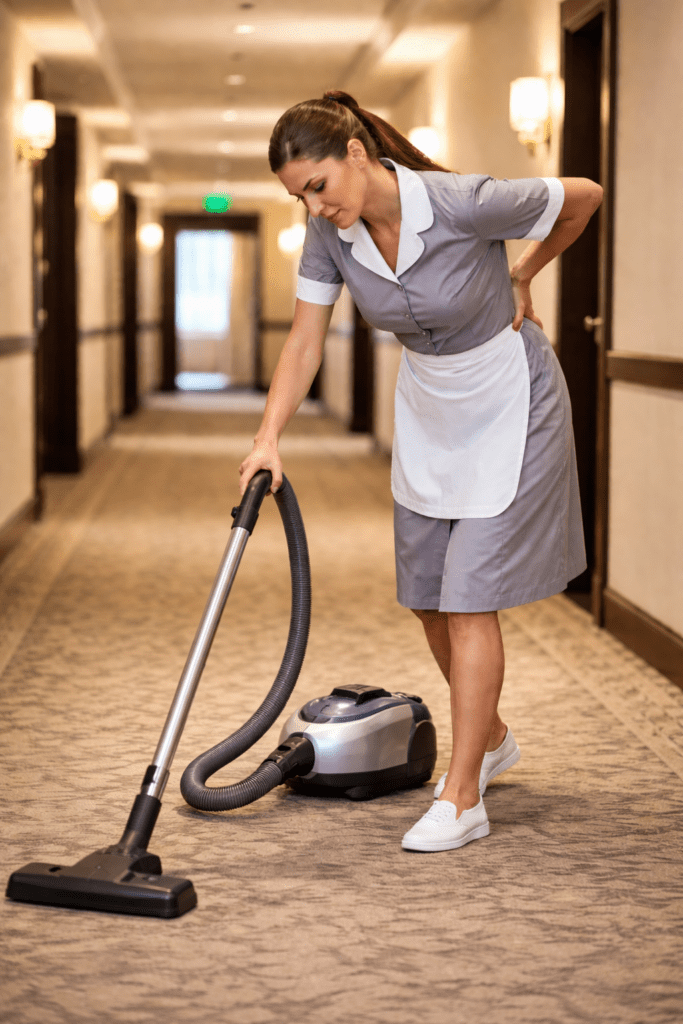
When staffing is limited, management may feel pressure to increase production.
Unfortunately, the message employees sometimes hear is:
“You need to work faster.”
That approach can damage morale without correcting the process that caused the problem.
A more productive question is:
“What prevents employees from completing this work efficiently?”
The answer may involve:
- A narrow cleaning path
- A small onboard solution capacity
- Frequent refilling
- Excessive walking
- Cord management
- Poor equipment balance
- Repetitive hand movement
- Difficult edge access
- Multiple single-purpose tools
- Complicated setup
- Inconsistent instructions
- Lack of follow-up training
Better workflow should remove unnecessary effort.
It should not simply increase expectations.
A well-designed system can allow employees to cover more space because the task contains fewer interruptions, fewer correction steps, and less wasted movement.
That is very different from demanding that the same employee perform an inefficient process at a faster pace.
Also Read 📖Can ACTIV8 Cut Commercial Vacuuming Time by 50%—and What Does That Mean for Your Margins?
Ergonomics Is an Operational Issue
Ergonomics is sometimes treated as a secondary benefit—something considered after productivity and price.
In practice, ergonomics affects both.
Equipment that is difficult to maneuver, refill, adjust, carry, trigger, or clean may:
- Slow the employee
- Increase fatigue
- Reduce consistency
- Create resistance to adoption
- Encourage shortcuts
- Require additional breaks
- Increase the likelihood of the equipment being abandoned
A product can perform well in a controlled demonstration and still fail in daily use if employees find it difficult or uncomfortable.
That is why the operator must participate in the evaluation.
Managers should observe:
- Posture
- Grip
- Reach
- Turning
- Pushing force
- Bending
- Lifting
- Carrying
- Cord handling
- Repetitive movement
- Ease of adjustment
- End-of-task fatigue
The fastest tool is not necessarily the one with the highest advertised production rate.
It may be the one employees can use correctly, comfortably, and consistently throughout the shift.
Also Read 📖Is a Cordless Wide Area Vacuum the Key to Cutting Labor Costs?
Sustainability Begins with Operational Control
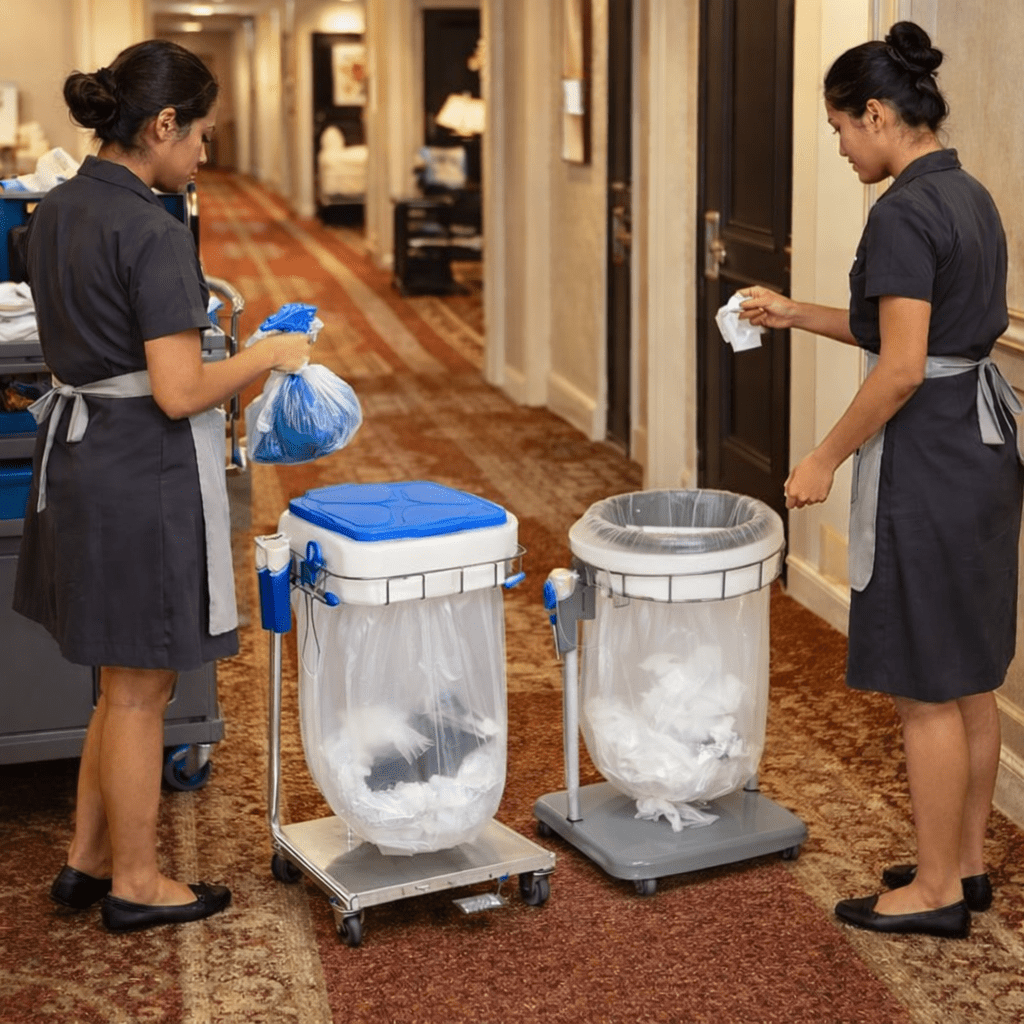
Sustainability conversations often begin with chemical ingredients or packaging.
Those issues matter, but environmental performance is also shaped by process design.
Consider the operational consequences of:
- Oversized waste liners
- Dried-out pre-moistened wipes
- Excess chemical application
- Unnecessary overlap
- Disposable materials used before their capacity is reached
- Premature equipment replacement
- Recleaning
- Uncontrolled dispensing
- Poor dilution
- Product left unused in buckets or tanks
Waste is frequently created by imprecision.
A controlled system can help employees use:
- The correct amount
- In the correct location
- At the correct time
- For the correct task
That is why sustainability and quality control often support one another.
Better control can reduce waste while producing more repeatable results.
Also Read📖 Waste & Waste-Receptacle Management | Longopac System by Fas-Trak
Mechanical Action Should Be Evaluated Before Stronger Chemistry
When a surface remains difficult to clean, the automatic response may be to use more chemical, a stronger concentration, or a more aggressive product.
That is not always the best answer.
Cleaning performance depends on several interacting factors:
- Soil type
- Surface type
- Chemistry
- Dwell time
- Temperature
- Mechanical action
- Tool selection
- Operator technique
Mineral deposits, soap film, embedded soil, edges, textured surfaces, and difficult grout lines may require better mechanical contact rather than simply more chemistry.
Facility leaders should ask:
- Is the chemical appropriate for the soil?
- Is adequate dwell time being provided?
- Is the pad or brush reaching the surface effectively?
- Is the employee applying enough mechanical action?
- Could a specialized tool reduce the need for repeated chemical application?
- Is the current process treating the symptom rather than the cause?
This approach can improve results while reducing unnecessary chemical exposure and consumption.
Quality Control Requires More Than Inspection

Inspections usually occur after the work has been completed.
By that point, the process has already succeeded or failed.
True quality control begins earlier.
It includes:
- Standardized preparation
- Correct dilution
- Consistent equipment setup
- Defined application rates
- Appropriate pad or brush selection
- Visual SOPs
- Operator training
- Repeatable movement patterns
- Equipment maintenance
- Clear inspection criteria
- Follow-up coaching
When results vary from shift to shift, management should avoid immediately blaming the employee.
Variation may be built into the process.
For example:
- One employee mixes a stronger solution
- Another applies more pressure
- One overlaps each pass heavily
- Another moves too quickly
- One pad is new
- Another is worn
- One employee received hands-on training
- Another watched for only a few minutes
If the method relies heavily on individual judgment, results will vary.
Standardization does not remove professional skill. It gives that skill a reliable framework.
Also Read 📖Why Are Cleaning Results Inconsistent? Fas-Tabs Create Controlled Outcomes
Standout Element: Facility Cleaning Process Scorecard
Use this scorecard to evaluate one cleaning process at a time.
Score each category from 1 to 5:
- 1: Serious operational weakness
- 2: Below expectations
- 3: Acceptable but inconsistent
- 4: Strong performance
- 5: Highly controlled and repeatable

Interpreting the Score
- 52–60: Strong, controlled process
- 42–51: Generally effective with targeted opportunities
- 30–41: Significant inconsistency or hidden cost
- Below 30: Process review and demonstration strongly recommended
This scorecard is not intended to produce a universal purchasing decision. It is designed to help a facility compare its current method with a proposed alternative under real operating conditions.
Purchase Price Is Not Payback Period
The price of cleaning equipment is visible.
The cost of inefficient labor is often not.
A simple payback analysis should consider:
- Initial equipment cost
- Labor hours saved
- Consumables avoided
- Chemical reduction
- Rework reduction
- Expected service life
- Maintenance
- Training
- Productivity consistency
- Downtime
- Residual or replacement value
A basic illustrative formula is:
Payback Period = Net Investment ÷ Estimated Monthly Operating Savings
For example, suppose a new process requires a net investment of $6,000 and is estimated to reduce documented operating costs by $1,000 per month.
The illustrative payback period would be:
$6,000 ÷ $1,000 = 6 months
That calculation is only useful when the savings assumptions are based on actual facility observations.
Facilities should avoid using generalized claims where local time studies are possible.
Measure the current process first.
Then test the alternative.
Why Demonstrations Matter

Product literature can explain features.
It cannot fully reveal application fit.
A meaningful demonstration allows a facility to evaluate:
- The actual building
- The actual surface
- The actual soil
- The actual employee
- The actual workflow
- The actual result
That dramatically reduces uncertainty.
A demonstration should not be staged solely to make the equipment look impressive.
It should answer practical questions.
What to Look for During a Demonstration
- How long does setup take?
- Can operators adjust the equipment easily?
- How many refills are required?
- How much walking is eliminated or added?
- Does the system reduce bending or carrying?
- Is application controlled?
- Are edges completed?
- How consistent is the finished result?
- How long does cleanup take?
- What training is required?
- How does the employee feel after using it?
- Can the process be repeated by another operator?
- What maintenance and parts support are available?
- What happens after the sale?
The best demonstration is not merely impressive.
It is measurable.
Where Fas-Trak Fits into the Operational Conversation
Fas-Trak’s product families address different parts of the complete facility cleaning system.
The 20-article plan includes coating application, vacuuming, mechanical cleaning, high dusting, waste handling, controlled wipes, restroom care, odor management, training, and service after the sale.
Examples include:
Coating Application
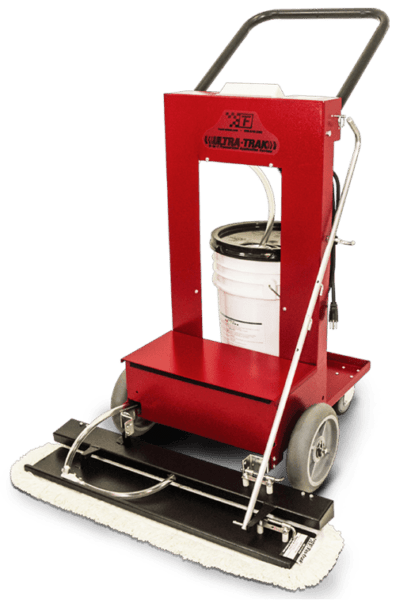
Ultra-Trak and Micro-Trak systems can be evaluated for:
- Application consistency
- Labor movement
- Solution handling
- Coverage
- Refill frequency
- Edge completion
- Setup and cleanup
- Operator fatigue
The operational conversation should not be limited to how quickly the equipment moves.
It should examine the complete coating process.
Vacuuming and Floor Care
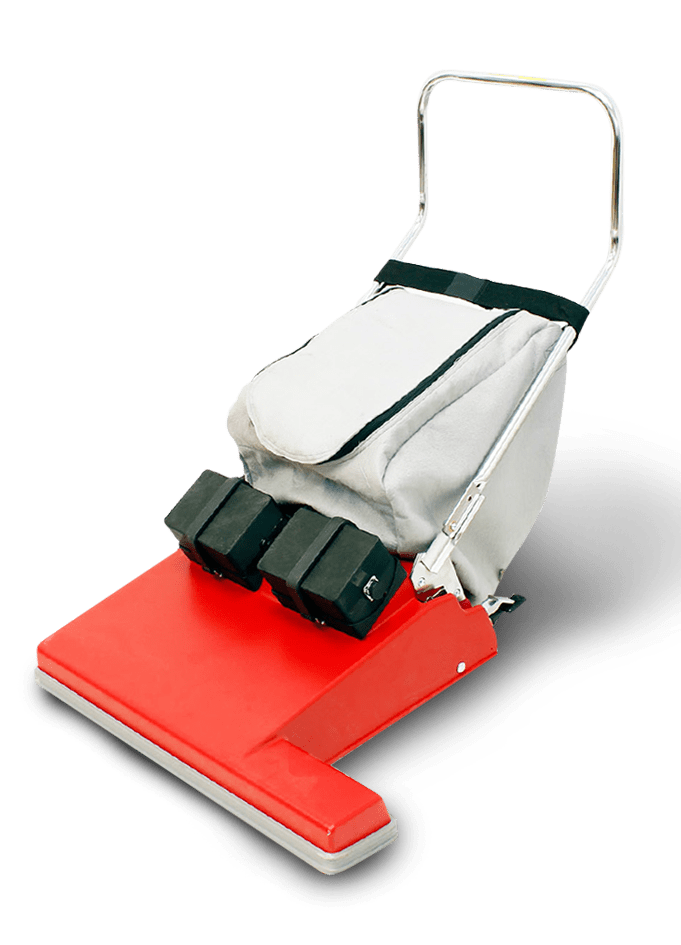
Fas-Vac and ACTIV8 can be evaluated for:
- Cleaning path
- Cord management
- Route efficiency
- Operator movement
- Production rate
- Accessibility
- Training
- Finished appearance
Elevated and Detailed Cleaning

Clean Spin, Fluid 3D, Fas-Edge, and related systems can support discussions about:
- Ladder reduction
- Floor-level access
- Edge completion
- Difficult surfaces
- Repetitive movement
- Mechanical cleaning
- Specialized detail work
Waste and Consumable Control

Longopac, REVA, Fas-Tabs, and ProTab Wipers can be evaluated for:
- Material use
- Plastic consumption
- Hygienic handling
- Waste-liner sizing
- Wipe control
- Product drying
- Dispensing consistency
- Storage efficiency
Restroom and Environmental Care

Pebble+, odor-control products, Rapid OC, Scale Away, UV-400, and related products can form part of a broader restroom or facility assessment.
The key is to avoid evaluating each item in isolation.
Restroom performance is affected by:
- Surface care
- Air movement
- Waste
- Odor
- Hand drying
- Touchpoints
- Mineral buildup
- Cleaning frequency
- User behavior
The right solution depends on the complete environment.
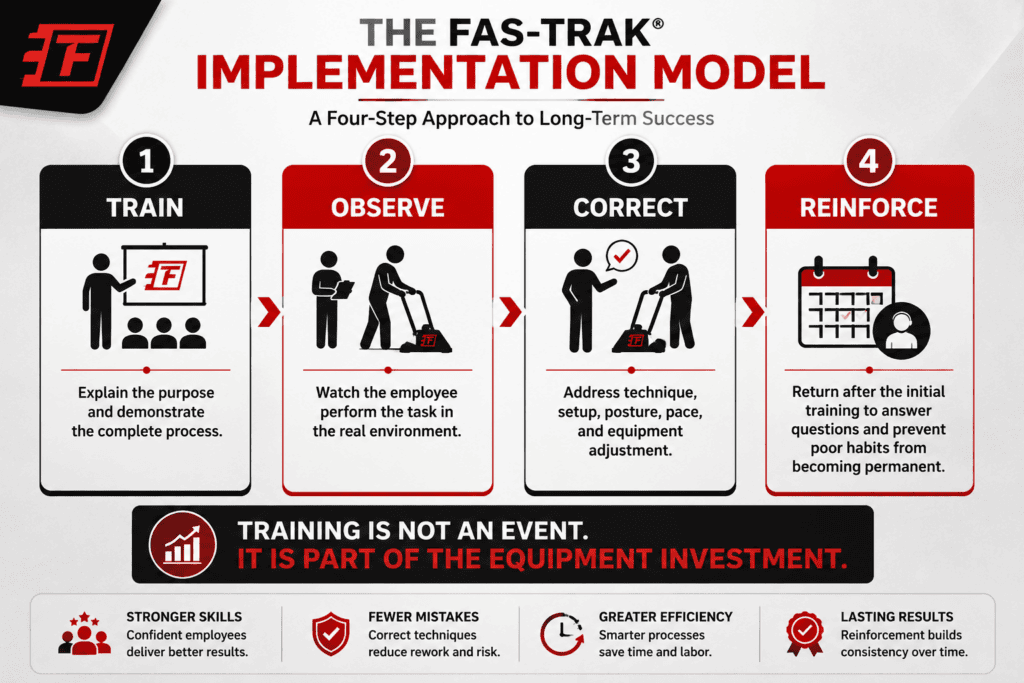
The First 30 Minutes of Training Matter
A new tool does not automatically create a new process.
Employees must understand:
- Why the process is changing
- How to set up the equipment
- How to adjust it
- How to use it correctly
- What good results look like
- How to clean it
- How to store it
- What to do when something goes wrong
Training that focuses only on buttons, switches, and assembly leaves out the most important question:
Why is this method better for the employee and the facility?
Employees are more likely to adopt equipment when they understand how it can reduce:
- Walking
- Refilling
- Carrying
- Repetition
- Corrections
- Physical strain
- Frustration
Service After the Sale Is Part of the Product
A product cannot produce long-term value when employees cannot obtain:
- Replacement parts
- Technical guidance
- Refresher training
- Troubleshooting
- Updated procedures
- Application support
- Maintenance information
This is especially important for distributors and manufacturers’ representatives.
Customers may remember the demonstration, but relationships are often won after the sale.
A consultative partner should continue asking:
- Is the equipment being used?
- Are employees following the process?
- Are expected results being achieved?
- Have conditions changed?
- Is additional training needed?
- Are consumables or parts readily available?
- Has the facility measured the outcome?
The sale should begin the operational relationship—not end it.
Also Read 📖Case Study: How Schools & Universities Cut Cleaning Time with Ultra-Trak + Micro-Trak
Distributor and Representative Insight

The strongest facility conversations rarely begin with:
“Would you like to see our newest product?”
They begin with questions.
Examples include:
- Which cleaning task creates the most employee frustration?
- Where does your team spend the most time walking or refilling?
- Which complaints return repeatedly?
- Which process varies most between shifts?
- Where are employees using ladders?
- Which consumables are being discarded before they are fully used?
- Which equipment is frequently left in storage?
- Where is rework accepted as normal?
- Which process has never been formally timed?
- What changed after your last equipment purchase?
These questions move the relationship from product supply to operational problem-solving.
They also create appropriate opportunities for:
- Facility walkthroughs
- Educational presentations
- Side-by-side trials
- Time studies
- Process scorecards
- Operator feedback
- ROI reviews
- Follow-up training
A distributor who brings useful questions becomes more difficult to replace than one who brings only a catalog.
Also Read 📖Cleaning Equipment Made in America? Yes, it’s Still Happening at Fas-Trak
Facility Operational Review Checklist
Use this checklist before changing a cleaning process or purchasing new equipment.
Observe the Current Process
- Watch the task from preparation through storage
- Record setup and cleanup time
- Count refill trips
- Note walking, bending, lifting, reaching, and repetitive movement
- Identify delays and interruptions
- Record edge and detail work
- Ask employees where frustration occurs
Measure the Current Cost
- Calculate direct labor time
- Measure chemical use
- Measure consumable use
- Record rework
- Track complaints
- Review equipment downtime
- Include maintenance and replacement costs
Evaluate an Alternative
- Use the actual facility environment
- Involve frontline employees
- Compare complete processes
- Measure setup, operation, and cleanup
- Evaluate ergonomics
- Review training requirements
- Compare finished results
- Confirm parts and service support
Follow Through
- Create a visual SOP
- Train all affected employees
- Observe initial use
- Correct technique early
- Reevaluate after 30 days
- Document actual savings and outcomes
Professional Perspective
The future of facility cleaning will not be defined by asking employees to perform outdated processes faster.
It will be shaped by leaders who understand how labor, equipment, chemistry, consumables, ergonomics, training, and quality control function together.
Innovation does not always mean purchasing the most advanced product available.
Sometimes it means:
- Measuring a process that has never been measured
- Removing one unnecessary trip
- Replacing guesswork with controlled dispensing
- Selecting mechanical action before adding more chemistry
- Giving employees a better way to reach a difficult surface
- Standardizing a process between shifts
- Right-sizing the materials being consumed
- Providing training that continues after deployment
The goal is not novelty.
The goal is a process that can be performed safely, consistently, economically, and repeatedly.
Facility-Service Innovation Begins with the Problem
Facility-service innovation rarely begins with a product presentation. It begins by recognizing an operational problem from an angle the customer may not yet have considered.
Fas-Trak works with distributors and manufacturers’ representative groups to turn those insights into productive demonstrations, educational presentations, and measurable customer solutions.
For partners seeking new reasons to open doors and begin meaningful facility conversations, Fas-Trak provides both the innovation and the practical support needed to make those opportunities count.
Also Read 📖Why Hand Drying Impacts Restroom Hygiene More Than You Think
Ready to Evaluate the Process—Not Just the Product?
A product demonstration should do more than show what equipment can do.
It should reveal whether the complete process becomes:
- More efficient
- Easier to perform
- More consistent
- Less wasteful
- More manageable for employees
- More economical to sustain
Contact Fas-Trak to arrange a product demonstration, educational presentation, or process-focused facility conversation.
Fas-Trak works with distributors, manufacturers’ representatives, and facility teams to identify operational challenges, evaluate practical solutions, support employee training, and build stronger results after the sale.
☎️Contact Fas-Trak

