

Every Summer, School Maintenance Teams Face the Same Race Against Time

By the time students leave for summer break, the clock is already ticking.
Hallways need to be stripped and refinished. Classroom floors need attention. Administrative offices, cafeterias, and common areas all have to be cleaned, restored, and ready before staff and students return.
But while facilities continue getting larger, maintenance departments are often being asked to do the work with:
- fewer people
- tighter budgets
- shorter turnaround windows
That pressure shows up quickly during floor finishing projects.
A crew may start the summer schedule feeling confident, but after several long days of:
- correcting overlap lines
- reworking uneven finish
- stopping constantly to reposition equipment
- fighting inconsistent application paths
…production slows down.
Fatigue increases. Timelines tighten. Small inefficiencies become major labor problems across an entire campus.
And that’s where many traditional floor finishing systems begin to break down.
Large school hallways and classroom wings demand something different:
smoother workflow
controlled application
production consistency
and systems designed for continuous movement instead of constant correction.
That’s where Ultra-Trak systems are changing how schools approach large-area floor finishing.
Large Facilities Expose Workflow Inefficiencies Quickly
Small inefficiencies don’t stay small in large school facilities.
A minor overlap issue in a classroom becomes a major labor problem across:
- multiple hallways
- several classroom wings
- entire school campuses
This is where many maintenance teams begin losing production time.
Common workflow problems include:
- repeated overlap correction
- inconsistent finish thickness
- uneven sheen
- stop-and-start movement
- excessive repositioning
- unnecessary rework
Over the course of a summer project, those inefficiencies compound quickly.
What Slows Large-Area Floor Finishing Down
The biggest delays are rarely caused by the finish itself.
They come from workflow interruptions.
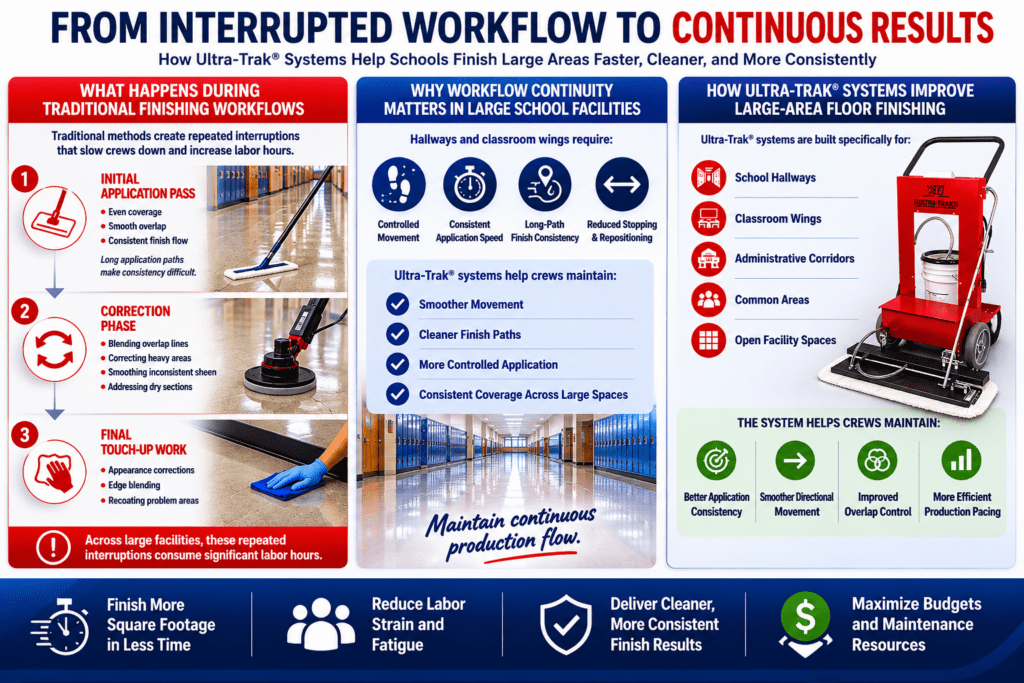
Traditional application systems often force crews into repetitive correction cycles that reduce productivity throughout the project.
Also Read 📖How Can School Maintenance Crews Cut Strip-Out Time in Half?
Where Productivity Improvements Begin
This is where the largest operational gains typically occur.
Reduced Overlap & Rework
Traditional workflows often create:
- visible overlap lines
- inconsistent gloss
- uneven finish blending
Ultra-Trak systems help crews maintain:
- more controlled finish paths
- smoother transitions
- improved consistency across long distances
👉 Result: Less correction work and cleaner finished appearance.
Improved Large-Area Coverage Efficiency
Long hallways can slow crews dramatically when systems require:
- frequent stopping
- constant repositioning
- repeated overlap correction
Ultra-Trak systems help crews maintain:
- smoother workflow pacing
- more continuous application movement
- improved production consistency
👉 Result: More square footage completed in less time.
More Consistent Finish Appearance
Uneven application commonly creates:
- streaking
- variable sheen
- drying inconsistencies
- visible finish defects
Controlled application improves:
- coating consistency
- finish uniformity
- overall floor appearance
👉 Result: Cleaner, more professional-looking floors across the facility.
Reduced Crew Fatigue
Traditional workflows increase:
- repetitive movement
- physical strain
- stop/start fatigue
Ultra-Trak systems help reduce unnecessary motion and workflow interruptions.
👉 Result: More consistent crew performance throughout long finishing projects.

Also Read 📖Fas-Trak Labor Savings Analysis | Floor Coating Efficiency & Cost Reduction
What School Maintenance Teams Are Facing
School maintenance departments today are managing:
- smaller crews
- larger facilities
- tighter turnaround schedules
- increased appearance expectations
Older workflows that depend heavily on repetitive correction work create growing operational strain across large facilities.
Modern maintenance teams are increasingly prioritizing:
- efficiency
- workflow optimization
- consistency
- labor reduction
- production reliability
Because maintaining floor appearance standards is no longer just about effort — it’s about operational efficiency.
Real-World School Scenario
A district maintenance team is preparing several buildings before the upcoming semester.
Areas include:
- main hallways
- classroom wings
- administrative corridors
- gathering spaces
Traditional Workflow Challenges:
- overlap correction slows production
- inconsistent finish blending creates rework
- crews fatigue late into shifts
- reopening timelines become difficult to maintain
Ultra-Trak Workflow Improvements:
- smoother hallway application
- more controlled finish placement
- faster classroom transitions
- reduced touch-up labor
👉 Outcome:
Crews complete larger sections more efficiently while maintaining cleaner, more consistent floor appearance throughout the facility.
How School Floor Maintenance Strategies Are Changing
The industry conversation is shifting away from:
- simply “working harder”
- relying on repetitive manual correction
- labor-heavy workflows
More schools are now prioritizing:
- workflow optimization
- application consistency
- production efficiency
- labor sustainability
Because the real goal is no longer just applying finish.
The real goal is:
👉 completing large-scale floor projects efficiently, consistently, and reliably.
Also Read 📖Why Are Tight Spaces the Hardest Areas to Finish in School Facilities?
Building a More Efficient School Floor Care Workflow
Over the course of this series, one thing has become increasingly clear:
The biggest challenges in school floor care are no longer just about cleaning floors.
They’re about:
- workflow efficiency
- labor sustainability
- production consistency
- and reducing unnecessary rework across large facilities.
Each stage of the maintenance process creates its own operational demands.
The 3-D Black Pad system addressed:
- labor-heavy strip-outs
- excessive passes
- wasted production time
Ultra-Trak spray systems improved:
- large-area cleaning efficiency
- chemical consistency
- workflow speed across hallways and common spaces
Micro-Trak systems focused on:
- precision finishing in classrooms, offices, corners, and tight transitions
- reducing touch-up work
- improving finish consistency in confined areas
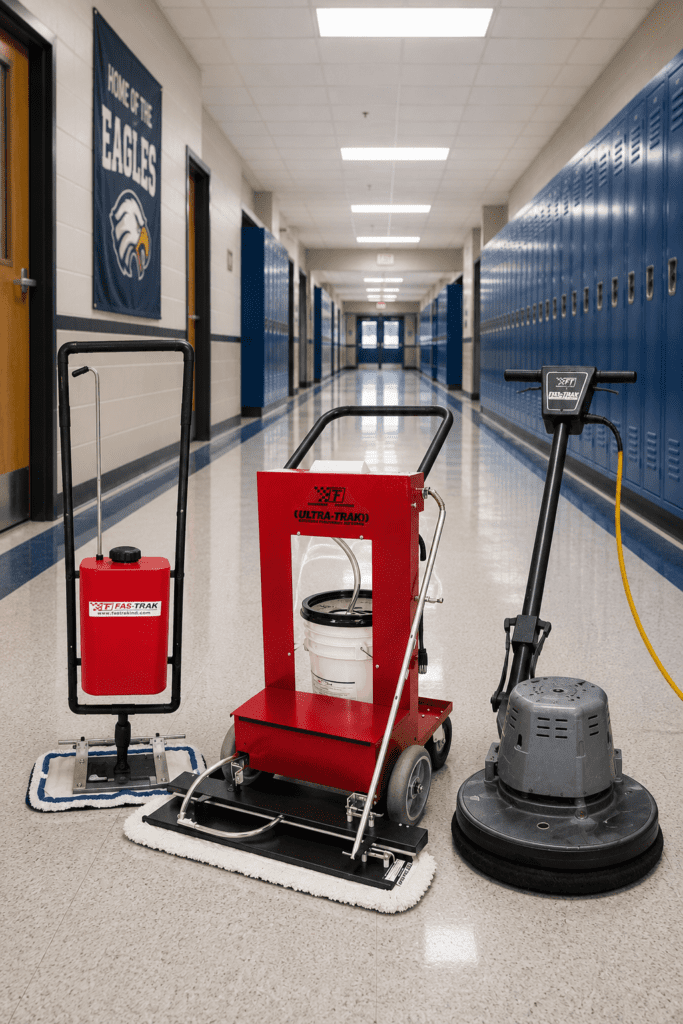
And now, Ultra-Trak large-area finishing systems bring those efficiency improvements together across:
- hallways
- classroom wings
- administrative corridors
- and large open facility spaces.
Together, these systems help school maintenance teams create a more connected workflow from:
stripping → cleaning → finishing → reopening
Instead of relying on labor-heavy correction work, modern floor care systems help crews:
- move more continuously
- maintain more consistent results
- reduce wasted labor hours
- improve appearance standards
- and complete projects more efficiently across the entire facility.
As schools continue facing staffing shortages, larger campuses, and tighter maintenance schedules, workflow optimization is becoming one of the most important parts of modern facility care.
Because in today’s maintenance environment, efficiency is no longer just about working faster.
It’s about building systems that help crews work smarter from start to finish.
10 (FAQs)
1. Why are large school hallways difficult to finish consistently?
Long application paths increase the chances of overlap lines, uneven finish thickness, and workflow interruptions.
2. How do Ultra-Trak systems improve large-area floor finishing?
Ultra-Trak systems improve workflow continuity, reduce overlap issues, and help crews maintain more consistent application across large spaces.
3. What causes overlap lines during floor finishing?
Overlap lines are typically caused by inconsistent application paths, stop/start movement, and uneven finish distribution.
4. Why does workflow continuity matter during floor finishing?
Continuous workflow reduces correction work, improves consistency, and helps crews finish larger areas faster.
5. How can schools reduce labor hours during floor finishing?
Schools can reduce labor by using systems designed for smoother movement, controlled application, and reduced rework.
6. What school areas benefit most from Ultra-Trak systems?
Large hallways, classroom wings, administrative corridors, and common areas benefit significantly from continuous-flow finishing systems.
7. How does controlled application improve floor appearance?
Controlled application creates more uniform finish thickness, reducing streaking, overlap marks, and appearance inconsistencies.
8. Why do traditional finishing systems slow crews down?
Traditional systems often require constant repositioning, repeated corrections, and inefficient workflow movement.
9. Can modern finishing systems reduce finish waste?
Yes. Controlled application systems help reduce overapplication, unnecessary overlap, and excess material use.
10. What is the biggest advantage of workflow-optimized floor finishing?
The biggest advantage is improved operational efficiency—helping crews complete projects faster with more consistent results and less labor strain.
