

Operational Intelligence™
60-Second Executive Brief
The Operational Challenge
Facility managers rarely wake up thinking, We need another cleaning product.
They think about labor shortages. Complaints. Floors that take too long to maintain. Restrooms that never seem consistently clean. Employees spending too much time walking, refilling, bending, carrying, or correcting work. Budgets that must stretch further without lowering expectations.
Yet many facility-service conversations still begin with a product.
That sequence is backwards.
The most valuable facility-service partners begin by understanding what is happening operationally. They examine the process, talk with employees, ask better questions, identify points of friction, and only then determine whether equipment, chemistry, training, workflow changes—or some combination—could improve the outcome.
Why It Matters
- Facility problems are rarely isolated product problems. Labor, workflow, ergonomics, training, equipment and quality often interact.
- Frontline employees know where processes break down. Their observations can expose inefficiencies that specifications and purchasing reports cannot.
- Demonstrations become more meaningful after discovery. Instead of simply proving that equipment works, the demonstration can test whether it solves the customer's actual problem.
Facility Manager Takeaway
Before discussing new equipment, ask your facility-service partner to walk the operation with you and identify the process being improved, the current pain points and the measurements that will determine whether an alternative is actually better.
For Distributors and Representatives
The fastest route to a meaningful equipment conversation may be to stop talking about equipment first.
Estimated Read Time: 9–11 minutes
Read More
Estimated Read Time: 9–11 minutes
⬇️⬇️⬇️⬇️
The Customer Doesn't Need Another Pitch. They Need Someone Who Notices the Problem.

Imagine two representatives walking into the same facility.
The first carries brochures.
Within minutes, the conversation turns to specifications, features, pricing and whatever product happens to be promoted that month.
The second representative carries a notebook.
Before recommending anything, they ask to see the facility.
They watch a custodian prepare equipment.
They notice an employee walking back to a supply area for another refill.
They ask why one section of flooring requires touch-up after application.
They see employees bending repeatedly during a routine task.
They ask the supervisor which process generates the most complaints.
They talk to the employee actually doing the work.
Only then do they begin discussing solutions.
Which representative is more likely to become valuable to the customer?
The distinction represents something much larger than sales technique.
It is the difference between selling products and understanding operations.
That distinction is at the heart of Fas-Trak Operational Intelligence™.
What Makes a Great Facility-Service Partner?
A great facility-service partner does more than supply cleaning products or equipment. The strongest partners understand a customer's workflow, labor demands, safety concerns, quality expectations and operating costs before recommending a solution. Facility walkthroughs, employee conversations, process measurements, demonstrations and follow-up support allow distributors and representatives to move from transactional selling toward long-term operational problem-solving.
1. The Difference Between a Vendor and an Operational Partner
There is nothing inherently wrong with selling products.
Facilities need products.
The problem begins when the product becomes the starting point rather than the potential solution.
A transactional conversation sounds like this:
"Here's what we sell."
An operational conversation begins differently:
"Show me what's giving your team trouble."
That small change can completely alter what happens next.
A floor-care problem, for example, might initially appear to require different equipment. After observation, the real issue could be inconsistent application technique, excessive refill trips, inadequate employee training, edge work requiring a second process, or equipment that employees simply dislike using.
Similarly, a restroom odor complaint might not be solved by adding another odor-control product if the underlying issue involves mineral accumulation, waste handling, air movement or inconsistent cleaning procedures.
A partner must understand the system around the problem.
A vendor asks:
What product are you currently using?
An operational partner also asks:
Why are you using it?
What does the process look like?
How long does it take?
Where does it slow down?
What do employees dislike about it?
What result are you trying to improve?
What happens when the process fails?
How will we know whether a new approach worked?
That is a very different relationship.
Also Read 📖Fas-Trak Cleaning Systems for Hospitals & Airports | High-Risk Facilities
2. Facility Walkthroughs Reveal What Purchasing Reports Cannot

Some operational problems are almost invisible on paper.
A purchasing report might tell management:
- How many gallons of chemical were purchased
- What equipment cost
- How many liners were ordered
- How much was spent on consumables
It probably won't show that an employee walks 200 feet several times per shift to refill something.
It won't show an awkward reach.
It won't show an operator fighting a cord around furniture.
It won't show a supervisor touching up edges after the crew leaves.
And it certainly won't show the expression on an employee's face when asked what they think about a piece of equipment.
That is why observation matters.
OSHA recommends proactively examining workplace conditions and processes, including direct observation and worker interviews, when identifying potential ergonomic problems.
The principle extends beyond ergonomics.
You cannot fully understand a cleaning process from the purchasing office.
You have to see the work.
3. Ask the People Who Actually Perform the Task
One of the most underused sources of Operational Intelligence™ is already inside the building.
The cleaning team.
Frontline employees know:
- Which machine is difficult to maneuver
- Which tool is constantly missing
- Which process requires unnecessary trips
- Which equipment takes too long to clean afterward
- Which floor requires repeat passes
- Which restroom causes recurring problems
- Which task causes fatigue
- Which product gets overused
- Which equipment gets avoided
- Which procedure works differently in practice than it does on paper
OSHA specifically identifies worker involvement as an important part of successful ergonomic programs because employees can identify hazards and provide feedback about potential improvements.
This is important for another reason.
Cleaning work is physically demanding.
NIOSH identifies common custodial exposures that include heavy lifting, prolonged standing and regular bending, while the Bureau of Labor Statistics notes that janitors and building cleaners spend much of their workday walking, standing and bending and may experience strains associated with lifting and repetitive motion.
So when an employee says:
"That process wears me out."
That should not automatically be dismissed as resistance to change.
It is operational information.
Also Read 📖Why Are Cleaning Results Inconsistent? Fas-Tabs Create Controlled Outcomes
Operational Insight™
The person performing a task eight hours a day may see an inefficiency that management, purchasing and the equipment manufacturer never see.
Great partners learn to listen for those observations.
4. Ten Questions That Can Change a Facility Conversation
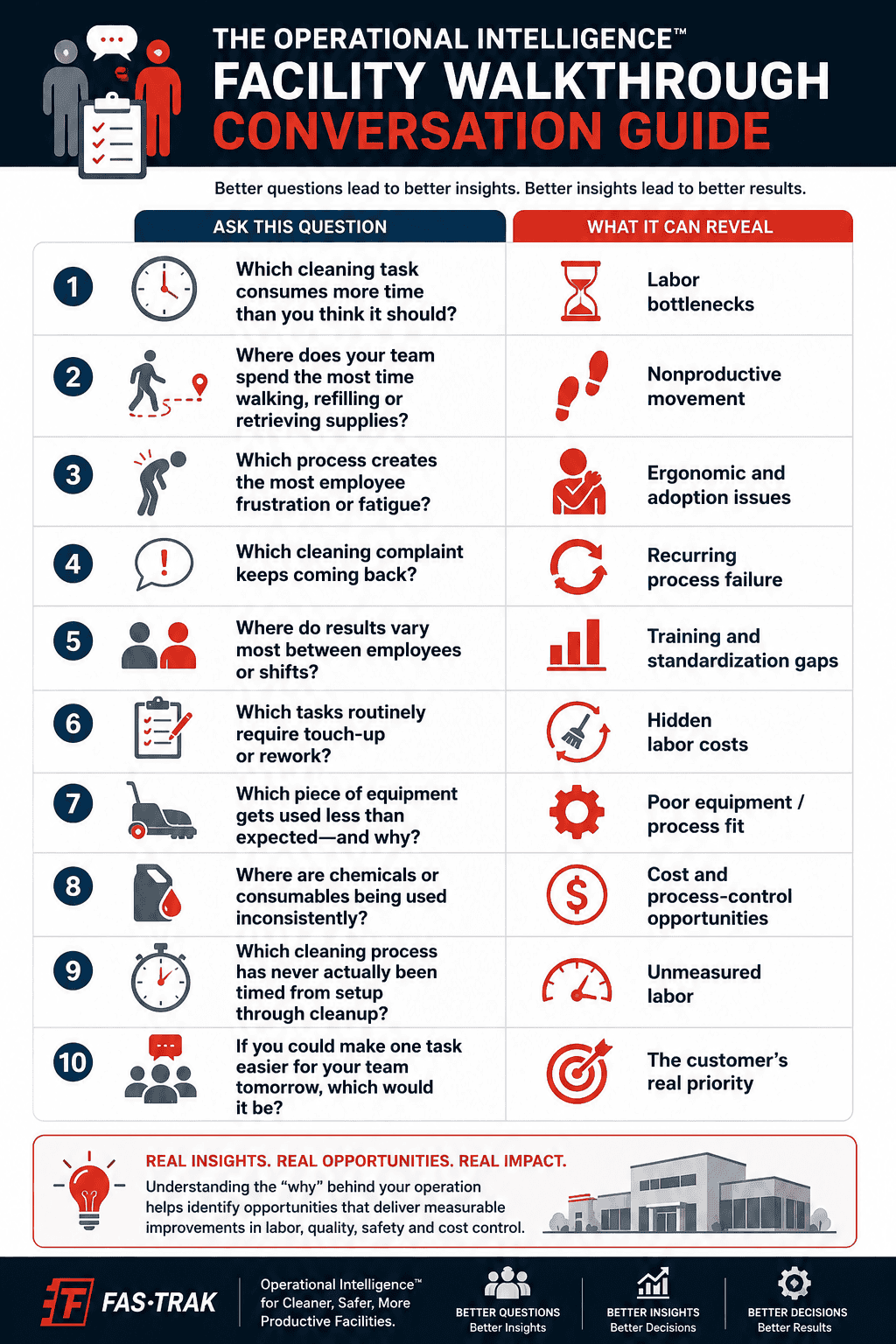
This week's standout element is deliberately simple.
No calculator.
No product comparison.
No specification chart.
Just better questions.
"Would you like to see our latest machine?"
That conversation can come later.
First, find the problem worth solving.
5. A Facility Walkthrough Should Follow the Work
A useful walkthrough is not a building tour.
It is an investigation.
Rather than walking from room to room looking for opportunities to insert products, follow an actual process.
Suppose the facility wants to improve floor coating application.
Don't begin with the applicator.
Start where the employee starts.
Step 1 — Preparation
Where is the equipment stored?
How long does preparation take?
What must be carried to the work area?
How is coating transported?
Step 2 — Setup
How much solution is prepared?
What tools are required?
How many employees participate?
How much time passes before application begins?
Step 3 — Application
Observe:
- Walking
- Refilling
- Turning
- Reaching
- Application consistency
- Overlap
- Edges
- Interruptions
- Employee posture
Step 4 — Correction
Does another employee follow behind?
Are edges completed separately?
Are missed or uneven areas corrected?
Step 5 — Cleanup
How long does cleanup take?
How much product remains?
How much equipment must be washed?
Step 6 — Storage
What happens afterward?
Where is equipment stored?
Is it easy to prepare for the next shift?
Now the representative understands the process.
Only then does an equipment discussion become meaningful.
Also Read 📖Enhancing Custodial Staff Skills for Better Service Quality
6. Why This Matters More as Labor Becomes More Valuable
The United States employed roughly 2.21 million janitors and cleaners, excluding maids and housekeeping cleaners, in May 2025, according to Bureau of Labor Statistics occupational employment data. Their mean hourly wage was $18.64.
The more important number for facility managers, however, may be what happens beneath those totals.
Cleaning is labor-intensive.
A few unnecessary minutes repeated across employees, shifts and locations can accumulate.
Consider a hypothetical facility where an inefficient process consumes just 10 unnecessary minutes per employee per shift.
With:
- 20 employees
- 5 shifts per week per employee
- 50 operating weeks
that represents approximately 833 labor hours annually.
That is not a Fas-Trak performance claim.
It is simple process mathematics.
The point is that operational waste does not need to be dramatic to become expensive.
The representative who notices those ten minutes may therefore bring considerably more value than the representative who simply negotiates another few dollars off the equipment price.
7. Better Ergonomics Can Be Better Operations

Operational efficiency and employee well-being do not have to compete.
OSHA describes ergonomics as fitting work to people and notes that ergonomic interventions can include modifying equipment, changing work practices and purchasing tools that reduce physical demands and unnecessary movement. OSHA also notes that productivity and efficiency can improve in many cases.
https://www.osha.gov/ergonomics/faqs
This creates another opportunity during facility walkthroughs.
Don't only ask:
How fast is the employee working?
Observe:
- How often are they bending?
- What are they carrying?
- How far are they reaching?
- How often do they repeat the same motion?
- Are they pushing or pulling unnecessary weight?
- Are they working overhead?
- Are they repeatedly repositioning equipment?
- Are they fighting the tool rather than using it?
NIOSH defines ergonomics around designing tasks to fit worker capabilities and reduce workplace risk factors.
For facility-service partners, that creates a powerful principle:
Remove unnecessary work before asking employees to work faster.
Also Read 📖Is a Cordless Wide Area Vacuum the Key to Cutting Labor Costs?
8. Demonstrations Should Test an Idea, Not Perform a Sales Show

This is where consultative selling becomes measurable.
Once the walkthrough identifies a specific operational problem, a demonstration can test whether an alternative solves it.
Suppose the walkthrough reveals:
Floor coating application requires frequent refilling and produces inconsistent results between operators.
Now an Ultra-Trak or Micro-Trak demonstration has a purpose.
The question is no longer:
"Do you like this machine?"
Instead:
"Does this application system improve the process we identified?"
Measure:
- Setup time
- Application time
- Refill frequency
- Operator movement
- Application consistency
- Edge work
- Product usage
- Cleanup
- Operator feedback
- Finished result
That is an entirely different demonstration.
The equipment is no longer the star of the presentation.
The customer's problem is.
The equipment earns attention by demonstrating that it may solve that problem.
9. Product Knowledge Still Matters—But Timing Matters More
None of this means product expertise becomes less important.
Quite the opposite.
A consultative representative needs enough product knowledge to connect operational problems with appropriate solutions.
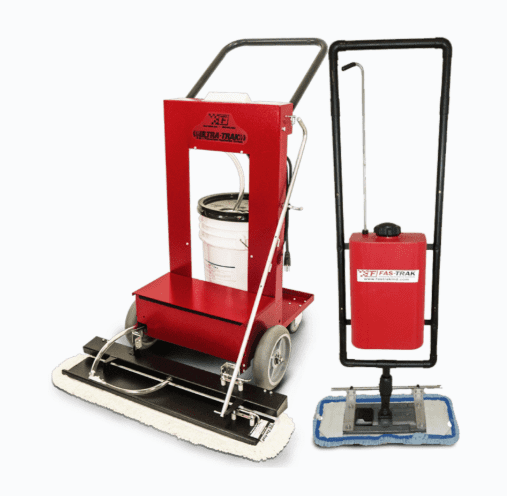
Fas-Trak's broader portfolio allows conversations to extend across multiple parts of facility operations, including:
- Floor coating application
- Vacuuming
- Edge cleaning
- Mechanical cleaning
- Elevated cleaning
- Restroom care
- Waste handling
- Controlled dispensing
- Odor management
- Wipe systems
But a representative does not need to introduce every product during every visit.
Sometimes the smartest recommendation is one product.
Sometimes it is a workflow change.
Sometimes it is training.
Sometimes the correct next step is:
"Let's measure this before we recommend anything."
That sentence can build enormous credibility.
Also Read 📖How Do Ultra-Trak & Micro-Trak Transform Coating Application?
10. The Best Sales Opportunity May Be a Problem Nobody Has Named Yet

Facilities adapt.
That is one of their greatest strengths—and one reason inefficiencies survive.
Employees compensate for broken processes.
Supervisors rearrange schedules.
Managers approve overtime.
Teams carry additional supplies.
Experienced employees develop workarounds.
Eventually, the workaround becomes the process.
Nobody describes it as a problem anymore.
This is where an experienced outside partner can bring unusual value.
A good representative can look at something familiar and ask:
"Why are you doing it that way?"
Not as criticism.
As curiosity.
That question may uncover:
- An outdated process
- Equipment that no longer fits the facility
- A training gap
- An unnecessary movement
- A recurring source of rework
- A consumable being wasted
- A safer alternative
- An opportunity for standardization
This is what bringing ideas looks like.
Distributor & Representative Insight™
Stop Planning Product Calls. Start Planning Problem-Solving Calls.
Before visiting a customer, choose one operational theme.
For example:
Labor Visit: Look for walking, setup, refilling and rework.
Ergonomics Visit: Look for lifting, bending, reaching, pushing and repetitive motion.
Quality Visit: Look for variation between employees, shifts and locations.
Sustainability Visit: Look for unnecessary chemistry, liners, wipes and disposable materials.
Training Visit: Look for differences between the written procedure and what employees actually do.
This gives representatives a legitimate reason to return repeatedly without arriving every month with another product pitch.
Each visit teaches the customer something.
And each visit teaches the representative more about the customer's operation.
That is how relationships compound.
Also Read 📖How Do Ultra-Trak & Micro-Trak Transform Coating Application?

Professional Perspective
Facility-service relationships become more valuable when knowledge flows in both directions.
The facility manager understands the building.
The cleaning employee understands the task.
The distributor understands the customer's history.
The manufacturer's representative understands applications across many facilities.
The manufacturer understands the equipment.
When those perspectives are brought together, the conversation becomes much more powerful than a traditional sales presentation.
The objective is not to prove that every facility needs different equipment.
The objective is to determine whether there is a better way to perform the work.
Sometimes there will be.
Sometimes there won't.
A partner willing to acknowledge both possibilities earns something that is increasingly difficult to purchase:
trust.
Facility-Service Innovation Begins with Better Questions
Facility-service innovation rarely begins with a product presentation.
It begins when someone notices an operational problem from an angle the customer may not yet have considered.
That could be an unnecessary refill.
A repetitive movement.
An inconsistent result.
A process nobody has timed.
A machine employees avoid.
A complaint everyone has accepted as normal.
Or simply a question nobody thought to ask.
Fas-Trak works with distributors, manufacturers' representatives and facility teams to turn those observations into productive demonstrations, educational conversations and practical solutions.
The objective isn't to put another product into a building.
It is to determine whether the building can operate better.
Also Read📖How Are Schools Finishing Large Hallways & Classrooms Faster with Smaller Crews?
Ready to Bring a Better Conversation Into the Facility?
Don't begin with the catalog.
Begin with the operation.
Walk the facility. Talk with the people doing the work. Identify the points of friction. Measure the existing process. Then determine whether equipment, training or workflow innovation can produce a meaningful improvement.
Fas-Trak can help distributors, manufacturers' representatives and facility teams turn operational questions into demonstrations and practical solutions designed around real-world applications.
Talk to Fas-Trak About an Operational Walkthrough or Demonstration
Contact Fas-Trak
Key Takeaways
- Great facility-service partners diagnose before they prescribe.
- A facility walkthrough should examine actual work—not simply look for places to sell products.
- Frontline employees are an important source of operational intelligence.
- Small amounts of wasted movement can become substantial labor consumption when repeated across a workforce.
- Ergonomics and productivity can support one another when better tools and processes eliminate unnecessary physical demands.
- Demonstrations should test specific operational hypotheses using measurable criteria.
- Product knowledge remains essential, but products should enter the conversation after the problem is understood.
- Long-term distributor relationships are strengthened through ideas, training, follow-up and measurable problem solving.
10 FAQs
1. What makes a good facility-service partner?
A strong facility-service partner understands the customer's operational challenges before recommending products. This includes observing workflows, speaking with employees, identifying inefficiencies, conducting meaningful demonstrations and supporting implementation after the sale.
2. Why should a cleaning equipment representative conduct a facility walkthrough?
A walkthrough allows the representative to see actual working conditions, including employee movement, setup, refilling, equipment use, ergonomic concerns, rework and quality problems that may not appear in purchasing data.
3. What questions should be asked during a facility walkthrough?
Useful questions focus on time-consuming tasks, recurring complaints, employee fatigue, rework, inconsistent results, equipment utilization, consumable use and processes that have never been objectively measured.
4. Why should frontline cleaning employees be included in equipment decisions?
Employees perform the work repeatedly and often understand operational obstacles better than anyone else. Their feedback can reveal equipment usability, fatigue, workflow and training issues that management may not routinely observe.
5. What should a facility measure before buying cleaning equipment?
Facilities should consider setup time, task completion time, employee movement, refill frequency, consumable and chemical use, rework, cleanup time, training requirements, maintenance, operator feedback and finished quality.
6. How can cleaning equipment improve labor productivity?
Appropriate equipment may improve productivity by eliminating unnecessary walking, carrying, refilling, repetitive movement, setup steps or rework. Actual improvements should be measured in the facility rather than assumed from general productivity claims.
7. Why are ergonomics important when selecting commercial cleaning equipment?
Cleaning work can involve lifting, bending, reaching, prolonged standing and repetitive movements. Evaluating ergonomics helps facilities consider how equipment and work practices affect both physical demands and operational performance.
8. What makes an effective cleaning equipment demonstration?
An effective demonstration tests equipment under realistic facility conditions and measures outcomes connected to the identified problem, rather than simply showcasing features or maximum operating speed.
9. How can distributors build stronger relationships with facility managers?
Distributors can become more valuable by helping customers identify operational problems, conducting walkthroughs, arranging objective demonstrations, supporting training and following up after implementation.
10. What is Fas-Trak Operational Intelligence™?
Fas-Trak Operational Intelligence™ is an educational approach centered on understanding the complete facility-cleaning process—including labor, workflow, ergonomics, quality, waste, training and equipment—so potential solutions can be evaluated against real operational needs.
Conclusion: The Best Partnerships Begin Before the Product Conversation
The most valuable facility-service partners are not defined by how many products they can present. They are defined by how well they understand the operation before recommending one.
That means walking the facility. Watching the work. Listening to the people performing it. Asking where time is being lost, where employees are struggling, where results become inconsistent, and where an accepted routine may actually be creating unnecessary cost.
Only then should the conversation turn to equipment.
This is the thinking behind Fas-Trak Operational Intelligence™: better questions create better insights, and better insights lead to better decisions. A product demonstration becomes far more meaningful when everyone understands exactly what problem is being tested, what success should look like, and what will be measured.
For distributors and manufacturers’ representatives, this approach also changes the relationship. Instead of returning only when there is something new to sell, you have a reason to return because there is something valuable to discuss—labor, ergonomics, workflow, training, quality, waste, safety, or another opportunity to improve the customer’s operation.
And for facility managers, that is the kind of partner worth keeping.
Fas-Trak believes innovation should solve real operational problems—not create another piece of equipment sitting in a storage room. Through facility walkthroughs, practical demonstrations, training, and ongoing support, Fas-Trak helps distributors, representatives, and facility teams move beyond the product conversation and focus on what ultimately matters:
Cleaner facilities. Smarter processes. Better-supported employees. And measurable operational results.
Ready to Start with the Right Questions?
Talk with Fas-Trak about conducting an operational walkthrough or scheduling a real-world demonstration. Start with the process. Identify the opportunity. Then determine whether there is a better way to get the work done.
☎️Contact Fas-Trak

