

How Cleaning Workflow Design Can Improve Facility Productivity
FAS-TRAK | OPERATIONAL EFFICIENCY SERIES · OCTOBER 12, 2026
Estimated read time 8–10 minutes
Executive Brief
Commercial cleaning productivity is often evaluated through labor hours, staffing levels, equipment costs, and the amount of square footage cleaned. Yet one of the most influential factors in operational performance is frequently overlooked: the design of the cleaning workflow itself.
When custodial teams follow fragmented routes, repeatedly retrieve supplies, move equipment unnecessarily, or revisit previously serviced areas, facilities incur labor costs that do not directly contribute to cleaning outcomes.
A strategically designed cleaning workflow can reduce unnecessary movement, improve task sequencing, align equipment with facility requirements, and create a more predictable cleaning operation.
For facility managers facing financial constraints, workflow improvement offers a practical opportunity to improve operational efficiency before considering additional staffing or major equipment investments.
Key Takeaways
-
Cleaning workflow design influences labor utilization, travel time, equipment productivity, and overall facility operating costs.
-
Fragmented cleaning routes can create hidden labor expenses through unnecessary movement, repeated setup, and inefficient task sequencing.
-
Route mapping, task standardization, and equipment selection should work together rather than operate as separate management decisions.
-
Measuring productive cleaning time against total paid shift time helps identify operational improvement opportunities.
-
Effective workflow redesign should preserve cleaning quality, employee safety, and required service frequencies while reducing avoidable work.
The Hidden Productivity Problem Inside Commercial Cleaning Operations
A custodial employee can work diligently throughout an entire shift and still operate within an inefficient cleaning system.
Consider a technician assigned to maintain several conference rooms, corridors, restrooms, and shared spaces across a large commercial building.
The employee begins cleaning one area, walks to a distant supply closet, returns with additional materials, completes a portion of the assignment, then travels across the building to retrieve another piece of equipment.
Later, the employee returns to a previously serviced area because a required task was missed or scheduled out of sequence.
Every movement consumes time. Not every movement creates cleaning value.
For facility managers, this distinction is important because labor represents a major recurring expense in custodial operations. When paid time is consumed by preventable travel, searching for supplies, unnecessary equipment changes, and repeated passes, the cost of delivering each cleaning task increases.
The issue is not necessarily employee performance.
The issue may be the operational design surrounding the employee.
Cleaning workflow design addresses this problem by examining how people, equipment, supplies, spaces, and assigned tasks interact throughout a cleaning shift.
Rather than simply asking employees to work faster, it asks a more productive question:
How can we organize the work so that fewer resources are wasted completing it?
What Is Cleaning Workflow Design?
Cleaning workflow design is the structured process of organizing custodial tasks, movement patterns, equipment, supply access, and service schedules to achieve consistent cleaning outcomes with efficient resource utilization.
A cleaning workflow includes more than a checklist of responsibilities.
It defines the sequence in which work occurs, the path employees follow, the equipment used for each task, and the conditions necessary to complete assignments without avoidable interruptions.
An effective workflow considers five interconnected components:
-
Task sequencing: Organizing cleaning activities in a logical order to minimize repeated work.
-
Route efficiency: Establishing practical travel paths through assigned cleaning zones.
-
Equipment alignment: Matching cleaning equipment to floor surfaces, accessibility, soil levels, and task requirements.
-
Supply accessibility: Positioning materials to minimize unnecessary retrieval trips.
-
Performance measurement: Evaluating labor time, cleaning quality, and operational consistency.
When these elements are coordinated, custodial operations become more predictable and easier to evaluate.
When they are disconnected, even experienced cleaning teams can lose productive time.
The Financial Impact of Fragmented Cleaning Workflows
Cleaning inefficiency is not always visible in a facility's operating budget.
It frequently appears as accumulated labor time distributed across hundreds or thousands of routine tasks.
A few unnecessary minutes may seem insignificant during a single shift. However, repeated across employees and operating days, those minutes can represent a meaningful financial exposure.
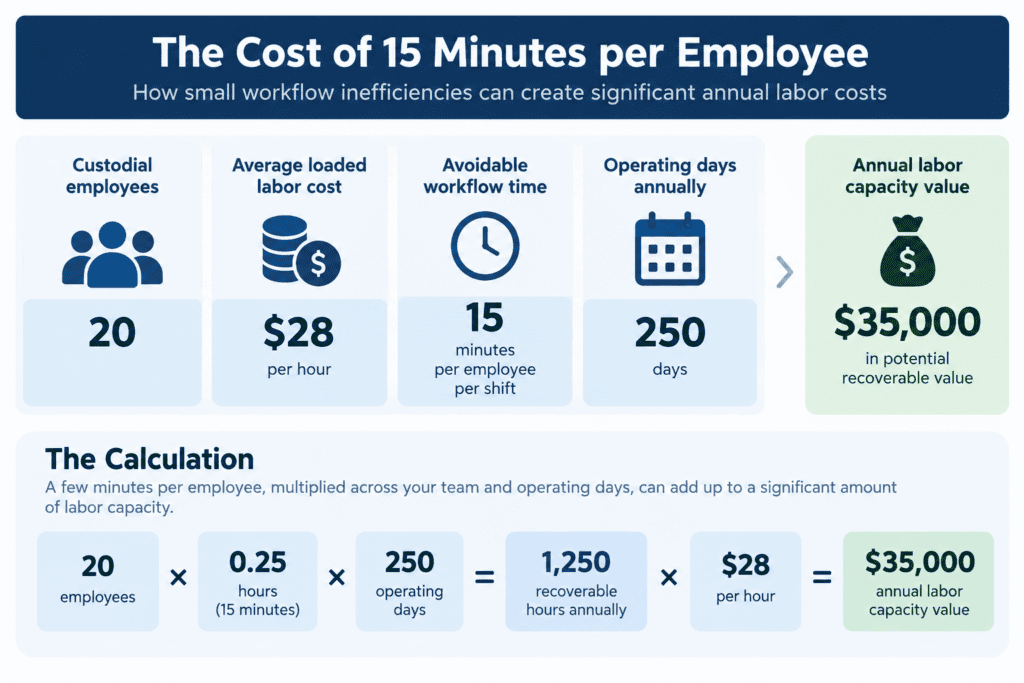
Illustrative assumptions, not measured Fas-Trak customer results. Loaded labor cost includes assumed wages and employer-related labor expenses. Recovered capacity does not automatically equal cash savings.
This example demonstrates the financial significance of small, repeated inefficiencies.
The facility is not necessarily paying employees too much. It may simply be using part of its paid labor capacity inefficiently.
Recovering that time could help the operation absorb additional cleaning requirements, reduce overtime when scheduling permits, improve service consistency, or limit future staffing pressure.
The actual financial benefit depends on whether the recovered hours translate into reduced paid time, avoided additional labor, or additional productive output.
The goal is not to remove necessary cleaning time. It is to eliminate unnecessary activity surrounding the cleaning process.
From Fragmented Routes to Streamlined Cleaning Operations
One of the most practical applications of workflow design is cleaning route optimization.
Traditional custodial assignments are frequently organized around individual rooms or broad building sections. Employees may be responsible for completing every cleaning task within an assigned area, regardless of equipment changes, travel distances, or supply requirements.
This approach can work well in smaller facilities. However, in larger buildings with diverse cleaning requirements, it may create unnecessary movement and repeated setup.
A streamlined workflow examines the relationship between physical spaces and cleaning activities.
Before-and-after workflow comparison
Before: Fragmented
Frequent backtracking, scattered tasks, repeated equipment changes.
After: Streamlined
Logical zone progression, fewer interruptions, coordinated equipment.
Conceptual workflow map for six cleaning zones. Actual route design must account for building layout, cleaning sequence, occupancy, and infection-control requirements.
The objective is not necessarily to create the shortest walking route. It is to develop the most efficient route that still satisfies operational and cleaning requirements.
For example, a cleaning route may need to account for:
-
High-traffic areas requiring multiple service intervals.
-
Restrooms requiring dedicated tools and contamination-control procedures.
-
Floor surfaces requiring different equipment.
-
Occupied rooms with restricted access windows.
-
Supply stations and equipment storage locations.
A well-designed route balances these requirements rather than optimizing distance alone.
Why Equipment Selection Is Part of Workflow Design
Cleaning equipment should not be evaluated independently of the workflow in which it operates.
A machine may have an impressive published production rate, yet deliver limited practical benefit when the operator must repeatedly reposition it, maneuver around obstacles, or interrupt work for setup and refilling.
The true operational value of equipment depends on how effectively it performs within the facility's actual conditions.
This is particularly relevant for floor coating, floor maintenance, and other repetitive applications.
Matching Fas-Trak equipment to the application

Designed for larger-scale floor coating applications, where open floor areas and longer application runs may favor higher-capacity equipment. Workflow planning should consider floor layout, setup, coating requirements, and actual operating conditions.

A compact coating application system suited to smaller areas and more constrained environments. It may complement a larger applicator where room dimensions, furnishings, and access limitations affect equipment efficiency.
Fas-Trak's published equipment guidance identifies approximate application rates of 20,000 square feet per hour for Ultra-Trak Plus and 8,000 square feet per hour for Micro-Trak Plus. These are product-positioning figures, not guaranteed whole-shift productivity rates.
The critical consideration is not which machine has the highest advertised output.
It is which equipment configuration produces the best combination of application quality, labor efficiency, operator usability, and total operating cost in the facility.
Fas-Trak's article, Cleaning Equipment Demonstrations: What Should You Measure?, explores how equipment demonstrations can test these operational questions under realistic conditions.

Measuring Productivity Beyond Square Footage
Square footage cleaned per labor hour is a useful productivity indicator, but it does not provide a complete picture of operational performance.
Two facilities with identical floor areas may have very different cleaning requirements.
One may consist primarily of open corridors and large rooms. Another may contain small offices, high-density furniture, numerous restrooms, and specialized surfaces.
Evaluating these facilities using a single production-rate target could produce misleading conclusions.
Instead, managers should monitor a combination of operational and quality indicators.

For example, consider an eight-hour paid shift containing 5.5 hours of direct cleaning activity.
The direct cleaning utilization rate would be:
This figure does not establish that the remaining time is wasted. Breaks, training, safety activities, equipment maintenance, and other necessary duties must be accounted for separately.
However, tracking the same categories consistently over time can reveal whether workflow changes are increasing productive capacity.
Importantly, cleaning quality must remain part of the measurement process.
ISSA's Clean Standards emphasize evaluating cleaning effectiveness through defined procedures, inspections, monitoring, and corrective action rather than relying solely on speed or output.
Individual Cleaning vs. Team Cleaning: Which Workflow Is Better?
Not every facility benefits from the same staffing structure.
Individual cleaning assigns responsibility for a defined area to one employee. Team cleaning distributes specialized tasks among coordinated employees following established routes.
Both approaches can be effective when matched to the building and workload.

ISSA identifies reduced tool switching, less unnecessary walking, and more predictable workload distribution among the potential advantages of team cleaning. It also recognizes that smaller facilities may benefit from hybrid approaches.
The appropriate decision should be based on building characteristics, staffing levels, service requirements, and measured outcomes.
The Role of Workflow Design in Financially Constrained Facilities
Facility managers rarely have unlimited resources.
Cleaning departments must often balance rising operating costs, staffing availability, equipment maintenance, and increasingly demanding service expectations.
Under these conditions, the instinct may be to reduce cleaning frequencies, defer equipment investments, or require employees to complete more work in less time.
These approaches can create additional risks if they compromise service quality or employee safety.
Workflow design offers a different starting point.
By identifying unnecessary movement, repeated setup, poorly positioned supplies, and equipment mismatches, managers may improve operational capacity without reducing essential cleaning requirements.
A facility that recovers productive time can potentially redirect that capacity toward higher-priority tasks, improve coverage during staffing shortages, or reduce avoidable overtime.
This is especially important when financial decisions involve equipment purchases.
The lowest purchase price does not necessarily represent the lowest operating cost.
Managers should consider the total cost of ownership, including labor, maintenance, consumables, training, equipment downtime, and expected service life.
A well-matched piece of equipment may provide greater operational value than a less expensive alternative that requires additional handling or labor.
From Workflow Observation to Equipment Demonstration

For distributors and equipment representatives, workflow analysis creates an opportunity to move beyond traditional product demonstrations.
Rather than beginning with equipment specifications, begin with the customer's operational problem.
Does the facility struggle with lengthy floor-coating procedures? Are employees spending too much time changing equipment? Are tight spaces reducing the practical productivity of larger machines?
Once the problem is defined, a demonstration can test whether a particular solution improves the workflow.
A meaningful equipment evaluation should compare:
-
Total task completion time before and after the change.
-
Setup, refill, and cleanup requirements.
-
Application consistency and finished-floor quality.
-
Operator comfort and training requirements.
-
Labor and consumable costs per completed task.
This turns the demonstration into an operational assessment rather than a simple product presentation.
For distributors, the benefit is a more consultative relationship with facility managers. For customers, it provides a stronger foundation for evaluating equipment investments.
Better Cleaning Workflows Begin With Better Questions
Facility productivity is not simply a measure of how hard employees work or how quickly equipment operates.
It reflects the efficiency of the entire cleaning system.
When tasks are sequenced logically, routes are designed intelligently, equipment is matched to the application, and performance is measured consistently, facilities gain greater control over their operations.
For managers facing financial constraints, this creates an important opportunity: improve the way existing resources are used before assuming that more resources are required.
The most productive cleaning operation is not necessarily the one with the largest workforce or the fastest equipment.
It is the one that consistently delivers the required cleaning outcome with the least avoidable waste.
Evaluate Your Cleaning Workflow With Fas-Trak
Is your facility losing valuable labor time through inefficient floor-care processes, repeated equipment changes, or poorly matched application systems?
Fas-Trak can help you explore equipment options and evaluate how different application methods may fit your facility's operational requirements.
Whether you manage a commercial property, educational campus, institutional facility, or large-scale cleaning operation, an application-focused equipment demonstration can help identify opportunities to improve efficiency while maintaining quality.
Contact Fas-Trak to discuss your cleaning workflow and arrange an equipment demonstration.


10 Frequently Asked Questions About Cleaning Workflow Design and Facility Productivity
1. What is cleaning workflow design in commercial facilities?
Cleaning workflow design is the process of organizing custodial tasks, cleaning routes, equipment, supplies, and employee responsibilities to improve operational efficiency. An effective cleaning workflow reduces unnecessary movement, minimizes repeated tasks, and supports consistent cleaning quality. Facility managers use workflow design to improve labor productivity, control operating costs, and make better use of existing cleaning resources.
2. How can cleaning workflow optimization improve facility productivity?
Cleaning workflow optimization improves facility productivity by reducing time spent traveling between cleaning areas, retrieving supplies, changing equipment, and repeating tasks. By organizing work into logical sequences and matching equipment to specific cleaning requirements, custodial teams can complete assignments more efficiently. These improvements may increase productive cleaning time without requiring additional employees or reducing cleaning standards.
3. What are the most common causes of inefficient cleaning workflows?
Common causes of inefficient cleaning workflows include poorly planned cleaning routes, unnecessary backtracking, inconvenient supply storage, frequent equipment changes, inconsistent task sequencing, and unclear employee responsibilities. Facility managers can identify these inefficiencies through workflow observations, task-time measurements, employee feedback, and cleaning quality inspections.
4. How much money can a facility save by improving cleaning workflows?
Potential savings depend on staffing levels, labor costs, operating schedules, and the amount of avoidable time recovered. For example, a facility with 20 custodial employees recovering 15 minutes per shift over 250 operating days could reclaim 1,250 labor hours annually. At a loaded labor rate of $28 per hour, this represents $35,000 in potential annual labor capacity value. Actual financial savings depend on whether recovered time reduces paid hours, overtime, or future staffing requirements.
5. What is the difference between individual cleaning and team cleaning?
Individual cleaning assigns one employee responsibility for multiple cleaning tasks within a designated area. Team cleaning distributes specialized tasks among employees working through coordinated cleaning routes. Individual cleaning may provide greater flexibility in smaller facilities, while team cleaning can improve task standardization and reduce equipment changes in larger environments. The best approach depends on facility layout, staffing, workload, and cleaning requirements.
6. How does cleaning equipment selection affect workflow efficiency?
Cleaning equipment selection affects workflow efficiency by influencing task completion time, setup requirements, operator movement, and equipment changeovers. Equipment that matches the facility's floor surfaces, accessibility, and cleaning requirements may reduce unnecessary labor. Facility managers should evaluate total task time, cleaning quality, operating costs, and equipment usability rather than relying exclusively on advertised production rates.
7. What performance indicators should facility managers use to measure cleaning productivity?
Facility managers should monitor productive cleaning time, travel and supply retrieval time, equipment setup time, task completion rates, rework frequency, and cleaning quality scores. These key performance indicators help identify where labor hours are being used effectively and where operational improvements may be possible. Tracking performance before and after workflow changes provides a measurable foundation for evaluating productivity improvements.
8. Can cleaning workflow improvements reduce labor costs without reducing staff?
Yes. Cleaning workflow improvements can help facilities control labor costs without immediately reducing staffing levels. Eliminating unnecessary movement, repeated setup, and inefficient task sequences allows existing employees to use more of their paid time productively. Recovered labor capacity may help reduce overtime, accommodate additional cleaning responsibilities, or avoid future staffing increases while maintaining required service standards.
9. How often should commercial cleaning workflows be evaluated?
Commercial cleaning workflows should be reviewed periodically and whenever significant operational changes occur. Changes in facility occupancy, floor surfaces, equipment, staffing, cleaning frequencies, or service requirements can affect workflow efficiency. Facility managers should establish baseline productivity measurements, monitor performance trends, and reassess cleaning routes and procedures when results indicate opportunities for improvement.
10. How can Fas-Trak help facilities improve cleaning workflow efficiency?
Fas-Trak offers specialized commercial floor-care equipment and application systems that facility managers can evaluate as part of their cleaning workflow improvement efforts. Equipment demonstrations can help determine whether specific products are appropriate for a facility's floor-care requirements, operating conditions, and productivity goals. By examining equipment performance, application methods, and total task time, facilities can make more informed purchasing and workflow decisions.
Learn more: Visit Fas-Trak to explore commercial floor-care equipment and inquire about an equipment demonstration.
Previous Article: Where Custodial Teams Lose Time During a Cleaning Shift | Fas-Trak
Next Article: What Makes Commercial Cleaning Equipment More Productive?

