

Where Custodial Teams Lose the Most Time During a Cleaning Shift
Estimated Read Time: 7–8 Minutes
Custodial productivity is not simply a measure of how quickly employees clean. During a typical shift, labor time is also consumed by travel, filling and dumping, equipment setup, supply retrieval, task changeovers and repeat passes. While many of these activities are necessary, inefficient workflows can cause small delays to accumulate into significant labor hours over time.
For facility managers, custodial supervisors, EVS leaders and BSC operations teams, the opportunity is not to push employees to work faster—it is to identify unnecessary steps that keep employees from productive cleaning.
By observing the complete cleaning shift, measuring where time is actually spent and evaluating how routes, supplies, procedures and equipment interact, facility teams can identify opportunities to reduce unnecessary movement and make better use of available labor hours.
Key Takeaways
- Productivity is more than cleaning speed. Travel, filling, dumping, setup, changeovers and repeat work all affect how much productive cleaning occurs during a shift.
- Small delays can become significant labor hours. Even a few potentially avoidable minutes per shift can accumulate when multiplied across employees and hundreds of annual shifts.
- Travel deserves attention. Repeated trips to custodial closets, water sources, dumping locations and equipment storage areas can interrupt productive cleaning time.
- Setup and task changeovers matter. Poor staging or frequent equipment changes can create additional steps between cleaning tasks.
- Repeat passes increase labor requirements. When an area must be cleaned again because the first process did not achieve the required result, additional labor is consumed without increasing the amount of area serviced.
- Equipment affects the entire workflow. Capacity, mobility, setup requirements, filling and dumping frequency, and ease of operation can influence more than the individual cleaning task.
- Better productivity does not mean making employees work faster. Effective workflow improvement focuses on removing unnecessary steps and interruptions rather than increasing physical pressure on custodial employees.
- Measure before making changes. A simple workflow study can separate productive cleaning time from travel, filling, dumping, setup, changeovers and repeat work.
- Calculate the annual impact. If a facility identifies 20 potentially avoidable minutes per shift across 260 shifts, that represents approximately 86.7 hours annually per employee. This is an illustrative calculation, not an industry benchmark.
- The biggest opportunity may be between the tasks. Improving how people, equipment, supplies and cleaning routes work together can turn more of the available shift into productive cleaning time.
A custodian can be moving for an entire shift and still spend a surprising amount of time not actually cleaning.
Walking back for supplies. Refilling solution. Emptying recovery tanks. Returning to a closet for a forgotten tool. Moving equipment from one area to another. Changing setups between tasks. Retracing a route. Cleaning an area twice because the first process did not produce the required result.
Individually, these interruptions may seem insignificant.
Across an eight-hour shift, multiple employees, multiple buildings, and hundreds of operating days, however, small workflow delays can accumulate into a significant labor issue.
For custodial supervisors, facility managers, EVS leaders, and building service contractor operations teams, improving custodial productivity does not necessarily begin by asking employees to work faster.
It begins by asking a better question:
Where does the time go between one productive cleaning task and the next?
That distinction matters—especially when staffing is tight and every available labor hour needs to produce as much useful cleaning as reasonably possible.
Custodial Productivity Is More Than Cleaning Speed
Productivity is sometimes reduced to a simple measurement:
How many square feet can one employee clean per hour?
That can be useful, but it does not tell the entire story.
The Official ISSA Cleaning Times uses five components when considering cleaning times: task, tool, time, total units, and training. ISSA also emphasizes that facility type, scope of work, desired cleaning standard, tools and equipment, and other operational variables affect how long work reasonably takes.
In other words, productivity cannot be evaluated responsibly by looking at square footage alone.
A custodian might perform an individual task efficiently while working inside an inefficient overall system.
The mop may not be the problem.
The vacuum may not be the problem.
The employee may not be the problem.
The workflow surrounding the task may be where the opportunity exists.
That is why supervisors should look beyond individual task times and examine the entire cleaning shift.
Also Read 📖Commercial Cleaning Costs: Calculate the True Cost Per Task

1. Travel Time: The Minutes Between the Work
One of the easiest forms of lost productivity to overlook is walking.
Custodial employees obviously need to move throughout a facility. Travel cannot—and should not—be eliminated.
The operational question is whether the amount of travel is necessary.
Consider how often employees may need to:
- Walk back to a custodial closet
- Retrieve forgotten supplies
- Return equipment to another location
- Move between distant work zones
- Find replacement liners, chemicals, cloths, or consumables
- Travel to centralized dumping or filling locations
- Return to an area because something was missed
A few additional minutes of travel may not appear important when observing one employee.
Multiply those minutes across an entire department, however, and the picture changes.
A Simple Example
Suppose avoidable movement consumes only 15 minutes per shift.
For a five-day workweek:
15 minutes × 5 days = 75 minutes per week
Over 52 weeks:
75 × 52 = 3,900 minutes
That equals:
65 hours per employee per year.
For a 10-person team, the same pattern represents:
650 labor hours annually.
This is not a claim that every facility loses 15 minutes per employee. Some will lose considerably less; others may discover more.
The point is that seemingly small workflow inefficiencies become significant when repeated.
The only way to know your number is to measure it.
2. Filling and Refilling
Water and cleaning solution do not magically appear where the work occurs.
Traditional cleaning processes may require employees to travel to a water source, fill equipment, transport the solution, perform the work, and eventually repeat the process.
Every refill creates a small interruption in productive cleaning.
The operational questions become:
How frequently are employees filling?
Where are they filling?
How far is the water source from the work area?
How much area can be completed before another refill becomes necessary?
These questions become particularly important in large facilities, schools, healthcare environments, industrial buildings, hospitality properties, and multi-floor operations.
A filling station located 30 feet from the work area creates a very different workflow than one located several corridors—or another floor—away.
The equipment selected for the job can also influence how frequently this cycle occurs.
3. Dumping and Waste Handling
What goes into cleaning equipment eventually has to come out.
Recovery water must be emptied. Trash must be consolidated. Waste must be transported. Containers may require relining. Equipment may need rinsing before returning to service.
These are legitimate parts of custodial work.
But they are also opportunities to examine workflow.
For example:
- Where are appropriate dumping locations?
- How far must employees travel to reach them?
- How often does equipment require dumping?
- Are employees making separate waste trips that could be consolidated?
- Does the route naturally bring the employee near the disposal location?
- Are trash and floor-care workflows unnecessarily crossing each other?
The objective is not simply to dump faster.
The objective is to design the shift so that necessary support activities fit logically into the cleaning route.
4. Setup and Changeover Time
Every time an employee stops one process and begins another, there may be a transition.
That transition could include:
Stop → Store → Retrieve → Prepare → Move → Restart
Consider an employee moving from vacuuming to restroom cleaning and then to hard-floor maintenance.
Different tools, chemicals, PPE, equipment, or procedures may be required.
One transition is insignificant.
Dozens of poorly planned transitions are not.
This is why equipment selection and workloading should be evaluated together.
A supervisor should ask:
Are we organizing the work around the facility—or forcing employees to constantly reorganize themselves around their equipment?
Standardized setups can help.
When employees begin a route with the expected tools, chemicals, consumables, and equipment available, fewer interruptions are required to complete assigned work.
5. Repeat Passes and Rework
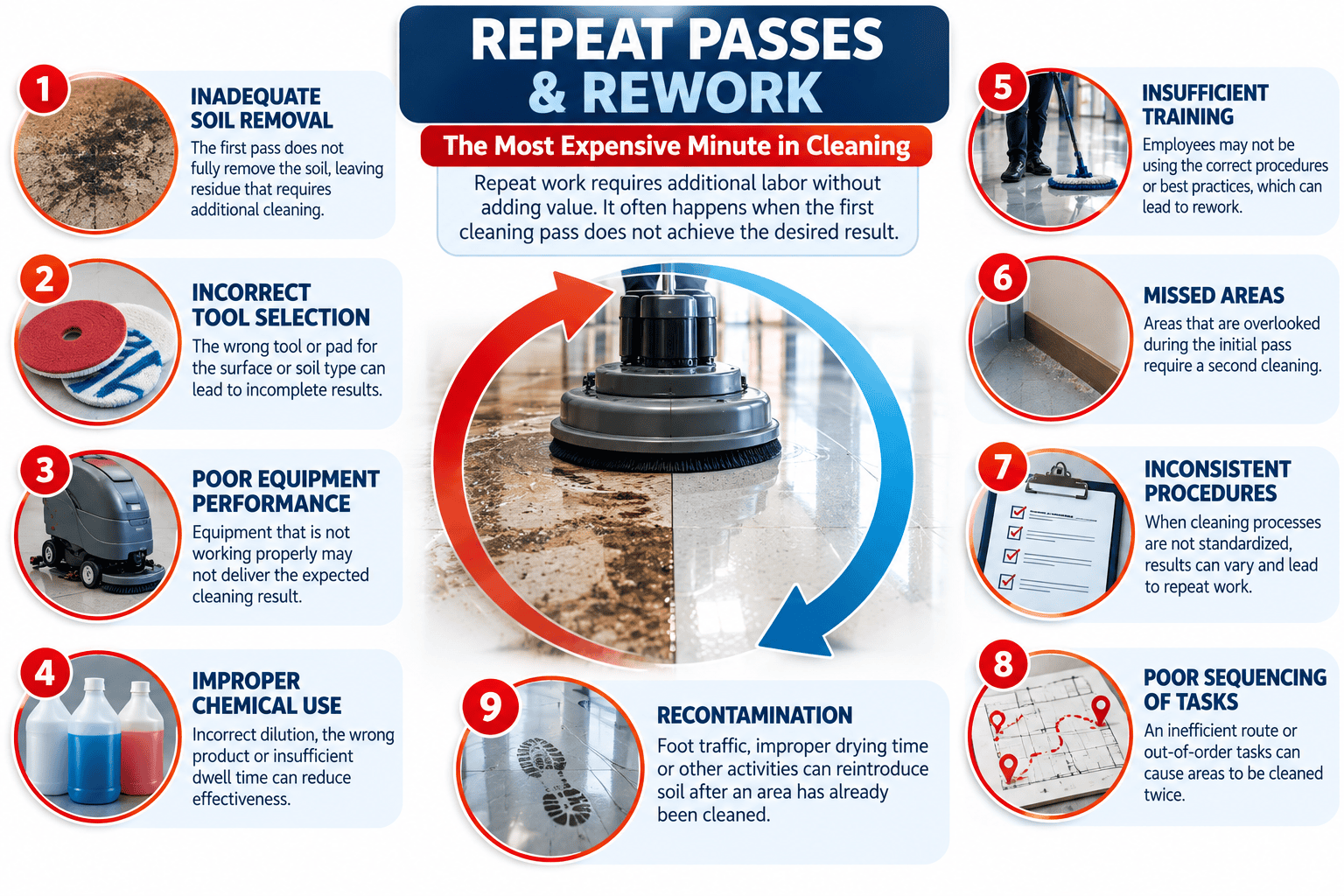
Perhaps the most expensive minute in cleaning is the minute spent doing something that should not have needed to be done again.
Repeat work can occur for many reasons:
- Inadequate soil removal
- Incorrect tool selection
- Poor equipment performance
- Improper chemical use
- Insufficient training
- Missed areas
- Inconsistent procedures
- Poor sequencing of tasks
- Recontamination after an area has already been cleaned
ISSA identifies completeness, effectiveness, speed, safety, sustainability, budget impact, and customer satisfaction among the criteria that can be considered when evaluating cleaning performance.
That is important because productivity should never be interpreted as speed at the expense of quality.
Finishing a floor quickly is not an efficiency improvement if someone has to return and clean it again.
The goal is not simply faster cleaning. It is effective cleaning with less unnecessary work surrounding it.
6. Poor Sequencing Creates Hidden Labor
The order in which cleaning tasks are completed can matter almost as much as the individual tasks themselves.
Imagine a route where an employee:
- Cleans offices.
- Walks across the building for supplies.
- Returns to empty trash.
- Travels back for floor equipment.
- Cleans the corridor.
- Discovers another room still requires service.
- Moves equipment again.
- Returns to the original area.
Every task may have been completed correctly.
The route was still inefficient.
Now imagine organizing the same workload so supplies, equipment, waste removal, and cleaning tasks follow a logical progression through the building.
The employee may complete essentially the same cleaning without increasing physical effort or rushing.
That is workflow improvement.
7. Equipment Can Change the Workflow
Equipment decisions are often evaluated according to purchase price, features, durability, or cleaning capability.
Those factors matter.
But equipment also influences labor flow.
Managers should consider questions such as:
- How quickly can the equipment be prepared for use?
- How frequently does it require filling or emptying?
- How easily can employees move it between work areas?
- How much area can it service before interruption?
- How much setup is required?
- Does it reduce unnecessary handling?
- Does it help consolidate steps?
- Is it appropriate for the actual size and layout of the facility?
The right equipment does not simply perform a cleaning task.
It should fit into the way employees move through the building.
ISSA's current Cleaning Times resources include productivity information for multiple types of equipment and are intended to help organizations compare tools and processes when planning workloads.
That makes equipment evaluation a labor-management decision as much as a purchasing decision.
Also Read 📖How To Control Commercial Cleaning Labor Costs
Don't Confuse Productivity With Working Harder
This is an important distinction.
A workflow study should not become an exercise in squeezing every second out of an employee's day.
Custodial employees already perform physically demanding work.
Making employees walk faster, rush tasks, skip appropriate procedures, or increase workloads without understanding the operating environment is not meaningful process improvement.
True efficiency looks for waste in the system rather than blame in the worker.
ISSA distinguishes productivity from efficiency in a similar way: productivity concerns the rate of work performed, while efficiency considers how work can be completed while minimizing wasted time, movement, energy, and resources.
That changes the management conversation from:
"How can we make our custodians work faster?"
to:
"How can we remove unnecessary steps that prevent our custodians from cleaning?"
That is a far more useful question.
ISSA Measuring Cleaning Performances
Measure the Shift Before Changing It
Before purchasing new equipment or rewriting cleaning schedules, observe the existing workflow.
A basic workflow study does not need to be complicated.
Choose a representative cleaning route and document what happens throughout it.
Record time spent on:
Productive Cleaning
Actual cleaning and surface-care activity.
Travel
Moving between work areas, closets, equipment, and supplies.
Filling
Preparing water or cleaning solution.
Dumping
Emptying recovery tanks, waste, or used solution.
Setup and Changeover
Preparing equipment, changing tools, or transitioning between tasks.
Repeat Work
Returning to areas or repeating cleaning processes.
Other Necessary Activities
Safety procedures, documentation, communication, required breaks, and facility-specific responsibilities.
Do not assume where the problem is.
Measure first.
ISSA similarly recommends time studies as a way to compare actual task performance with expected times and identify potential discrepancies or inefficiencies.
The Cleaning-Shift Timeline
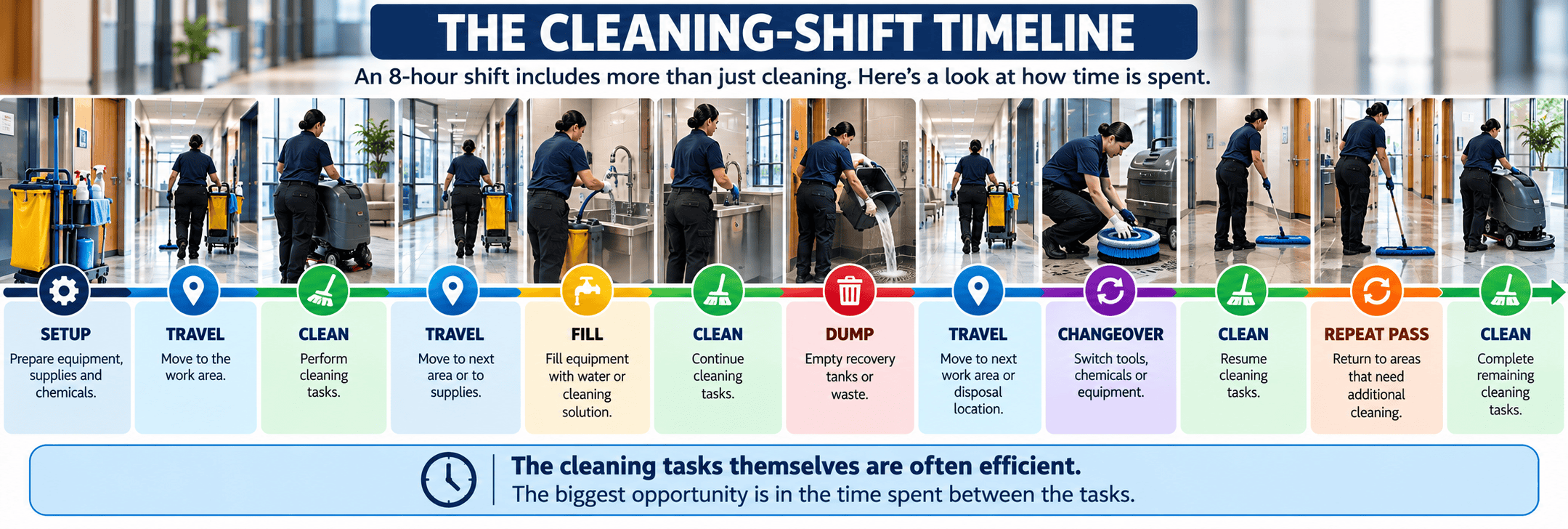
One of the most useful visual tools for supervisors is a simple shift timeline.
Instead of seeing an eight-hour shift as one continuous block labeled CLEANING, divide it into the activities that actually occur:
SETUP → TRAVEL → CLEAN → TRAVEL → FILL → CLEAN → DUMP → TRAVEL → CHANGEOVER → CLEAN → REPEAT PASS → CLEAN
Once the shift is visualized this way, operational patterns become much easier to recognize.
A supervisor may discover that the cleaning tasks themselves are already reasonably efficient.
The opportunity exists in the spaces between those tasks.
That is where workflow design becomes valuable.
Also Read 📖 Cleaning Equipment Demonstrations: What Should You Measure? | Fas-Trak
Calculate Your Recoverable Time
Once the observations have been recorded, management can begin modeling the potential impact.
Step 1: Identify Avoidable Minutes
Separate necessary support activities from activities that could reasonably be reduced through better routing, staging, equipment, or procedures.
Step 2: Calculate Annual Frequency
For a five-day-per-week operation:
5 shifts × 52 weeks = 260 shifts annually
Step 3: Calculate Annual Recoverable Hours
Avoidable Minutes per Shift × Annual Shifts ÷ 60
For example:
20 minutes × 260 ÷ 60 = approximately 86.7 hours annually
Again, this is an illustration—not an industry benchmark.
But it demonstrates why small improvements deserve attention.
Step 4: Scale the Calculation
If similar conditions affect multiple employees:
Recoverable Hours per Employee × Number of Employees
Now management can begin evaluating the operational significance of a workflow change.
Also Read 📖The New Economics of Facility Cleaning
Better Productivity Begins With Better Questions
When staffing becomes difficult, the immediate reaction may be to ask:
How do we get more work out of fewer people?
A better starting point may be:
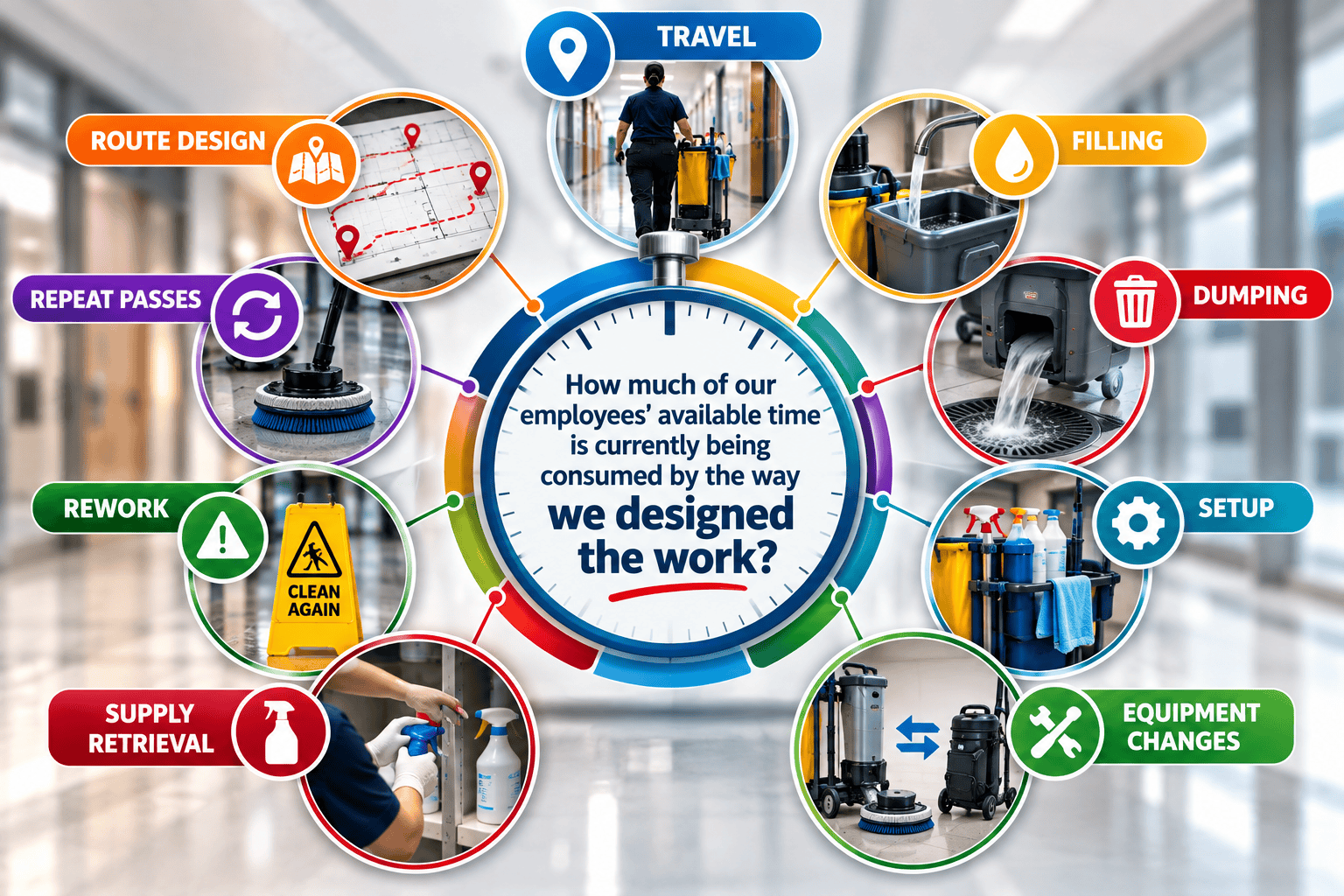
How much of our employees' available time is currently being consumed by the way we designed the work?
Look at:
- Travel
- Filling
- Dumping
- Setup
- Equipment changes
- Supply retrieval
- Route design
- Repeat passes
- Rework
Then look at the cleaning equipment and processes surrounding those activities.
The solution may involve different equipment.
It may involve repositioning supplies.
It may involve changing the cleaning route.
It may involve training.
It may involve standardizing procedures.
Or it may involve several small changes that together produce a meaningful improvement.
Also Read 📖Facility Walkthrough Questions That Reveal Cleaning Costs
Turn More of the Shift Into Productive Cleaning Time
Custodial productivity is not simply about completing individual tasks faster.
It is about creating a cleaning system in which people, equipment, supplies, routes, and processes work together efficiently.
When managers can see where time is being spent, they can make better decisions about staffing, equipment, work loading, and workflow design.
And sometimes the biggest opportunity is not hidden inside the cleaning task at all.
It is hiding in the minutes between the tasks.
Fas-Trak Industries works with facility teams to evaluate cleaning workflows and demonstrate equipment in real operating environments.
Rather than evaluating equipment only from a specification sheet, a demonstration can help your team examine how a solution fits into the actual movement, setup, cleaning, filling, dumping, and daily workload of your facility.
Contact Fas-Trak to discuss your cleaning workflow and arrange an equipment demonstration.


Frequently Asked Questions
1. What is custodial productivity?
Custodial productivity is a measure of how effectively available labor time is used to complete required cleaning work. It involves more than how quickly an employee cleans. Travel, equipment setup, filling, dumping, supply retrieval, task transitions and repeat work can all affect the amount of productive cleaning completed during a shift.
2. Where do custodial teams commonly lose time during a cleaning shift?
Time can be consumed by necessary activities such as traveling between work areas, retrieving supplies, filling equipment, dumping recovery water or waste, setting up equipment and changing between tasks. Additional time may also be lost through inefficient routing, unnecessary trips, poor staging or repeat cleaning. A workflow study can help distinguish necessary support time from potentially avoidable activity.
3. How can facility managers measure custodial productivity?
Facility managers can observe representative cleaning routes and record how employees' time is divided among productive cleaning, travel, filling, dumping, setup, changeovers, supply retrieval and repeat work. Comparing these observations with the facility's scope of work and required cleaning standards can reveal where workflow improvements may be possible.
4. Does improving custodial productivity mean employees have to work faster?
No. Improving productivity does not necessarily mean asking custodial employees to move faster or rush cleaning tasks. A more sustainable approach is to reduce unnecessary movement, interruptions and repeated steps so employees can spend more of their available labor time completing productive cleaning.
5. How does travel time affect custodial productivity?
Travel becomes an important productivity factor when employees repeatedly walk long distances for supplies, equipment, water, waste disposal or forgotten items. Some travel is unavoidable, but better route planning, supply staging and equipment placement may reduce unnecessary trips and allow more of the shift to be devoted to cleaning.
6. How can cleaning equipment affect labor efficiency?
Cleaning equipment can influence setup time, mobility, filling and dumping frequency, the amount of area completed between interruptions and the number of steps required to perform a task. Evaluating equipment in the actual facility environment can help managers determine whether it fits the building's workload, layout and cleaning processes.
7. Why are repeat cleaning passes a productivity problem?
Repeat passes require additional labor without necessarily adding proportional value. They may occur because of improper procedures, equipment selection, training issues, missed areas, heavy soil conditions or inadequate results from the first cleaning pass. Identifying why rework occurs can help facilities improve both cleaning quality and labor efficiency.
8. How can better cleaning routes improve custodial workflow efficiency?
A well-designed cleaning route organizes tasks, equipment, supplies, filling locations and waste disposal into a logical progression through the facility. This can reduce backtracking, unnecessary equipment movement and repeated trips to custodial closets while helping employees transition more efficiently from one task to the next.
9. How can custodial teams calculate potentially recoverable labor time?
Begin by measuring potentially avoidable minutes during a representative shift. Multiply those minutes by the number of annual shifts and divide by 60 to convert the result into hours. For example, 20 minutes per shift across 260 shifts equals approximately 86.7 hours annually. This is an illustrative calculation rather than an industry benchmark; each facility should measure its own workflow.
10. How can Fas-Trak help facilities improve cleaning workflow efficiency?
Fas-Trak can help facility teams evaluate how cleaning equipment fits into real-world workflows. An equipment demonstration allows managers and custodial teams to examine factors such as movement, setup, cleaning, filling, dumping and task transitions in the actual operating environment. Contact Fas-Trak to discuss your cleaning workflow and arrange an equipment demonstration.
Previous Article: Commercial Cleaning Costs: Calculate the True Cost Per Task
Next Article: How Cleaning Workflow Design Can Improve Facility Productivity

