

Labor Is Getting More Expensive. Wasted Labor Is Getting More Expensive, Too.
Estimated Reading Time: 6 Minutes
For facility managers and commercial cleaning operations, controlling labor costs has become an increasingly difficult equation.
The U.S. Bureau of Labor Statistics reports that the median hourly wage for janitors and building cleaners reached $17.71 in May 2025. In educational services, the median was $18.63, while healthcare and social assistance reached $18.35 per hour.
And wages are only part of the picture.
Across private industry, employer compensation costs increased 3.3% during the 12 months ending June 2026, while wages and salaries increased 3.1% and benefit costs increased 3.8%.
That creates an important question for facilities:
If every labor hour costs more, how much of that hour is actually being spent productively cleaning?
The answer may reveal an opportunity that has little to do with asking employees to work harder or faster.
It may be hidden inside the workflow.
Key Takeaways
- Rising wages are only one component of increasing commercial cleaning labor costs.
- Walking, setup, refilling, equipment changes and rework all consume paid labor time.
- Recovering even a few minutes per employee per shift can accumulate into substantial labor hours over a year.
- Efficiency should focus on removing unnecessary steps—not reducing cleaning standards.
- Measuring a workflow before changing it helps facilities identify where improvements can have the greatest impact.
1. Why Commercial Cleaning Labor Costs Keep Rising
Labor pressure isn't unique to commercial cleaning.
As of June 2026, total private-industry employer compensation averaged $46.89 per hour worked, including $32.82 in wages and salaries and $14.07 in benefits. Those figures represent the entire private workforce rather than cleaning employees specifically, but they demonstrate why employers increasingly need to consider total compensation, not simply hourly wages, when evaluating labor costs.
Commercial cleaning operations face another challenge.
Cleaning remains highly dependent on human labor. Floors must be cleaned. Restrooms must be serviced. Trash must be collected. High-touch surfaces require attention. Supplies must be replenished.
There is only so much labor a facility can remove before cleaning quality begins to suffer.
That means another part of the equation deserves attention:
How efficiently are the available labor hours being used?
Also Read 📖Fas-Trak Labor Savings Analysis | Floor Coating Efficiency & Cost Reduction
2. An Eight-Hour Shift Isn't Eight Hours of Cleaning
Consider a 480-minute shift.
Not every one of those minutes can—or should—be spent with a mop, vacuum, auto scrubber or cleaning cloth in hand.
Workers legitimately need time to prepare equipment, retrieve supplies, move between work areas, empty and refill equipment, change tools and perform other necessary tasks.
The operational question is whether those activities are taking more time than necessary.

None of these activities necessarily looks significant when observed once.
The problem is frequency.
Five minutes repeated several times per shift becomes measurable labor.
Multiply it across several employees, five days a week and 52 weeks a year, and small workflow inefficiencies stop being small.
Also Read 📖The New Economics of Facility Cleaning
3. What Can 20 Minutes Per Shift Actually Mean?
Here's a deliberately simple example.
Suppose a facility discovers that one employee is spending an avoidable 20 minutes per eight-hour shift walking back for supplies, making unnecessary equipment changes or repeating a process.
That equals:
20 minutes × 5 shifts = 100 minutes per week
Over 52 weeks:
100 minutes × 52 = 5,200 minutes
That's approximately:
87 labor hours per employee, per year.
Now consider a cleaning operation with 10 employees experiencing the same workflow friction.
That becomes approximately:
867 labor hours annually.
This does not mean a facility will automatically eliminate 867 paid hours or achieve a particular dollar savings. Labor requirements, schedules, contracts and operational conditions vary considerably.
It does demonstrate something important:
Minutes are an operational resource.
Recovering those minutes may allow a cleaning team to accomplish more within its existing labor allocation, absorb additional responsibilities, reduce overtime pressure or redirect labor toward higher-priority cleaning tasks.
Also Read 📖Cleaning Equipment Demonstrations: What Should You Measure? | Fas-Trak
4. Five Places Facilities Can Look for Recoverable Time

Before cutting staffing or pushing production rates higher, examine how the work is actually being performed.
1. Travel Distance
Where are supplies, chemicals, equipment, water sources and waste-disposal points located?
Repeated travel across a large facility can consume considerable time without appearing on a cleaning specification.
2. Setup and Changeover
Count how often employees stop one task to retrieve, change, prepare or return equipment.
A process requiring frequent interruptions may deserve another look.
3. Refill Frequency
A refill doesn't just include filling a tank.
It may include traveling to the water source, emptying equipment, refilling it, returning to the work area and restarting the task.
Reducing unnecessary refill cycles can therefore affect much more than water capacity.
4. Repeat Passes and Rework
Doing something twice is expensive.
If a floor, surface or area regularly requires repeat cleaning, determine why.
The issue could involve the procedure, chemistry, equipment, soil load, training or simply a mismatch between the tool and the task.
5. Equipment-to-Task Fit
The largest machine isn't automatically the most productive. Neither is the smallest.
A piece of equipment should fit the facility, surface, traffic level, obstacles, storage limitations and actual cleaning objective.
Productivity depends on the entire process, not one specification on an equipment sheet.
Also Read📖From Vendor to Problem-Solving Partner | Fas-Trak Operational Intelligence™
5. Efficiency Doesn't Mean Asking People to Clean Faster
This distinction matters.
Cleaning faster and cleaning more efficiently are not necessarily the same thing.
If an employee is already performing a task correctly, simply demanding greater speed can create new problems: missed areas, inconsistent results, fatigue and ultimately rework.
Operational efficiency takes a different approach.
Instead of asking:
“How can this employee clean faster?”
Ask:
“What is preventing this employee from spending more of the shift productively cleaning?”
That question changes the conversation.
A worker walking 300 feet to refill equipment doesn't need to walk faster.
A worker making repeated trips for supplies doesn't necessarily need more training.
A floor requiring multiple passes doesn't necessarily need someone pushing the machine faster.
The process itself may need improvement.
Also Read 📖From Vendor to Problem-Solving Partner | Fas-Trak Operational Intelligence™
6. Measure the Workflow Before You Change It
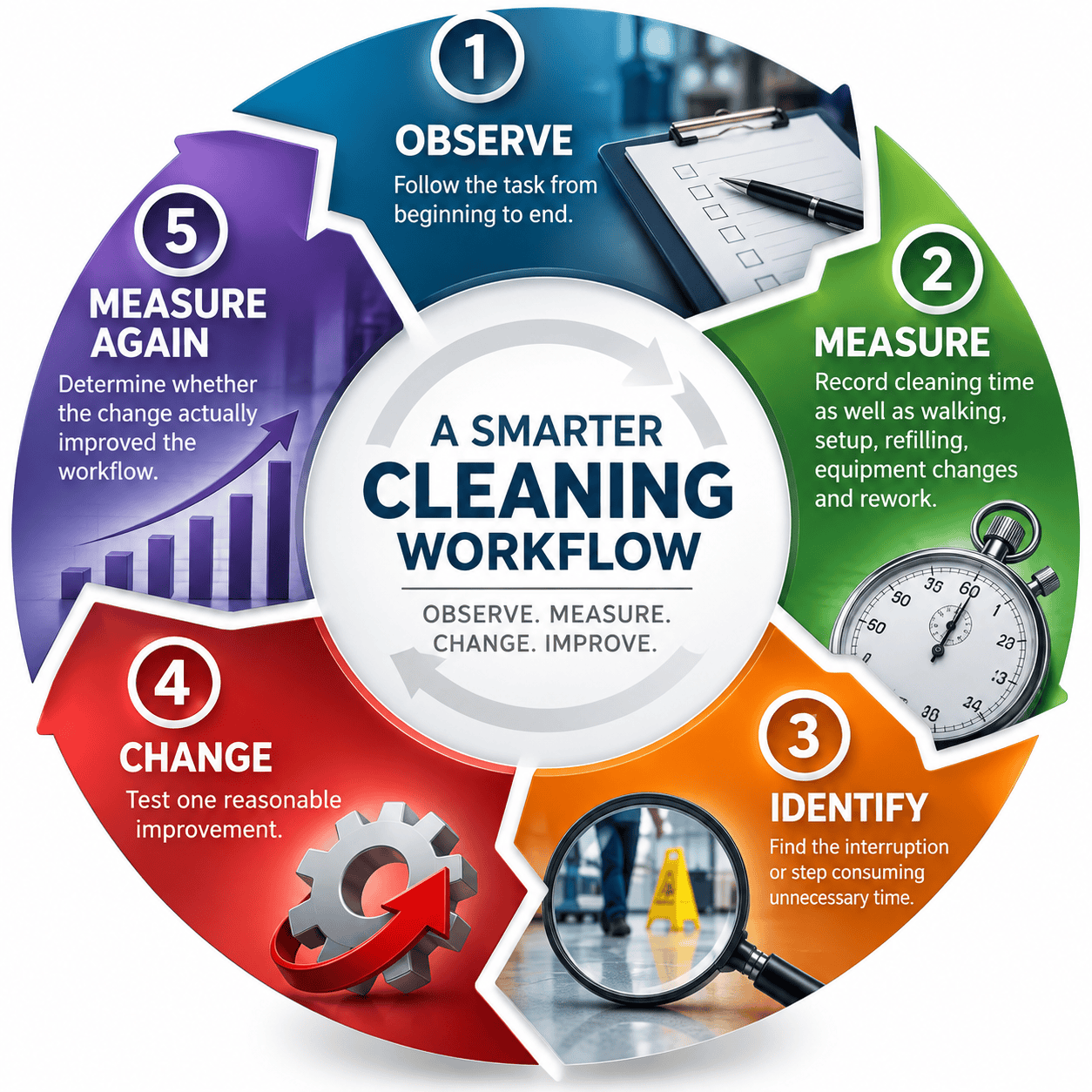
Facilities don't need a complicated productivity study to begin finding opportunities.
Start with one labor-intensive task.
Observe → Measure → Change → Measure Again
Observe: Follow the task from beginning to end.
Measure: Record cleaning time as well as walking, setup, refilling, equipment changes and rework.
Identify: Find the interruption or step consuming unnecessary time.
Change: Test one reasonable improvement.
Measure again: Determine whether the change actually improved the workflow.
This last step is critical.
A new chemical, procedure or piece of equipment should not be considered more efficient simply because it appears faster.
Measure the result.
Did the task require fewer minutes?
Were there fewer interruptions?
Did refill frequency change?
Was rework reduced?
Was the expected cleaning outcome maintained?
Those answers turn an equipment demonstration or process change into something much more useful:
operational evidence.
Also Read 📖Why the Best Facility-Service Partners Bring Ideas—Not Just Products
Operational Intelligence™: Reduce Friction, Not Standards
The goal of labor efficiency should not be to squeeze more work out of fewer people regardless of the consequences.
It should be to identify the places where labor is being consumed without improving the cleaning outcome.
Walking.
Waiting.
Unnecessary setup.
Excessive refilling.
Poor task sequencing.
Repeat passes.
Those minutes matter more as labor costs rise.
The facilities that understand their workflows can make better decisions about staffing, equipment, procedures and budgets because they aren't relying solely on assumptions.
They are working from what is actually happening on the floor.

Start With the Workflow
Before assuming rising commercial cleaning labor costs require fewer people, reduced frequencies or lower service standards, look at where the existing labor hours are going.
Sometimes the opportunity isn't hidden in the budget.
It's hidden in the minutes.
Fas-Trak works with cleaning professionals, facility teams and distributors to evaluate cleaning processes and explore equipment solutions in real operating environments.
Contact Fas-Trak for help evaluating cleaning workflows and arranging an equipment demonstration.


Frequently Asked Questions
1. Why are commercial cleaning labor costs increasing?
Labor costs can rise because of wages, benefits, overtime, staffing requirements, turnover, and the amount of labor required to complete cleaning tasks. Workflow inefficiencies can also increase the effective cost of each labor hour when employees spend excessive time walking, setting up equipment, refilling, changing tools, or repeating work.
2. How can facilities reduce cleaning labor costs without cutting staff?
Facilities can begin by examining workflow efficiency. Reducing unnecessary travel, setup time, refill cycles, changeovers, waiting, and rework may allow more productive cleaning to occur within the same labor hours.
3. What is cleaning workflow efficiency?
Cleaning workflow efficiency looks at how labor, equipment, supplies, and procedures work together to complete a task with as few unnecessary interruptions as possible while still maintaining the required cleaning outcome.
4. Can cleaning equipment reduce labor requirements?
Equipment can influence productivity, but the result depends on the facility, task, surface, workflow, and equipment-to-task fit. Facilities should compare actual task time and cleaning outcomes before and after a change rather than assuming a machine will automatically reduce labor.
5. How should a facility measure cleaning productivity?
A facility should measure the entire workflow, not just active cleaning time. That means tracking setup, travel, refilling, equipment changes, waiting, rework, and the actual time spent cleaning so the full labor picture becomes visible.
Read Previous Article: Facility Walkthrough Questions That Reveal Cleaning Costs
Next Article: How to Calculate the True Cost of a Commercial Cleaning Task
