

How to Calculate the True Cost of a Commercial Cleaning Task
Reading Time: Approximately 7 minutes
The Price of Cleaning Is Not the Same as the Cost of Cleaning
A gallon of cleaner has a price. A piece of equipment has a price. A box of supplies has a price.
But a cleaning task has a cost—and those are two very different numbers.
For facility managers trying to control commercial cleaning costs, focusing primarily on purchase price can hide some of the largest expenses occurring inside the workflow. Labor spent retrieving equipment, preparing solutions, walking to refill stations, changing tools, repeating unsuccessful work and cleaning up after the task all consume resources.
The result is an important operational distinction:
The true cost of cleaning is not simply what a facility buys. It is what the facility spends to achieve the required result.
That makes cost-per-task one of the more useful measurements available to facility managers, EVS directors and procurement teams evaluating cleaning processes.
Key Takeaways
- Purchase price and true cleaning cost are not the same measurement.
- Labor is a major component of custodial expense, making small time losses financially important.
- Calculate the complete workflow from setup through cleanup—not just active cleaning time.
- Include consumables, equipment allocation, travel, refills, changeovers and expected rework.
- Multiply small inefficiencies by annual task frequency to expose their budget impact.
- Compare equipment using cost per acceptable completed task, not purchase price alone.
- Validate manufacturer productivity claims under the facility's actual conditions.
- Labor hours recovered may create additional productive capacity even when they do not translate directly into payroll reductions.
Why Labor Changes the Commercial Cleaning Cost Equation
Commercial cleaning is fundamentally labor-intensive.
APPA's current Cleaning Operations guidance describes custodial operations as highly labor intensive and notes, as a rule of thumb excluding benefits, that approximately 90% of custodial costs can be labor versus approximately 10% cleaning supplies. APPA specifically recommends considering tasks, frequencies, time requirements, space type, equipment, materials and hourly labor cost when evaluating custodial operations.
ISSA similarly identifies labor as the largest cleaning expense, although percentages vary depending on the type of organization and accounting methodology.
The U.S. Bureau of Labor Statistics reported a $17.71 median hourly wage for janitors and building cleaners in May 2025. Actual employer cost, however, can be considerably higher once payroll taxes, benefits, workers' compensation, training, uniforms, supervision and other employment-related expenses are included.
That changes how equipment and supplies should be evaluated.
Saving $10 on a consumable matters.
Saving 20 minutes of recurring labor may matter much more.
Also Read 📖Why Are Cleaning Results Inconsistent? Fas-Tabs Create Controlled Outcomes
Start With the Entire Cleaning Workflow

One of the easiest mistakes in calculating commercial cleaning costs is timing only the moment when the worker is actively cleaning.
Suppose a floor takes 30 minutes to clean.
It is tempting to record:
Cleaning time = 30 minutes
But what happened before and after those 30 minutes?
The employee may have needed to:
- Walk to a custodial closet.
- Retrieve the machine or tools.
- Fill or prepare the system.
- Transport equipment to the work area.
- Return for additional solution.
- Change pads or accessories.
- Move cords or reposition equipment.
- Clean the equipment after use.
- Return everything to storage.
- Repeat portions of the floor that did not meet the required standard.
Those minutes belong to the task too.
A 30-minute cleaning process can easily become a considerably longer operational process once the complete workflow is measured.
Think Door-to-Door, Not Tool-to-Floor
For cost analysis, start the clock when the employee begins preparing to perform the task and stop it when the employee is ready to move to the next assignment.
That is the time the organization is actually purchasing.
Also Read 📖Facility Walkthrough Questions That Reveal Cleaning Costs
The Six Costs That Belong in a Cost-Per-Task Calculation
1. Direct Labor
Begin with the employee's fully loaded hourly labor rate, not simply base wage.
For example, assume a facility determines that its fully loaded labor rate is:
$28 per hour
If the complete task requires 45 minutes:
0.75 hours × $28 = $21.00 labor cost
That becomes the starting point—not the final answer.
The ISSA How To Calculate Cleaning Times
2. Consumables
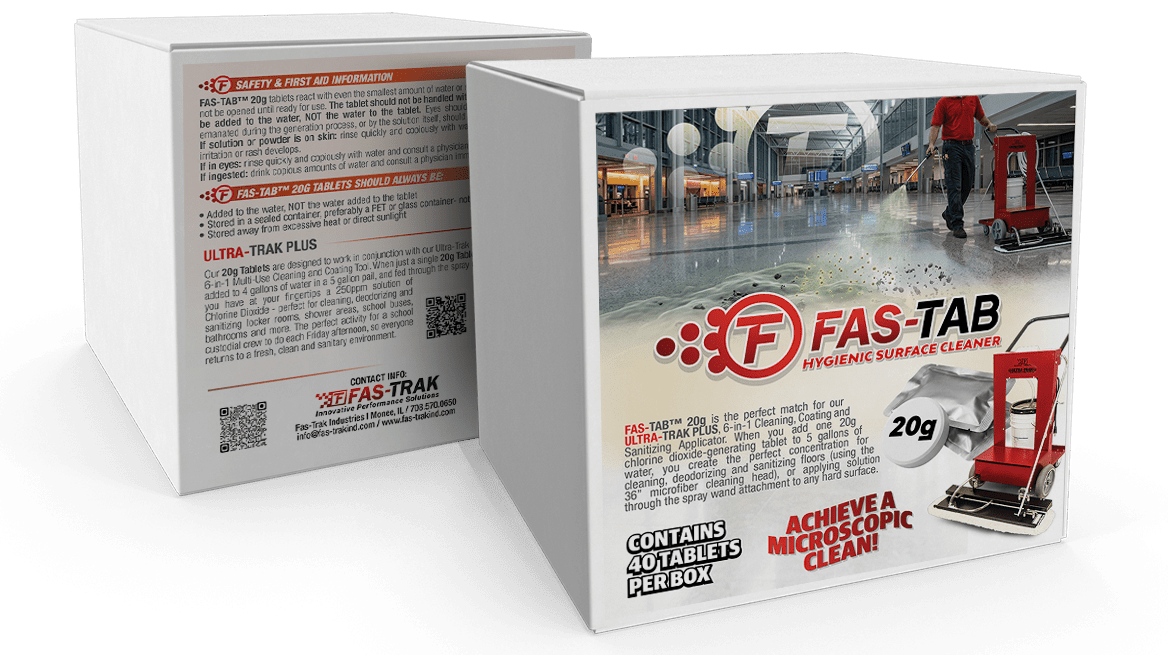
Next calculate the supplies consumed during each task.
Depending on the process, this could include:
- Cleaning chemistry
- Disposable wipes
- Mop pads
- Vacuum bags
- Floor pads
- Finish or coating
- Liners
- Brushes
- Filters
- Other disposable or limited-life materials
If $3.25 of materials are consumed during the task:
Consumable Cost = $3.25
This category is easy to see because facilities receive invoices for it.
Labor inefficiency is often much harder to see.
Also Read 📖How Spray Power Cleaning Systems Help Schools Clean Faster with Less Labor
3. Equipment Cost Per Use
Equipment should not be treated as free simply because the facility already owns it.
Its cost can be distributed across its expected working life.
A simplified calculation is:
Equipment Cost per Use = Total Ownership Cost ÷ Expected Number of Uses
Total ownership cost may include:
Purchase Price + Maintenance + Repairs + Batteries/Accessories – Expected Residual Value
A $6,000 machine used 1,500 times during its service life represents approximately:
$6,000 ÷ 1,500 = $4.00 per use
Maintenance and repair expenses can then be incorporated for a more complete calculation.
This allows procurement teams to compare a lower-priced machine with a more productive alternative on operational economics rather than purchase price alone.
Also Read📖How Can School Maintenance Crews Cut Strip-Out Time in Half?
4. Setup, Walking and Travel
Here is where cost analysis becomes interesting.
Assume an employee spends eight minutes per task:
- retrieving equipment,
- walking to a supply location,
- preparing materials, and
- transporting everything to the work area.
At a $28 fully loaded hourly rate:
8 minutes ÷ 60 × $28 = $3.73
That may seem insignificant.
Until the task occurs 10 times per day.
$3.73 × 10 = $37.30 per day
Across 250 operating days:
$37.30 × 250 = $9,325 annually
The example is hypothetical, but the lesson is real:
Small workflow inefficiencies become expensive when multiplied by frequency.
This is why facility managers should measure movement as carefully as cleaning.
Also Read 📖Cleaning Equipment Demonstrations: What Should You Measure? | Fas-Trak
5. Refills, Changeovers and Waiting
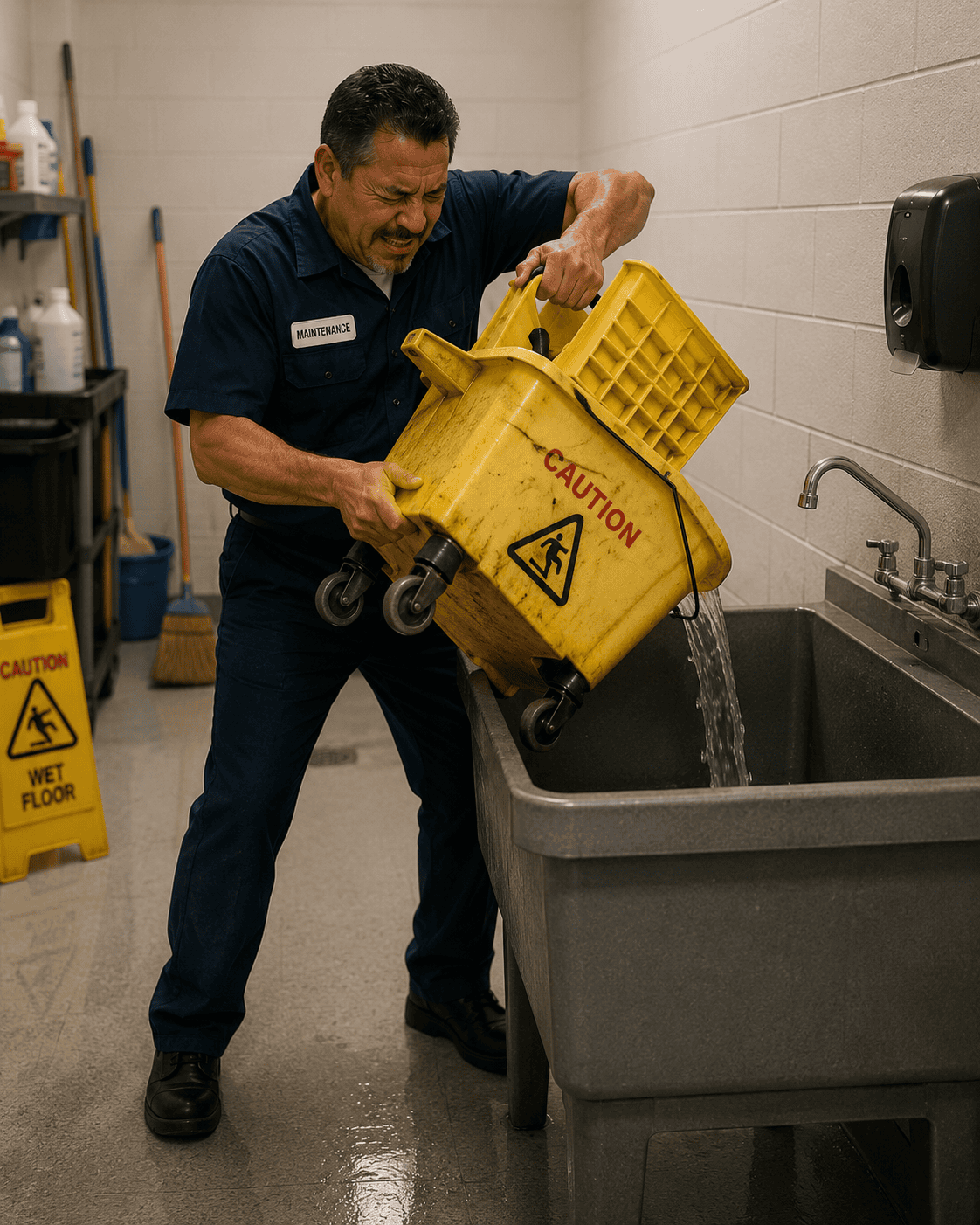
Every interruption has a labor cost.
Consider:
- returning to a sink,
- refilling a tank,
- replacing a solution,
- switching tools,
- searching for supplies,
- waiting for equipment,
- changing batteries,
- relocating electrical cords, or
- stopping because another employee has the needed machine.
Five minutes here and four minutes there may barely register during a shift.
Across hundreds or thousands of repetitions, they become a measurable operating expense.
A useful calculation is:
Interruption Cost = Minutes Lost ÷ 60 × Fully Loaded Hourly Rate
Then:
Annual Interruption Cost = Interruption Cost × Annual Task Frequency
This turns an inconvenience into a number management can evaluate.
Also Read 📖Facility Walkthrough Questions That Reveal Cleaning Costs
6. Rework
Rework may be the most overlooked cleaning cost of all.
If the first attempt does not produce the required outcome, the facility pays for some portion of the task twice.
Common examples include:
- A floor requiring another pass.
- A restroom requiring corrective cleaning.
- Uneven coating requiring additional work.
- Residue requiring rinsing.
- Missed soil generating a complaint and callback.
- Inconsistent application requiring correction.
Instead of assuming every task succeeds on the first attempt, measure the facility's actual rework rate.
For example, if a $30 task requires rework 10% of the time and the average rework costs $12:
Expected Rework Cost per Task = 10% × $12
= $1.20
That $1.20 should be included in the true task cost.
A Practical Guide to APPA Cleaning Management Standards
Building a Commercial Cleaning Cost-Per-Task Calculator
Facility managers can now combine these numbers.
Consider this hypothetical recurring task:
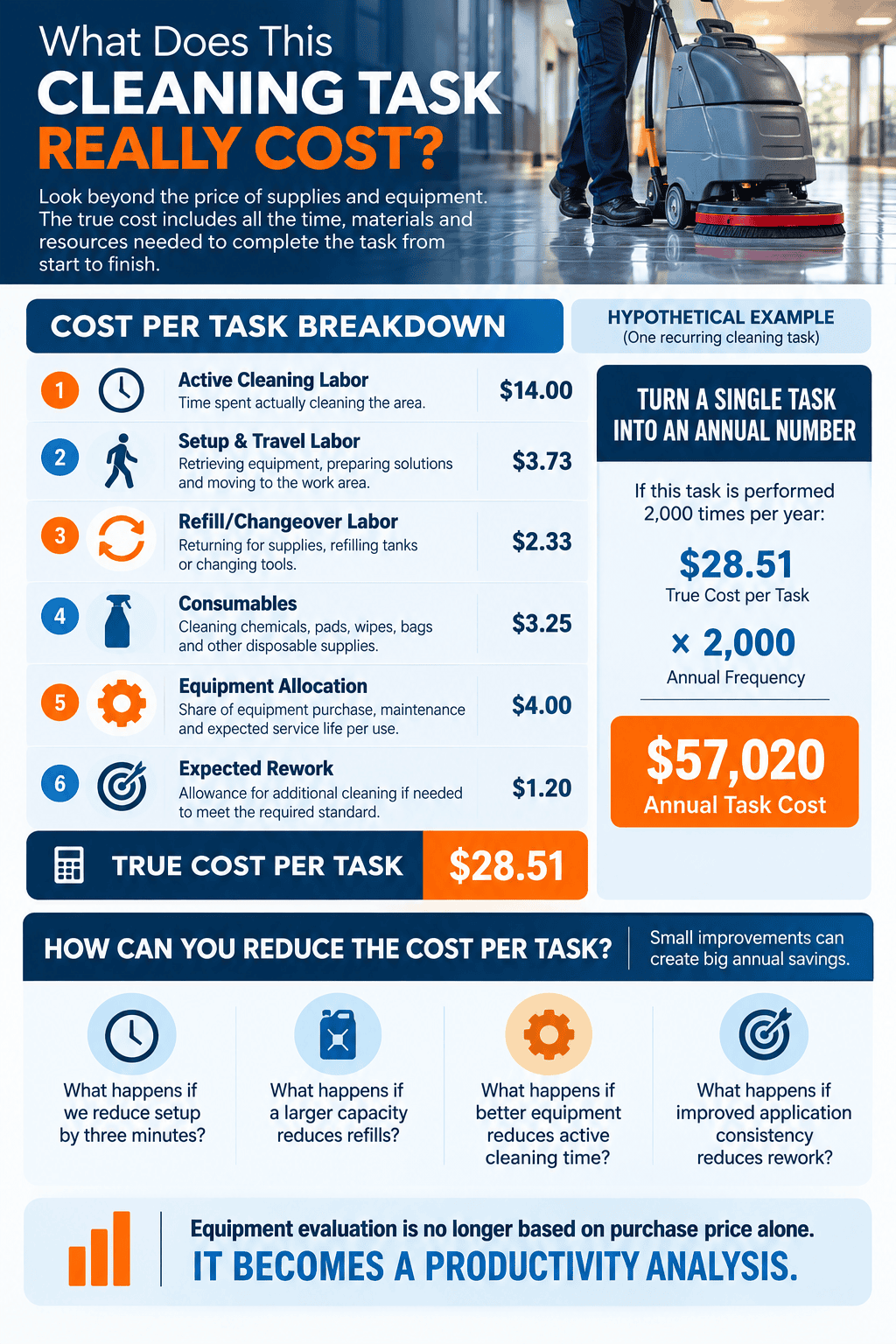
Now suppose the task occurs 2,000 times annually.
$28.51 × 2,000 = $57,020 annual task cost
This is where cost-per-task becomes valuable.
Management can begin asking:
What happens if we reduce setup by three minutes?
What happens if a larger capacity reduces refills?
What happens if better equipment reduces active cleaning time?
What happens if improved application consistency reduces rework?
Suddenly, equipment evaluation is no longer based primarily on purchase price.
It becomes a productivity analysis.
US Bureau of Labor Statistic for Janitors and Building Cleaners
The Metric Procurement Should Be Comparing
Imagine two cleaning systems.
System A
Purchase price: $1,500
Task time: 50 minutes
System B
Purchase price: $3,500
Task time: 35 minutes
Looking only at capital expenditure makes System A appear less expensive.
But at a hypothetical fully loaded labor rate of $28 per hour, the 15-minute difference represents:
15 ÷ 60 × $28 = $7.00 labor difference per task
If the task is performed 1,000 times annually:
$7 × 1,000 = $7,000 in annual labor difference
That does not automatically make System B the better choice. Maintenance, reliability, consumables, training, quality and service life still matter.
It does demonstrate why purchase price alone cannot answer the question.
The better comparison is:
Cost per acceptable completed task.
Also Read 📖The New Economics of Facility Cleaning
Measure Productivity Without Sacrificing the Cleaning Standard
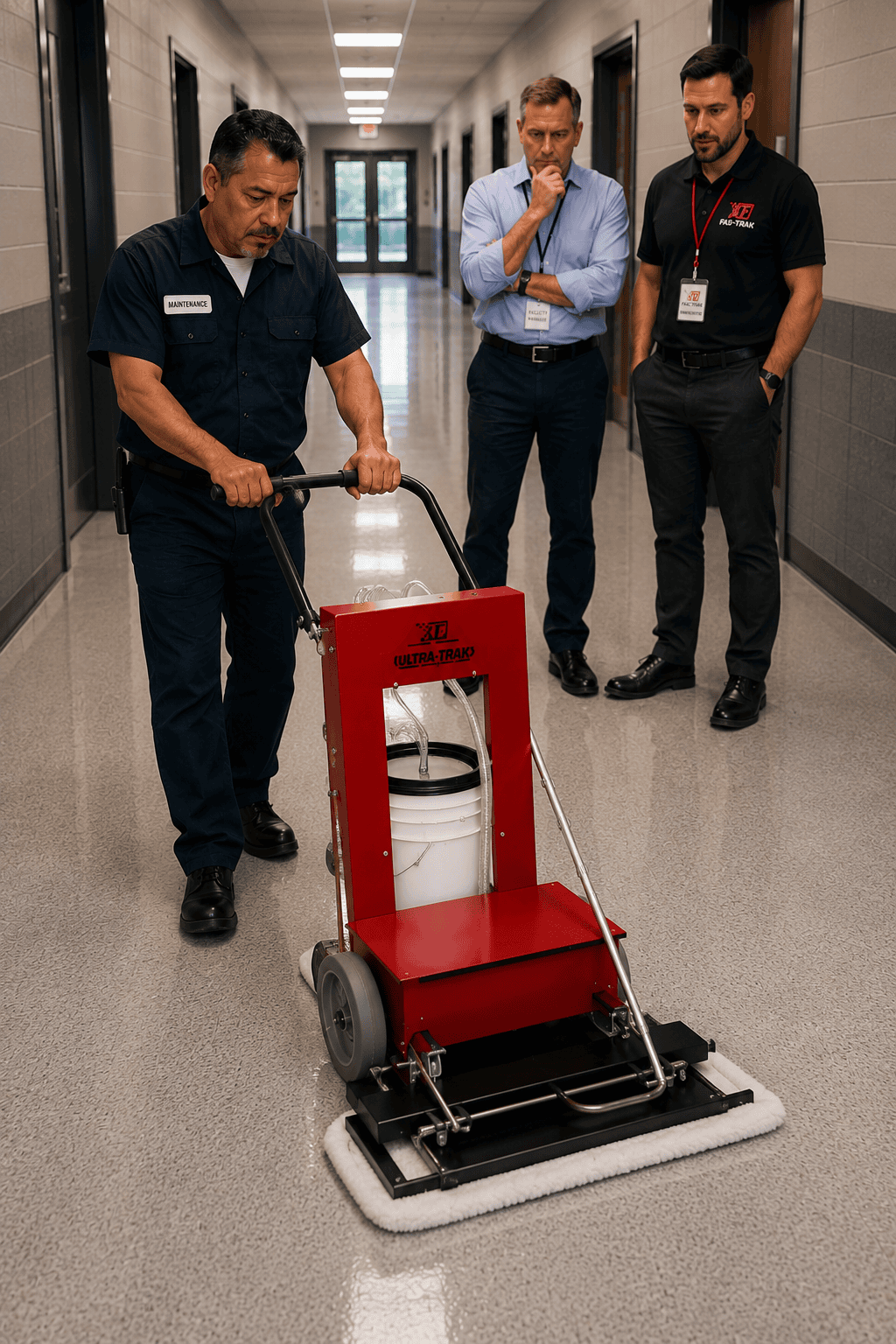
There is an important warning here.
Faster does not automatically mean cheaper.
If a process reduces task time but increases missed soil, complaints, surface damage or rework, its apparent productivity gain may disappear.
APPA's custodial guidance makes a similar distinction by considering productivity together with the required level of appearance. Cleaning output must therefore be measured against an established result—not simply square footage or minutes.
The operational objective should be:
Achieve the required cleaning result with the lowest sustainable use of labor, materials and equipment.
That is very different from telling employees to work faster.
It means improving the system surrounding the employee.
Also Read 📖Cleaning Equipment Demonstrations: What Should You Measure? | Fas-Trak
Where Fas-Trak Fits Into the Cost Equation
Fas-Trak's approach to cleaning equipment is built around this exact operational problem: if labor represents a substantial portion of cleaning expense, reducing unnecessary labor inside repetitive workflows can create meaningful economic value.
For example, Fas-Trak reports that its Ultra-Trak Plus can apply floor finishes or sealers at up to 25,000 square feet per hour, clean large areas using its 36-inch Fas-Mop configuration at up to 30,000 square feet per hour, and dispense directly from chemical containers to reduce transfer steps and product waste.
Its Micro-Trak system is designed for smaller applications and is rated by Fas-Trak at approximately 8,000 square feet per hour for floor coating.
Other Fas-Trak technologies address different parts of the workflow—from wide-area vacuuming and floor care to dispensing, surface cleaning and specialized application systems.
These specifications should not simply be inserted into a purchasing spreadsheet and assumed to represent a facility's savings.
They should be tested against the facility's actual workflow.
That is what makes an equipment demonstration valuable.

Run a Cleaning Workflow Test Before Making the Purchase
Instead of asking a vendor:
"How much does the machine cost?"
add five more questions:
- How long does our current process take from setup through cleanup?
- How many employees are required?
- How much consumable product does the process use?
- How often do interruptions or rework occur?
- What changes when the proposed equipment performs the same task?
Then conduct a side-by-side demonstration.
Record:
Current Process
Total minutes → Consumables → Rework → Cost per task
versus
Proposed Process
Total minutes → Consumables → Rework → Equipment allocation → Cost per task
The result is much more useful than a product demonstration based primarily on features.
It becomes a small operational study.
Also Read 📖Why the Best Facility-Service Partners Bring Ideas—Not Just Products
From Cost Per Task to Annual Budget Impact
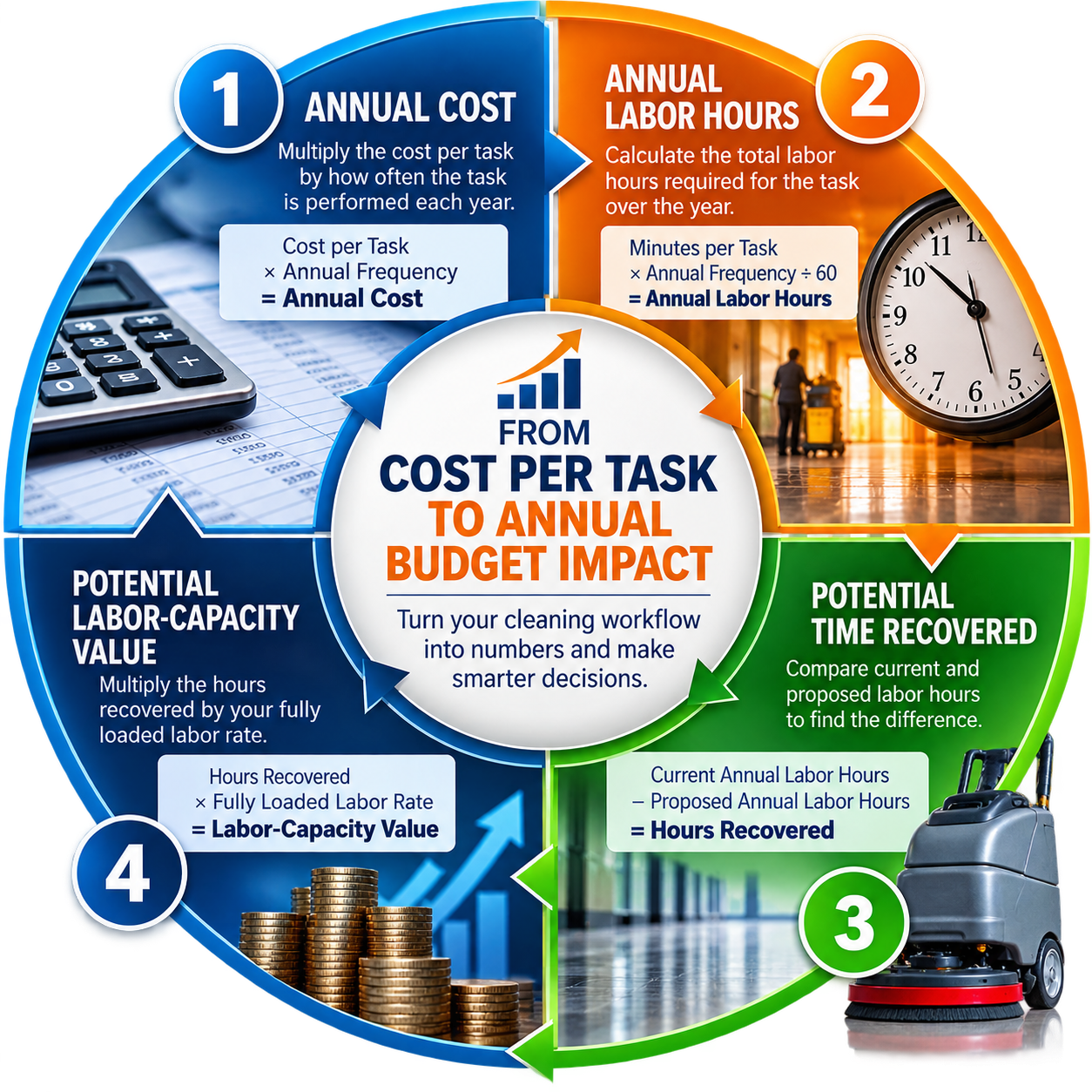
Once the cost per task is known, management can model larger financial decisions.
Annual Cost
Cost per Task × Annual Frequency
Annual Labor Hours
Minutes per Task × Annual Frequency ÷ 60
Potential Time Recovered
Current Annual Labor Hours – Proposed Annual Labor Hours
Potential Labor-Capacity Value
Hours Recovered × Fully Loaded Labor Rate
Notice the term labor-capacity value rather than automatic "savings."
Reducing a task by 100 labor hours does not necessarily mean an organization removes 100 hours from payroll.
Instead, those hours may allow the existing workforce to:
- cover additional square footage,
- complete detail cleaning,
- absorb staffing shortages,
- reduce overtime,
- perform preventive maintenance,
- improve inspection scores, or
- complete work previously being deferred.
For many facilities, recovering productive capacity may be more valuable than reducing headcount.
Also Read 📖Effective Strategies for Reducing Cleaning Staff Turnover
The Cost-Per-Task Mindset Changes Purchasing Decisions
The next time a cleaning product or piece of equipment is evaluated, resist starting with:
"Which one costs less?"
Start with:
"What does each option make the completed task cost us?"
That question forces labor, workflow, consumables, equipment and quality into the same conversation.
It can also reveal something important about commercial cleaning costs:
The most expensive part of a cleaning system is not always the item with the largest price tag.
Sometimes it is the five unnecessary minutes repeated thousands of times each year.
Also Read 📖Why Are Cleaning Results Inconsistent? Fas-Tabs Create Controlled Outcomes
Turn Your Cleaning Workflow Into Numbers
Fas-Trak works with facility managers, operations teams and cleaning professionals to evaluate how cleaning and floor-care equipment performs inside real working environments.
Rather than evaluating equipment solely from a specification sheet, organizations can examine the workflow itself—setup, application, movement, capacity, consumable use and task completion time.
Contact Fas-Trak to discuss your current cleaning workflow or arrange an equipment demonstration.
Bring a stopwatch.
Bring your labor rate.
Bring your current equipment.
And calculate what the task is really costing you.

FAQs
1. How do you calculate the true cost of a commercial cleaning task?
The true cost of a commercial cleaning task is calculated by adding the fully loaded labor cost, consumables, equipment cost per use, setup and travel time, refill or changeover time, and expected rework costs. A practical formula is: True Cost per Task = Labor + Consumables + Equipment + Setup/Travel + Refills/Changeovers + Rework. For recurring tasks, multiply the cost per task by the number of times the task is performed annually to estimate its total annual cost.
2. What costs should be included when calculating commercial cleaning costs?
Commercial cleaning costs should include both direct and indirect workflow expenses. Direct costs include employee labor, cleaning chemicals, disposable supplies and equipment. Indirect costs can include time spent retrieving equipment, preparing solutions, walking between work areas, refilling tanks, changing tools, waiting for equipment, cleaning equipment after use and correcting work that did not meet the required standard. Measuring the entire workflow provides a more accurate cost than looking at supply or equipment prices alone.
3. Why is labor important when calculating the cost of a cleaning task?
Labor is important because commercial cleaning is a labor-intensive operation, and employees are paid for the entire time required to complete a task—not only the minutes spent actively cleaning. Setup, travel, refilling, equipment changes, cleanup and rework all consume paid labor time. Even a few unnecessary minutes can become a significant annual expense when the same cleaning task is performed hundreds or thousands of times.
4. How can commercial cleaning equipment reduce cost per task?
Commercial cleaning equipment can reduce cost per task when it helps employees complete the required cleaning standard using less labor time, fewer workflow interruptions, lower consumable use or less rework. The financial benefit should be measured using the facility's actual operating conditions rather than equipment purchase price alone. Comparing the current process with a proposed process through an equipment demonstration can help determine whether productivity improvements justify the investment.
5. What is the best way to compare the cost of two commercial cleaning systems?
The most useful comparison is the cost per acceptable completed task, rather than purchase price alone. Facility managers should compare total labor time, setup requirements, consumable use, equipment cost per use, refill or changeover time, maintenance requirements and rework while maintaining the same cleaning standard. Annual task frequency should then be applied to each option to estimate the long-term operational cost of each cleaning system.
